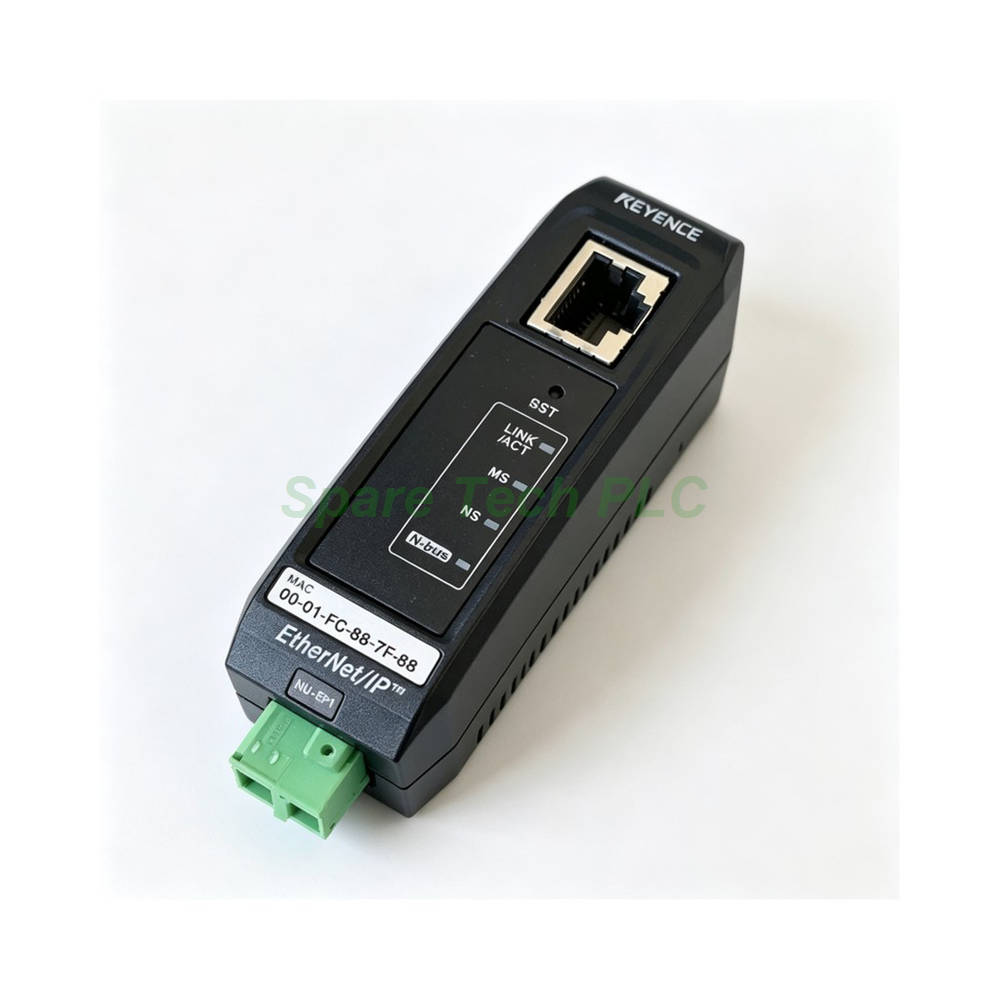
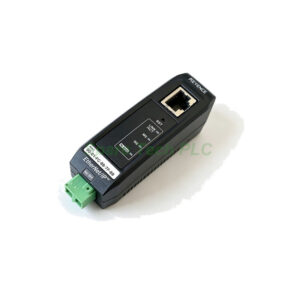
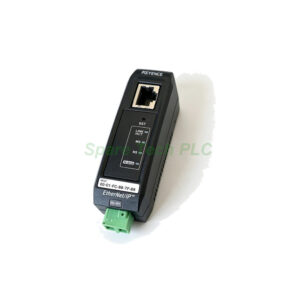
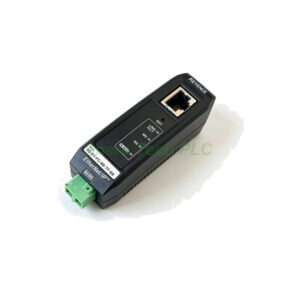
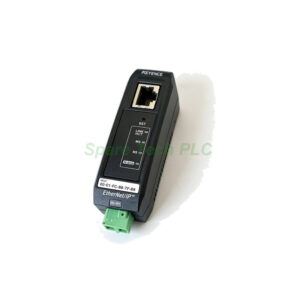
Keyence NU-EC1 EtherCAT Network Unit
Product Introduction
The Keyence NU-EC1 serves as a bridge between N-bus sensor amplifiers and EtherCAT networks. This unit allows engineers to integrate multiple sensor channels into a single high-speed communication bus. Consequently, machine builders can reduce wiring complexity and improve data throughput. The device operates on standard 24 VDC power and supports the CoE protocol for seamless mailbox communication. Furthermore, its dual RJ-45 ports enable daisy-chain topologies with a node distance of up to 100 meters.
Technical Specifications
The NU-EC1 delivers reliable network performance for demanding industrial environments. First, the Ethernet interface complies with IEEE802.3u (100BASE-TX) at 100 Mbps. It uses Cat 5e STP cabling with RJ-45 connectors. Additionally, the unit supports EtherCAT process data cyclic communication and mailbox CoE. The sensor connection side accommodates up to 16 N-bus compatible amplifiers through a wiring-saving connector. Moreover, the total passing current for connected amplifiers is limited to 1,200 mA or less.
Power requirements are modest. Specifically, the Keyence NU-EC1 accepts 24 VDC ±10% with ripple of 10% or less. Its power consumption stays at 1,700 mW or below, drawing roughly 70 mA at 24 V excluding sensor current. Besides, the unit includes no communication expansion slots, keeping the design simple and focused.
Mechanical and Environmental Parameters
The unit weighs approximately 0.08 kg including connectors. Unfortunately, dimensions and protection ratings remain unavailable from the manufacturer. However, the operating temperature range spans -20 to +55 °C without freezing. Meanwhile, relative humidity should stay between 35 and 85% RH without condensation. Storage temperature data is not published. Therefore, users should store the device in a dry, temperature-controlled area.
Installation Guide
Mounting the NU-EC1 follows a straightforward procedure. First, connect the N-bus sensor amplifiers using the wiring-saving connector. Then, attach the EtherCAT network cables to the dual RJ-45 ports. Next, apply 24 VDC power within the specified tolerance. After that, configure the EtherCAT master to recognize the unit via CoE mailbox communication. Finally, verify cyclic process data exchange and node addressing on the network.
For instance, when integrating with a Keyence sensor array, ensure the total current draw of all amplifiers remains under 1,200 mA. Besides, keep cable runs within 100 meters per node to maintain signal integrity. Also, use shielded twisted-pair Cat 5e cables to reduce electromagnetic interference.
Packaging List
Keyence NU-EC1 Network Unit ×1
Wiring-saving connector ×1
RJ-45 connectors ×2 (pre-installed)
Quick start guide ×1
FAQ
Q1: What is the maximum number of sensor amplifiers the NU-EC1 supports?
A: The NU-EC1 connects up to 16 N-bus compatible amplifiers, with a total passing current of 1,200 mA or less.
Q2: Does the NU-EC1 require external configuration software?
A: No dedicated software is needed. The unit communicates via EtherCAT CoE, so standard master configuration tools suffice.
Q3: Can I use the NU-EC1 in a daisy-chain network topology?
A: Yes. The dual RJ-45 ports enable daisy-chain connections with a node distance of 100 meters using Cat 5e STP cables.
Q4: What is the power consumption of this network unit?
A: The Keyence NU-EC1 consumes 1,700 mW or less, drawing about 70 mA at 24 VDC excluding sensor current.
Q5: How is the NU-EC1 shipped and what carrier do you use?
A: We ship via Fedex, UPS, and DHL. The unit weighs approximately 0.08 kg and ships with all original connectors and a quick start guide.