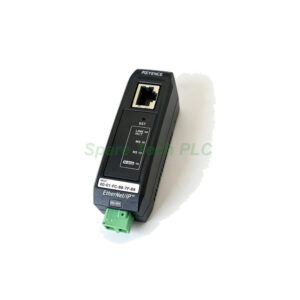
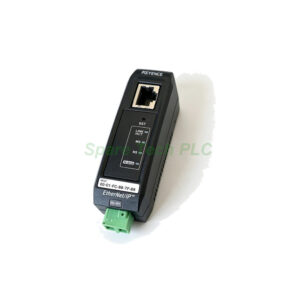
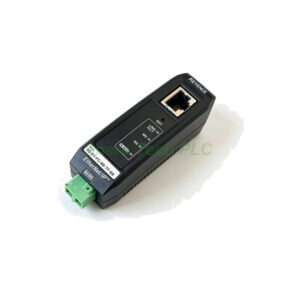
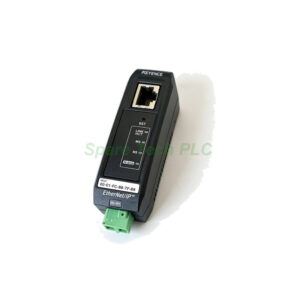
Keyence NU-EP1 Network Communication Unit
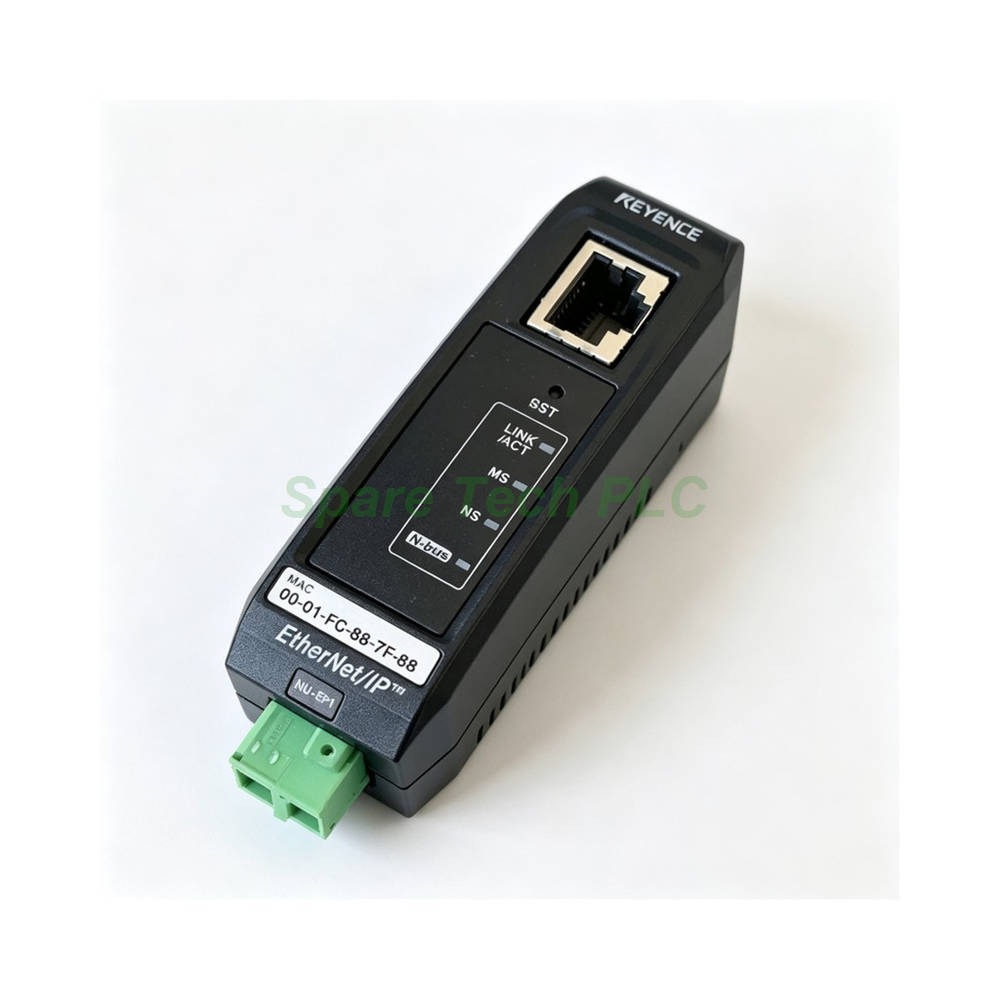
The NU-EP1 from Keyence is a network communication unit that links N-bus sensor amplifiers to an EtherNet/IP network. Specifically, it collects amplifier data and passes it to a PLC or host controller through a single RJ-45 port. Power over Ethernet support removes the need for a separate power line in many installations. Moreover, the compact housing fits inside dense control panels and small junction boxes.
Technical Specifications
The Ethernet interface complies with IEEE802.3 (10BASE-T) and 802.3u (100BASE-TX). It also meets 802.3af PoE Class 3, so the unit can draw power from a PoE switch. Maximum cable length is 100 m per segment. For protocol support, the unit handles EtherNet/IP cyclic (implicit) and message (explicit) communication. Additionally, it manages up to 64 connections with a request packet interval from 0.5 to 10,000 ms.
On the sensor side, the unit connects N-bus compatible amplifiers through a wiring-saving connector. It supports a maximum of 16 amplifier units. Besides, total passing current must stay at 1,200 mA or less. Therefore, plan the amplifier count and current load before wiring the bus.
Communication Details
The built-in port is an RJ-45 Ethernet port with PoE. Supported protocols include EtherNet/IP (UCMM, Class 3). Furthermore, no additional communication expansion is available on this model. Consequently, the NU-EP1 acts as a single-purpose gateway between the N-bus amplifier group and the EtherNet/IP network.
Electrical Parameters
The unit accepts 24 VDC +/-10% through the power connector. During PoE operation, it tolerates up to 57 VDC on the Ethernet line. Power consumption is 1,500 mW or less (60 mA at 24 V), excluding sensor current. This low draw helps keep panel heat under control when many units sit side by side.
Environmental and Physical Data
The operating temperature range is -20 to +55 °C with no freezing. Relative humidity stays between 35 and 85% RH with no condensation. The unit weighs approximately 0.08 kg including connectors, so it mounts easily on a DIN rail or panel plate. Storage temperature, protection rating, and dimensions are not available in the current specification.
Installation Guide
First, mount the NU-EP1 on a 35 mm DIN rail near the amplifier group. Next, connect the N-bus cable from the amplifiers to the unit. Then, plug the Ethernet cable into the RJ-45 port. After that, set the IP address through the PLC or setup tool. Finally, verify the connection count and RPI settings match the controller configuration.
Keep the Ethernet cable away from motor drives and high-current lines. Also, confirm the PoE source delivers Class 3 power when no separate supply is used. For long cable runs, check that the total length stays below 100 m.
Packaging List
Shipping is available via Fedex, UPS, and DHL.
FAQ
Q1: What is the main function of the NU-EP1?
A: The NU-EP1 connects up to 16 N-bus sensor amplifiers to an EtherNet/IP network. It acts as a gateway between the amplifier bus and the PLC.
Q2: How many EtherNet/IP connections does the unit support?
A: It supports up to 64 connections with a request packet interval from 0.5 to 10,000 ms.
Q3: Does the NU-EP1 support PoE?
A: Yes. It complies with IEEE802.3af PoE Class 3, so it can draw power from a PoE switch without a separate supply line.
Q4: What is the maximum number of amplifiers it can connect?
A: The unit supports up to 16 N-bus compatible amplifiers, with total passing current at 1,200 mA or less.
Q5: What is the maximum Ethernet cable length?
A: Maximum cable length is 100 m per segment. Keep this limit in mind when planning the network layout.