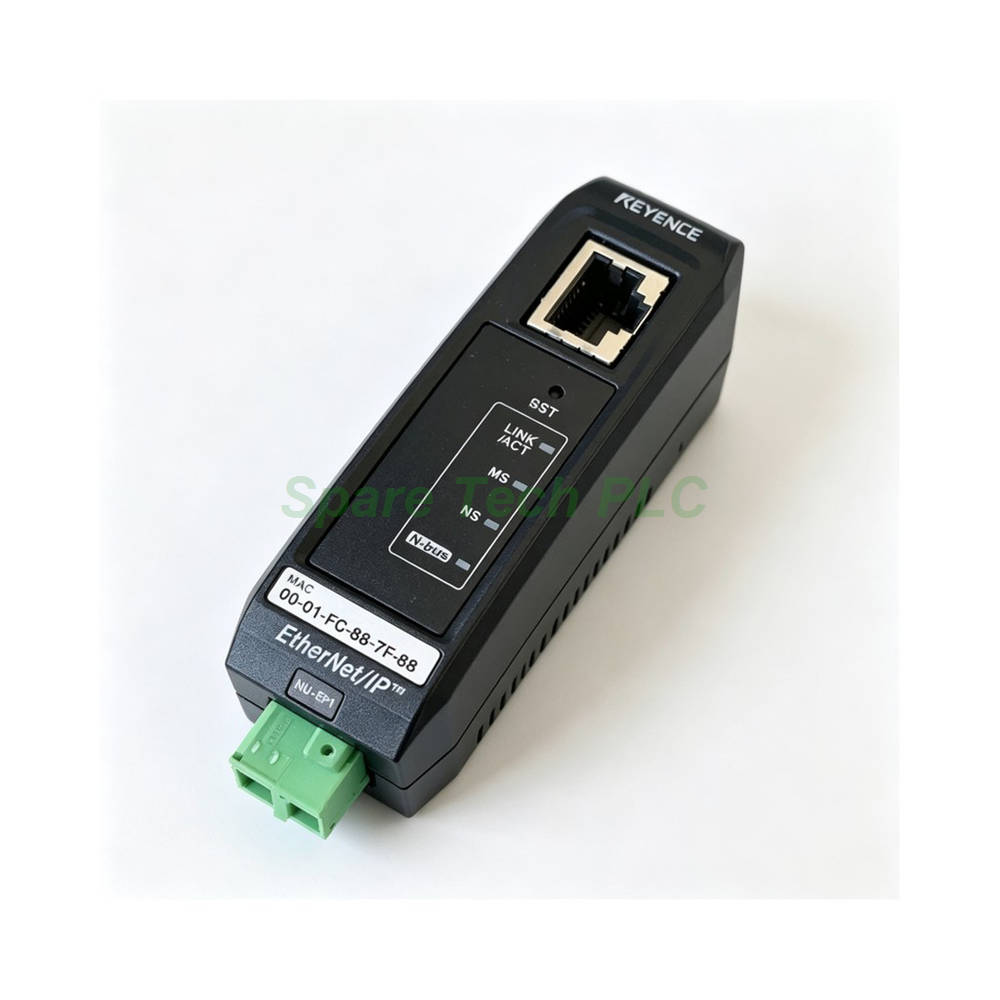
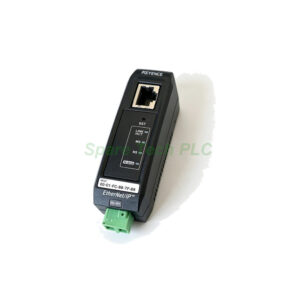
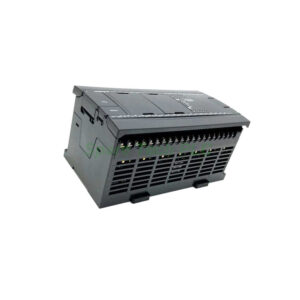
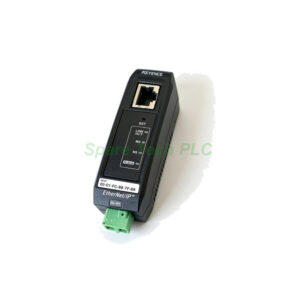
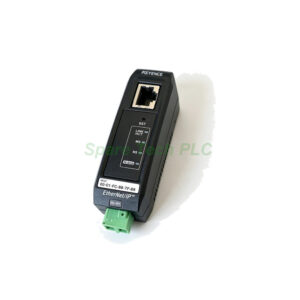
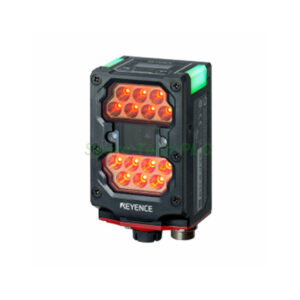
Keyence NU-CL1 CC-Link Network Communication Unit
Product Introduction
The NU-CL1 from Keyence integrates N-bus sensor amplifiers into a CC-Link network. This unit acts as a remote device station. It reduces wiring work significantly because one communication cable handles data transmission to the PLC. Furthermore, the module supplies power to connected amplifiers directly through a wiring-saving connector. Therefore, engineers can deploy compact sensor networks without complex parallel wiring.
Technical Specifications
The CC-Link interface supports Ver.2.00 and Ver.1.10 with switchable operation. Transmission speeds range from 156 kbps to 10 Mbps across five selectable steps. Station numbers are configurable from 1 to 64. In Ver.2.00 mode, the unit occupies 3 stations. Meanwhile, Ver.1.10 mode allows selection of 1, 2, 3, or 4 occupied stations.
Sensor connectivity is a core feature. The NU-CL1 accepts up to 16 N-bus compatible sensor amplifiers. Moreover, the allowable passing current totals 1,200 mA or less for the connected amplifier chain. This capacity supports multiple sensor types, including fiber, photoelectric, laser, pressure, and flow amplifiers. The unit supplies power to these amplifiers via the wiring-saving connector, eliminating separate power runs to each sensor position.
Key Electrical Parameters
Supply Voltage: 24 VDC ±10%
Ripple: 10% or less (P-P)
Power Consumption: 1,400 mW or less (55 mA max at 24 V, excluding sensor current)
CC-Link Communication Parameters
Supported Version: Ver.2.00 / Ver.1.10 (switchable)
Station Type: Remote device station
Occupied Stations: Ver.2.00 = 3 stations; Ver.1.10 = 1/2/3/4 stations (switchable)
Transmission Speed: 156 k / 625 k / 2.5 M / 5 M / 10 Mbps
Station Number: 1 to 64
Mechanical and Environmental Parameters
The unit weighs approximately 0.08 kg including connectors. Its compact housing suits tight cabinet spaces and distributed sensor junction boxes. Operating temperature ranges from -20 to +55 °C without freezing. Relative humidity must stay between 35 and 85% RH with no condensation. The NU-CL1 is designed for standard industrial environments where CC-Link networks are common.
Installation Guide
First, mount the NU-CL1 on a DIN rail or flat panel inside the control cabinet. Next, connect the CC-Link terminal block to the network cable. The unit includes a CC-Link connector and power connector in the package. Then, set the station number and transmission speed using the rotary switches on the front face. After that, connect the N-bus sensor amplifiers using the wiring-saving connector. Finally, apply 24 VDC power and verify the CC-Link LED indicators for normal operation.
Ensure the total current draw of all connected sensor amplifiers stays below 1,200 mA. Additionally, terminate the CC-Link network properly using the supplied 110 Ω, 1/2 W terminal resistors. The unit supports both Ver.2.00 and Ver.1.10 networks; therefore, confirm the master station's version before powering up.
Packaging List
NU-CL1 Network Communication Unit × 1
Operation Manual × 1
CC-Link Connection Connector × 1
Power Connection Connector × 1
Terminal Resistor (110 Ω, 1/2 W) × 1
End Unit × 2
FAQ
Q1: How many sensor amplifiers can the NU-CL1 connect?
A: It connects up to 16 N-bus compatible sensor amplifiers. The exact number depends on the specific amplifier models and their current consumption.
Q2: What is the maximum allowable current for connected sensors?
A: The total passing current must not exceed 1,200 mA. This limit covers power supplied from the unit to the connected sensor amplifiers.
Q3: Can the NU-CL1 switch between CC-Link versions?
A: Yes. The unit supports Ver.2.00 and Ver.1.10 with switchable operation. In Ver.2.00 mode, it occupies 3 stations; in Ver.1.10 mode, it can occupy 1, 2, 3, or 4 stations.
Q4: What transmission speeds does this unit support?
A: The NU-CL1 supports 156 kbps, 625 kbps, 2.5 Mbps, 5 Mbps, and 10 Mbps. Users select the speed via the rotary switches to match the network configuration.
Q5: How is the unit shipped?
A: We ship via Fedex, UPS, and DHL. Transit times typically range from 3 to 7 business days depending on destination.