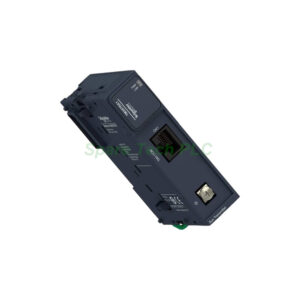
Product Introduction
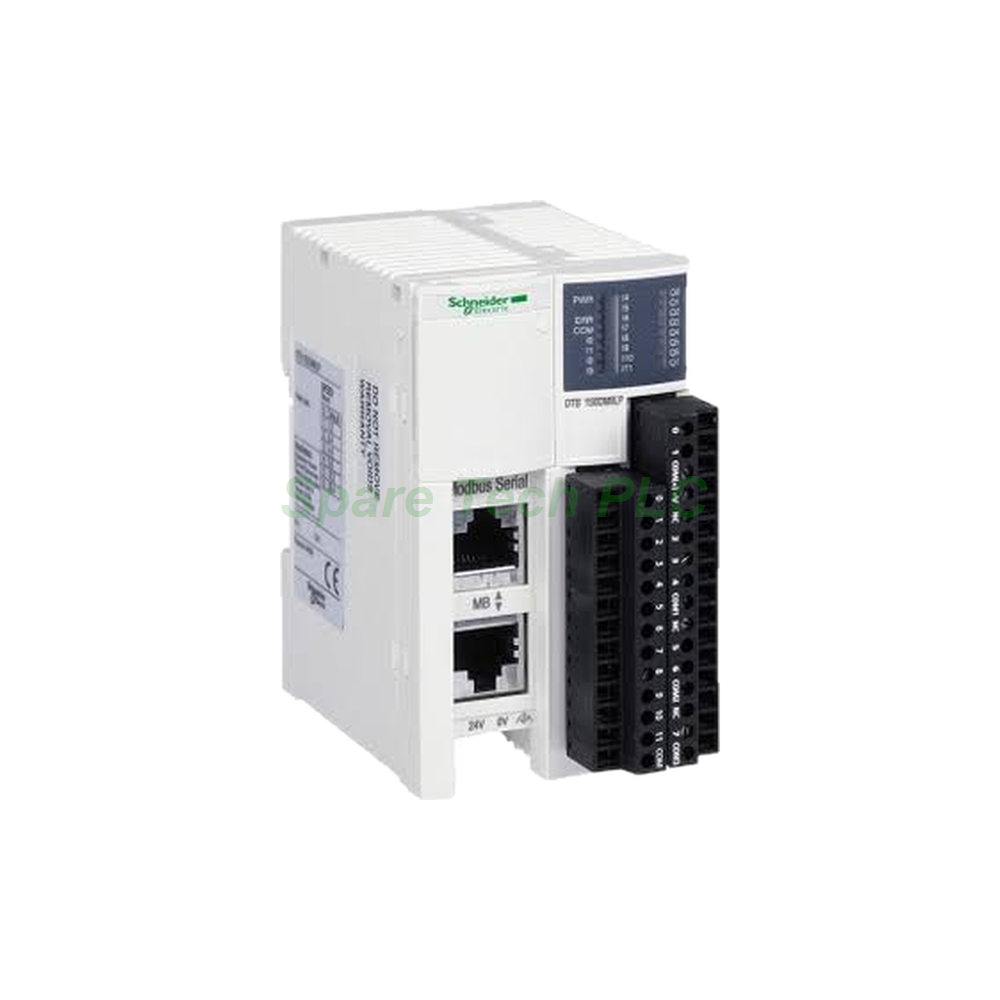
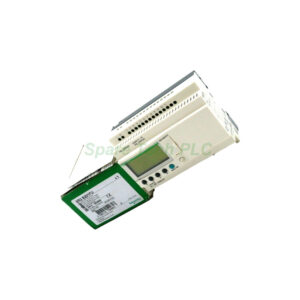
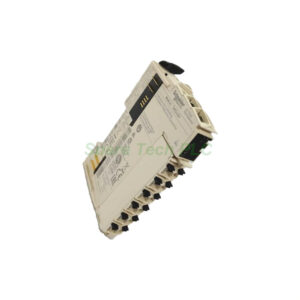
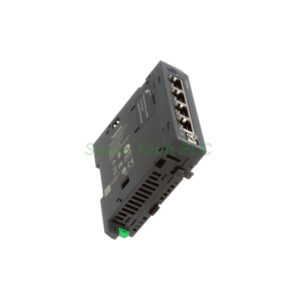
The Schneider Electric OTB1S0DM9LP belongs to the renowned Modicon OTB product line. This module offers a flexible and reliable solution for distributed I/O applications. It provides a versatile mix of digital input and output channels, making it an ideal choice for various automation tasks. The module communicates via a non-isolated Modbus serial link and supports both RTU and ASCII protocols. Specifically, it integrates 12 discrete input channels and 8 discrete output channels, which combine solid-state and relay types.
Technical Specifications
The OTB1S0DM9LP module handles a wide range of industrial signals effectively.
Discrete Inputs:
This module offers 12 EN/IEC 61131 type 1 inputs. Users can configure these as either sink or source, and they accept a 24 V DC voltage. The input current varies by channel; for instance, I0...I1 and I6...I7 draw 5 mA, while I2...I5 and I8...I11 draw 7 mA.
Discrete Outputs:
The module includes 8 outputs. Q0 and Q1 are solid-state PNP source outputs, while Q2 through Q7 are relay outputs. The relay outputs handle up to 2000 mA, whereas the solid-state outputs support up to 300 mA.
Communication Interface:
This module features an integrated non-isolated serial link with 2 RJ45 connectors in parallel. It supports a master/slave Modbus RTU/ASCII protocol over an RS485 network. The data format supports 7 or 8 bits with 1 or 2 stop bits, and users can set parity to none, even, or odd.
Power Supply:
The OTB1S0DM9LP requires a 24 V DC supply with limits of 20.4 to 26.2 V. Its maximum power consumption reaches 19 W.
Output Characteristics and Performance
Understanding the performance of the Schneider Electric OTB1S0DM9LP outputs proves crucial for proper application.
Output Types:
This unit uses two solid-state outputs for high-speed switching and six relay outputs for robust, isolated switching of AC or DC loads.
Relay Outputs:
Each relay contact (Q2...Q7) switches up to 240 V AC or 30 V DC. The maximum current per common for relay outputs is 8 A. Moreover, the electrical durability reaches 500,000 cycles for various load types like AC-1 (500 VA) and DC-1 (60 W).
Solid-State Outputs:
The solid-state outputs (Q0, Q1) deliver a faster response time of just 5 µs, making them suitable for applications requiring frequent switching. They also offer overvoltage protection between 38 and 40 V.
Input Details and Communication
The OTB1S0DM9LP ensures reliable signal acquisition and efficient data exchange.
Input Characteristics:
With an input impedance ranging from 3.4 kOhm to 5.7 kOhm, the module works with a variety of sensors. Configurable filtering times of 0 ms, 3 ms, or 12 ms help debounce input signals and reject noise.
Counting and Pulse Functions:
This module features 2 counting inputs with a 32-bit capacity. It supports counting frequencies up to 20,000 Hz. Additionally, it provides 2 pulse generator outputs with a frequency of up to 7 kHz, capable of performing pulse width modulation (PWM).
Network Topology:
Devices can link via daisy-chaining or tap junctions. The maximum bus length reaches 15 meters (49.21 ft), and up to 32 devices can connect per segment.
Mechanical and Environmental Specifications
The Schneider Electric module operates reliably in demanding industrial conditions.
Mounting Options:
Users can easily mount the OTB1S0DM9LP onto a 35 mm symmetrical DIN rail using the built-in clips. Alternatively, they can fix it to a panel or solid plate using a fixing kit.
Environmental Limits:
This module operates in ambient air temperatures from 0 to 55 °C (32 to 131 °F). For storage, it withstands temperatures from -25 to 70 °C (-13 to 158 °F). Its relative humidity tolerance is 30 to 95% without condensation.
Protection and Durability:
With an IP20 degree of protection, it safeguards against fingers and small tools. Moreover, it offers robust resistance to vibrations (1 gn at 57...150 Hz) and shocks (15 gn for 11 ms). This unit carries the CE marking and complies with European health, safety, and environmental protection standards. It is also a Green Premium product.
Installation Guidelines
Proper installation maximizes the performance of your Modicon OTB module.
Mounting Procedure:
Secure the OTB1S0DM9LP onto a 35 mm DIN rail inside a control cabinet. Ensure adequate clearance around the unit for airflow and wiring. Allow at least 8.5 mm when the clamp pulls out.
Wiring Instructions:
Use a removable screw terminal block for I/O connections. Follow the wiring diagram carefully: output points 0 and 1 are source transistor outputs, and all other output points are relay. Also, the COM terminals do not connect together internally.
Power Supply Connection:
Connect a 24 V DC power supply to the designated terminals. For protection, install a 2 A fast-blow fuse (ABE7FU200) in the power supply circuit. This safeguards the module from overcurrent conditions.
Communication Setup:
Connect the Modbus network using twisted shielded pairs to the RJ45 connectors. Ensure proper termination and grounding of the shield to avoid communication errors.
Packaging List
When you receive your Schneider Electric OTB1S0DM9LP, the package contains the following items for a quick start:
1 x OTB1S0DM9LP I/O Distributed Module
1 x Removable screw terminal block for I/O connections
Installation and wiring diagram guide
Note: Certificates and warranty documents do not come with the package. All orders ship via FedEx, UPS, or DHL.
Frequently Asked Questions (FAQ)
Q1: What is the difference between the solid-state and relay outputs on the OTB1S0DM9LP?
A1: The solid-state outputs (Q0, Q1) are faster, with a response time of 5 µs, and they suit high-frequency switching. Conversely, the relay outputs (Q2...Q7) provide galvanic isolation, allowing them to switch AC loads up to 240 V. They work best for less frequent but higher power applications.
Q2: Can I use the OTB1S0DM9LP module with a 120 V AC power supply?
A2: No. The OTB1S0DM9LP is a DC-powered module. It requires a 24 V DC nominal supply voltage, with a permissible range of 20.4 to 26.2 V DC. Applying AC voltage will damage the unit.
Q3: What is the maximum number of expansion modules I can add to this I/O island?
A3: The OTB1S0DM9LP supports up to 7 I/O expansion modules. This allows a maximum configuration of up to 132 discrete I/O points, providing significant flexibility for system scaling.
Q4: Does this module support the Modbus TCP/IP protocol?
A4: No. This specific part number, OTB1S0DM9LP, has a non-isolated serial link for Modbus RTU/ASCII communication over RS485. For Modbus TCP/IP, you would need a different network interface module.
Q5: What type of load can the relay outputs (Q2...Q7) handle?
A5: The relay outputs handle a variety of loads. For example, they are rated for 500,000 cycles at 500 VA for AC-1 loads, and 200 VA for AC-15 loads. They also switch DC loads up to 30 W for DC-1 or 30 W for DC-13. Always ensure the connected load does not exceed the maximum current rating of 8 A per common.
Attention: The above product information is sourced from the internet and cannot be guaranteed to be authentic.
For specific product parameters and prices, please contact
SpareTech PLC professionals in a timely manner.