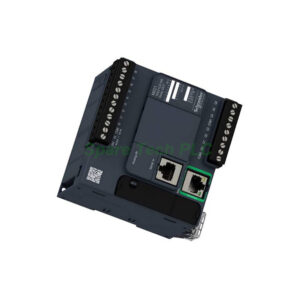
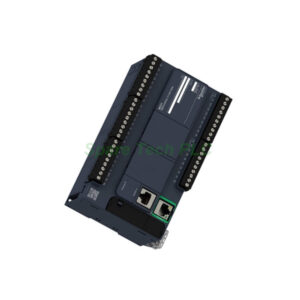
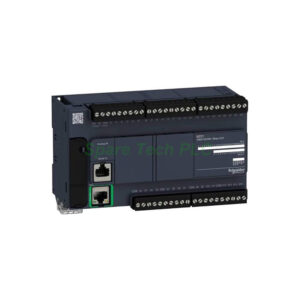
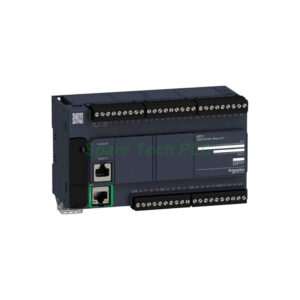
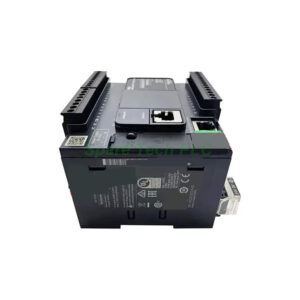
Modicon M238 Compact Base – High-Speed Control in a Small Footprint
Product Introduction
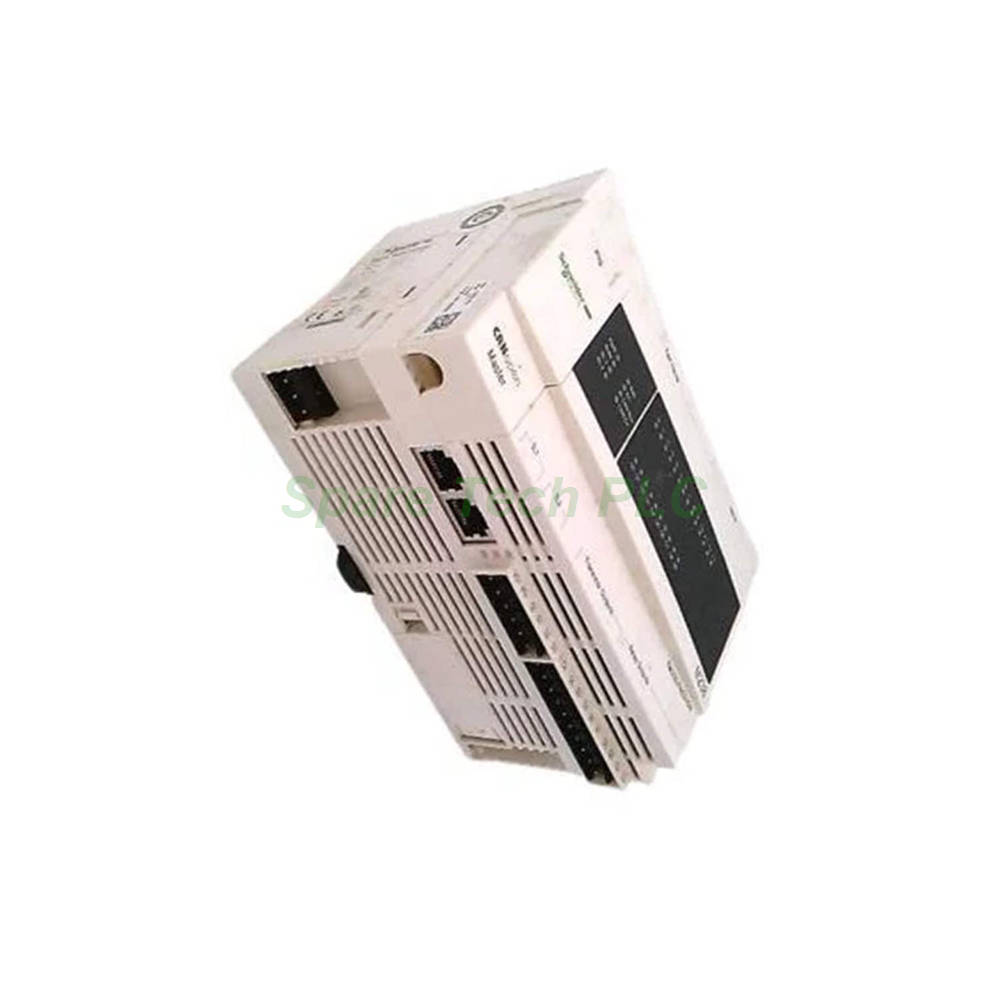
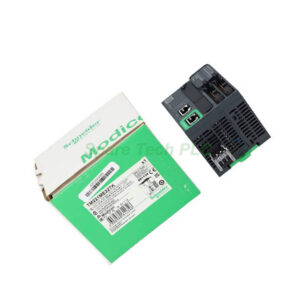
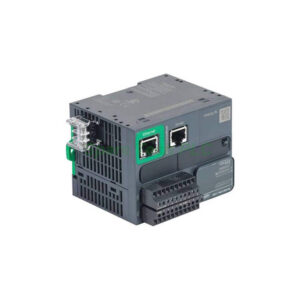
The TM238LDD24DT belongs to the Modicon M238 family, a series known for its compact design and high-performance capabilities. Schneider Electric designed this controller for applications that require fast input response and precise output control. It operates on a 24 V DC supply and provides 24 discrete I/O points. Among these, 8 inputs are fast inputs, and 4 outputs are fast outputs, making it ideal for positioning, counting, and PWM tasks.
Moreover, this model includes 500 kB of internal RAM, which handles complex programs and data processing with ease. It also supports up to 7 expansion modules, allowing you to scale your system as needs evolve. The built-in real-time clock and optional battery backup ensure data retention during power outages. For communication, it offers a USB port and an isolated serial link supporting Modbus RTU/ASCII protocols.
Key Technical Specifications
Power Supply and Power Consumption
The TM238LDD24DT accepts a supply voltage from 19.2 to 28.8 V DC, with a nominal rating of 24 V DC. Its maximum inrush current reaches 35 A, while total power consumption stays at or below 17.2 W. The controller also provides a sensor power supply output ranging from 19.2 to 30 V DC. This feature simplifies wiring by directly powering field devices.
Discrete Inputs – Standard and Fast
This controller includes 14 discrete inputs in total. Specifically, 8 inputs are fast inputs compliant with EN/IEC 61131-2 Type 1 standards, while 6 inputs are standard Type 1 inputs. Both types accept 24 V DC signals. Fast inputs feature a response time of just 300 ns, whereas standard inputs respond within 3 ms. You can also configure input filtering times from 0.004 ms to 4 ms, giving you flexibility to reject noise or detect short pulses. Additionally, all inputs support sink or source wiring, but fast inputs are positive logic (sink) only.
Discrete Outputs – Standard and Fast
The TM238LDD24DT provides 10 discrete outputs: 6 standard outputs and 4 fast outputs. All outputs operate at 24 V DC. Standard outputs can drive loads from 20 mA to 500 mA, while fast outputs deliver up to 500 mA in normal mode. In PWM or PTO mode, fast outputs are limited to 100 mA. Fast outputs support PWM frequencies up to 20 kHz and PTO frequencies up to 100 kHz. This capability makes the controller suitable for stepper motor control, LED dimming, and precision timing applications.
High-Speed Counting and Positioning
For counting tasks, the controller features 8 fast inputs that function as high-speed counters (HSC) at 100 kHz with 32-bit capacity. These counters support various modes, including single-phase, pulse/direction, and A/B quadrature. For motion control, it offers 2 PTO/PWM channels at 100 kHz. Therefore, you can manage two axes of positioning or generate pulse trains for servo drives. The integrated PID function further expands its utility in process regulation.
Memory and Data Backup
The TM238LDD24DT includes 500 kB of internal RAM for user applications and data. This memory is ample for mid-sized programs with complex arithmetic and floating-point calculations. Execution times are fast: Boolean operations take only 0.971 µs, while integer arithmetic completes in 0.439 µs. For data retention, the controller supports retain and retain-persistent variables. An optional lithium battery (TSXPLP01) can back up these variables for up to one year, while internal retention lasts 3 days and 22 hours without battery.
Communication Ports
This model integrates two communication interfaces. First, a Mini B USB 2.0 port allows direct connection to a programming terminal. Second, an isolated serial link with an RJ45 female connector supports RS232 or RS485 communication. This serial port works as a Modbus master or slave, using RTU or ASCII protocols. The default baud rate is 115.2 kbit/s, but you can adjust it from 1.2 to 115.2 kbit/s. Additionally, the port supplies 5 V at 200 mA for external devices.
Expansion Capability
You can connect up to 7 I/O expansion modules to this controller. Depending on the connector type, total I/O points can reach 248 with HE-10 connectors, 192 with spring terminal blocks, or 136 with removable screw terminal blocks. This modularity ensures you can tailor the system to your specific application requirements.
Mechanical and Environmental Specifications
Physical Dimensions and Mounting
The TM238LDD24DT measures 118 mm in height, 157 mm in width, and 86 mm in depth. It weighs 0.56 kg. You can mount it on a 35 mm symmetrical DIN rail or directly on a panel. Its robust construction ensures stable operation in industrial environments.
Temperature and Humidity
The controller operates reliably in ambient temperatures from -10 °C to 55 °C. Storage temperature ranges from -40 °C to 70 °C. It handles relative humidity up to 95% without condensation. These ratings make it suitable for harsh factory floors and outdoor enclosures.
Vibration and Shock Resistance
With vibration resistance of 3.5 mm at 5–150 Hz (1 gn) and shock resistance of 15 gn for 11 ms, the TM238LDD24DT withstands mechanical stress from nearby machinery. This durability reduces the risk of failure due to vibration-induced loose connections.
Electrical Immunity
The controller meets stringent EMC standards. It features dielectric strength of 500 V for 1 minute between supply/earth and I/O/earth terminals. Insulation resistance exceeds 10 MΩ at 500 V. It also withstands micro-breaks of up to 10 ms, ensuring continuous operation during brief power dips.
Installation and Wiring Guide
Mounting the Controller
Choose a clean, dry location inside your control panel. Ensure adequate spacing for heat dissipation. For DIN rail mounting, snap the unit onto a 35 mm rail. For panel mounting, use screws through the mounting holes. Always verify that the panel is grounded properly.
Power Supply Connections
Connect the 24 V DC power source to the removable screw terminal block designated for power. Observe polarity carefully. The controller includes built-in protection against short circuits, overloads, and overvoltage, which enhances system safety.
Input and Output Wiring
Use the dedicated terminal blocks for inputs and outputs. The 7-terminal block handles standard inputs, while the 12-terminal block serves fast inputs. For outputs, use the 6-terminal block for standard outputs and the 10-terminal block for fast outputs. For high-speed signals, always use shielded cables to minimize electromagnetic interference. Keep cable lengths under 30 m for standard I/O and under 10 m for fast I/O in counter or PWM modes.
Communication Cabling
Connect your PC to the USB port using a standard mini B cable. For serial communication, use an RJ45 cable. The isolated serial link provides reliable data exchange even in electrically noisy environments. Remember to configure the communication parameters in your software to match the slave devices.
Packaging List
1 x TM238LDD24DT logic controller (compact base)
1 x 2-pin power supply terminal block (removable)
1 x 7-terminal input connector (standard inputs)
1 x 12-terminal connector (fast inputs)
1 x 6-terminal output connector (standard outputs)
1 x 10-terminal connector (fast outputs)
1 x Quick reference guide
Note: Programming software, communication cables, and expansion modules are sold separately.
Frequently Asked Questions (FAQ)
1. What is the maximum counting frequency of the fast inputs?
The fast inputs support counting frequencies up to 100 kHz in normal and counter modes. This makes them suitable for high-speed encoder and pulse monitoring applications.
2. Can I use the fast outputs for PWM control?
Yes. The fast outputs support PWM mode with frequencies up to 20 kHz. In this mode, the output current is limited to 100 mA, which is sufficient for controlling small loads or generating analog-like signals.
3. How many expansion modules can I connect?
You can connect up to 7 I/O expansion modules. The total number of I/O points depends on the connector type, reaching up to 248 points with HE-10 connectors.
4. What software do I need to program this controller?
Schneider Electric recommends SoMachine or EcoStruxure Machine Expert – Basic. These software packages support the M238 series and provide programming in ladder, FBD, and structured text.
5. Does the controller retain data after a power failure?
Yes. Retain and retain-persistent variables remain intact. Without an optional battery, data is retained for 3 days and 22 hours. With the TSXPLP01 battery, retention extends to one year.