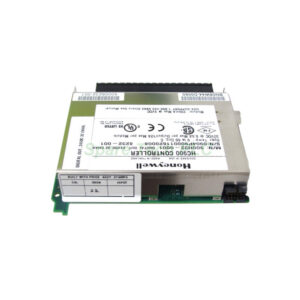
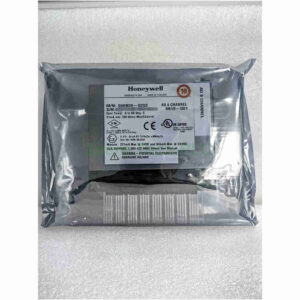
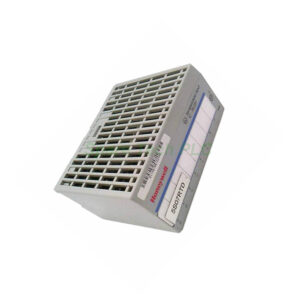
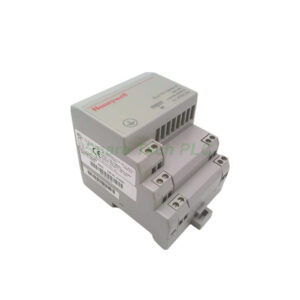
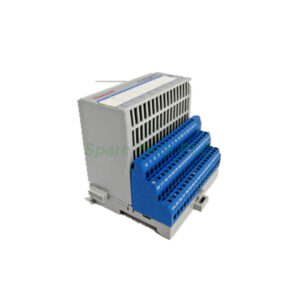
Honeywell Universal AI (900A01-0202)
Product Introduction
The Honeywell 900A01-0202 supports up to eight user-configurable inputs. You can set each channel individually for thermocouple, RTD, resistance, mV, V, or mA. This flexibility makes it ideal for mixed-signal environments. The module provides point-to-point isolation at 400 VDC. Additionally, backplane isolation reaches 1 KVDC to logic circuits.
Analog-to-digital conversion synchronizes with the CPU execution cycle. Therefore, data interchange latency is eliminated. All analog input modules process in parallel. Consequently, adding more modules does not increase scan time. A green blinking LED indicates normal scanning. Meanwhile, a red LED alerts you to module diagnostics.
The 900A01-0202 includes advanced sensor management features. For thermocouple inputs, a warning signal indicates needed maintenance before sensor failure. A separate sensor failure signal is also provided. You can configure burnout values per channel for T/C, mV, and V inputs.
Technical Specifications
Input impedance reaches 10 megohms for T/C and mV inputs. For voltage inputs, impedance exceeds 1 megohm. Current inputs use 250 ohms. Noise rejection includes series mode >60 dB. Moreover, common mode rejection exceeds 130 dB at 120 VAC.
The module supports multiple RTD types. These include PT100 3-wire with 40 ohms balanced maximum. Thermocouple leg resistance is 100 ohms. RTD types 100, 500, and 1000 use 100 ohms per leg. Low-range RTDs and 10-ohm copper use 10 ohms per leg.
Burnout configuration options include upscale, downscale, a defined value, or none. Over-range limits reach +/-10% for linear voltage ranges. For non-linear ranges like T/C and RTD, the limit is +/-1%. T/C break detection uses a current pulse method. Faulty thermocouple detection triggers a warning when resistance exceeds 100 ohms.
Accuracy and Resolution
Factory accuracy reaches ±0.1% of range for most inputs. For 0V to 10V and -10V to 10V ranges, accuracy is ±0.2%. Cold junction accuracy is ±0.7°C. Reference conditions include 25°C ±3°C temperature and 45-55% non-condensing humidity.
Temperature effect on accuracy stays within ±0.01% of full scale per degree Celsius. The A/D converter delivers 15-bit resolution. Update rate is 500 ms per module. Long-term stability reaches 0.1% per year. Reference junction sensing uses two RTDs at the top and bottom of the module.
Mechanical & Environmental Parameters
Operating temperature ranges from 0°C to 60°C. Storage temperature goes from -40°C to 85°C. Humidity tolerance is 5% to 95% non-condensing. The module withstands vibration up to 2g at 10–500 Hz. Shock resistance is 30g for 11 ms half-sine.
Power consumption is typically 1.8 W from the backplane. The module uses redundant factory calibration stored in non-volatile memory. Diagnostics monitor factory calibration, 24 VDC supply, and user configuration. Channel configuration data also resides in non-volatile memory.
Frequently Asked Questions (FAQ)
1. Can the Honeywell 900A01-0202 accept both thermocouple and RTD inputs on different channels?
Yes, each of the eight channels is independently configurable for any supported input type.
2. What does the warning signal for thermocouple inputs indicate?
It indicates that maintenance is needed before a complete sensor failure occurs. This helps prevent unexpected shutdowns.
3. How does burnout configuration work?
You can set each channel to upscale, downscale, a defined value, or no burnout detection. This determines output behavior during sensor failure.
4. Does adding more analog input modules slow down the scan time?
No, all analog input modules process in parallel. Scan time remains unchanged regardless of how many modules you add.
5. Is cold junction compensation included?
Yes, two RTDs at the top and bottom of the module provide accurate cold junction compensation. Accuracy is ±0.7°C.