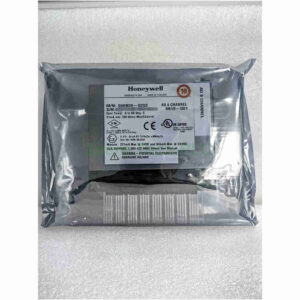
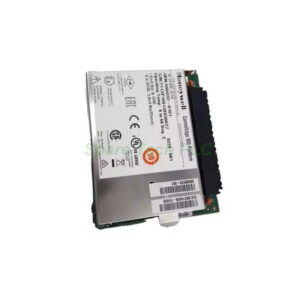
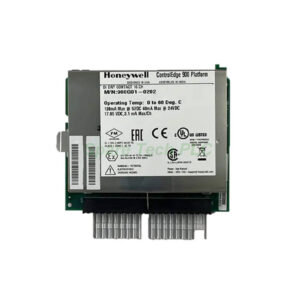
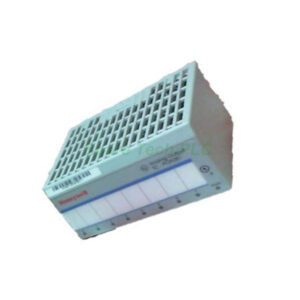
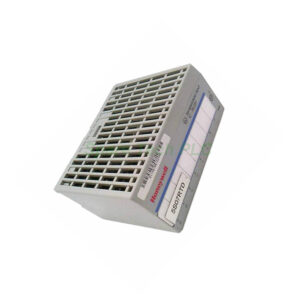
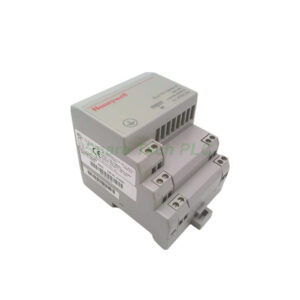
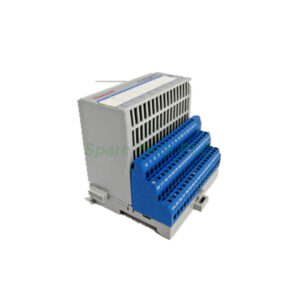
Honeywell Digital Input 120/240 VAC (900G03-0202)
Product Introduction
The Honeywell 900G03-0202 is an externally powered AC digital input module. It accommodates 16 sinking inputs across two circuit voltages. Two common terminals support each group of eight inputs. When AC power applies between a common terminal and an input, that input turns ON. A green LED per channel shows the ON state. Additionally, controller logic can invert the state when needed.
Technical Specifications
This I/O module handles high-voltage AC signals reliably. Its key parameters appear below.
Inputs per module: 16 (sinking type)
Input voltage range: 80 VAC to 264 VAC
Peak voltage: 264 VAC
AC frequency: 47 Hz to 63 Hz
Galvanic isolation: 2 groups of 8 inputs (350 VAC max.)
ON voltage level: 75 VAC
OFF voltage level: 20 VAC
Input impedance: 48 K ohms nominal
Input current: 1 mA nominal at 120 VAC / 2 mA nominal at 230 VAC
Minimum ON current: 0.3 mA
Maximum OFF current: 0.2 mA
OFF to ON response time: 4 ms + 1.5 line cycles maximum
ON to OFF response time: 4 ms + 2 line cycles maximum
The Honeywell 900G03-0202 stores no calibration data because it is a simple digital input module. However, it includes diagnostic monitoring through the red status LED.
LED Indicators and Diagnostics
A green blinking status LED on the module indicates normal scanning activity. A red status LED lights up when module diagnostics detect a fault. Furthermore, each of the 16 channels has its own green LED. This per-channel LED turns on when the corresponding digital input is active.
Meanwhile, controller logic can invert any input state. For instance, a normally open contact becomes interpreted as normally closed. This flexibility simplifies wiring and logic design.
Mechanical and Isolation Parameters
Isolation groups: Two groups of eight inputs each
Isolation voltage: 350 VAC maximum between groups
Terminal block type: Euro style (sold separately)
Power source: External AC power (module does not draw from backplane for inputs)
Mounting: Standard rack mounting
Installation Guidelines
First, mount the Honeywell 900G03-0202 in a suitable rack. Next, connect AC power to the common terminals for each group. Wire each field device between a common terminal and an input terminal.
Moreover, ensure the AC voltage stays between 80 VAC and 264 VAC. For 120 VAC applications, expect about 1 mA per input. For 230 VAC applications, expect about 2 mA per input.
Keep response times in mind. The OFF-to-ON transition takes 4 ms plus up to 1.5 line cycles. The ON-to-OFF transition takes 4 ms plus up to 2 line cycles. Finally, use the logic inversion feature if your field contacts are normally closed.
Packaging List
Honeywell 900G03-0202 Digital Input module – 1 unit
Quick start guide – 1 copy
Channel label sheet – 1 piece
Dust cover – 1 piece
Note: The Euro style terminal block is not included. No calibration certificate or warranty documents ship with this item.
Shipping
We deliver worldwide using FedEx, UPS, or DHL. Tracking information is provided after dispatch.
Frequently Asked Questions (FAQ)
1. Can I mix 120VAC and 240VAC inputs on the same module?
Yes. The Honeywell 900G03-0202 accepts any voltage from 80 VAC to 264 VAC per channel. But both groups share the same voltage range.
2. What does “sinking input” mean for this module?
Sinking means the input provides a path to common. AC power applies between the common terminal and the input terminal. The input turns ON when current flows into it.
3. How fast can the module detect a pulse signal?
The OFF-to-ON response time is 4 ms plus up to 1.5 line cycles. At 50 Hz, one cycle is 20 ms. So total could be up to 34 ms. For fast pulses, use a DC input module instead.
4. What happens if I apply voltage below 75 VAC?
The input stays OFF. The guaranteed OFF voltage level is 20 VAC maximum. Between 20 VAC and 75 VAC, the state is undefined. Always stay above 75 VAC for reliable ON detection.
5. Do I need external resistors or protection devices?
No. The Honeywell 900G03-0202 has built-in 48 K ohm input impedance. It limits current to safe levels. However, for noisy environments, consider external suppression devices.