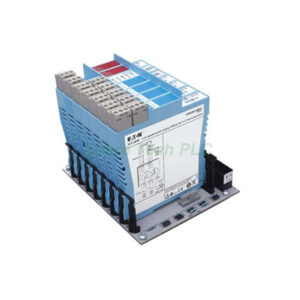
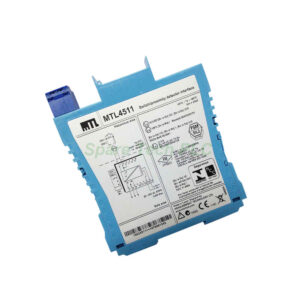
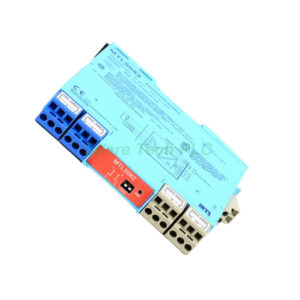
MTL5073 Temperature Converter with 3 Port Isolation for THC and RTD Inputs
The MTL5073 accepts signals from thermocouples or RTDs and converts them into a 4-20mA current signal. This model features 3 port isolation between input, output, and power circuits. Consequently, you get improved signal integrity and protection against ground loops. The unit operates on a 20 to 35V DC supply with a 35VDC rated maximum. Its compact design mounts on a standard 35mm DIN rail.
Supported Input Types and Signal Sources
The MTL5073 handles a wide variety of temperature sensors. For thermocouple (THC) inputs, it supports types J, K, T, E, R, S, B, and N. These follow BS 4937 standards. For millivolt (EMF) inputs, the range is -75 to +75mV with a 3mV minimum span.
For RTD inputs, the MTL5073 works with 2-wire, 3-wire, and 4-wire platinum RTDs conforming to BS 1904/DIN 43760 (100Ω at 0°C). Additionally, it supports resistance inputs from 0 to 400Ω with a 10Ω minimum span. The RTD excitation current is 200µA nominal.
Cold Junction Compensation and Accuracy
For thermocouple applications, cold junction compensation is available. You can set it to automatic or manual mode. CJC error is less than 1.0°C. A HAZ-CJC plug containing an integral CJC sensor is supplied with the unit.
Calibration accuracy at 20°C includes hysteresis, non-linearity, and repeatability. For mV and THC inputs, accuracy is ±15µV or ±0.05% of input value (whichever is greater). For RTD inputs, accuracy is ±80mΩ. Output accuracy is ±11µA.
Temperature drift is typically ±0.003% of input value per °C for mV/THC inputs. For RTD inputs, drift is ±7mΩ/°C. Output drift is ±0.6µA/°C. Common mode rejection is 120dB for 240V at 50Hz or 60Hz. Series mode rejection is 40dB for 50Hz or 60Hz.
Output Specifications and Isolation
The output range is 4 to 20mA nominal (direct or reverse acting). Maximum load resistance is 600Ω. The MTL5073 provides 250V rms isolation between input, output, and power supply terminals. Testing occurs at 1500V rms minimum between safe-area and hazardous-area terminals. Note that output and power supply are not isolated from each other.
Sensor Failure Protection and Alarms
You can configure the MTL5073 for safe drive on sensor failure. Options include upscale (above range), downscale (below range), or off. Green LED indicates power and status. Yellow LED shows alarm conditions.
Power Requirements and Consumption
Supply voltage range is 20 to 35V DC. Current consumption varies with supply voltage:
Power dissipation is 1.2W at 24V with a 20mA signal. At 35V, dissipation reaches 2.0W.
Environmental Specifications
Operating temperature range is -20 to +60°C. Storage temperature range is -40 to +80°C. Humidity tolerance is 5% to 95% relative humidity (non-condensing). The unit mounts in a safe area location. For hazardous area signal sources, it supports Zone 0, IIC, T4-T6 and Division 1, Groups A-D.
Installation Guidelines
First, mount the MTL5073 on a 35mm top-hat DIN rail (EN 50022-35 x 7.5). Next, connect your THC or RTD sensor to the input terminals (CON1). For thermocouple applications, install the supplied HAZ-CJC plug on terminals 1–3. Then, wire the 4-20mA output to your load via terminals 4 and 5 (CON2). After that, connect a 20-35V DC power supply to the power terminals. Finally, configure the unit using MTL PCS45 software with a PCL45USB interface. Wire sizes up to 2.5mm² are acceptable.
Packaging List
MTL5073 temperature converter (one unit)
HAZ-CJC plug (for thermocouple cold junction compensation)
Signal and power connectors (supplied)
Product quick start guide (printed)
Note: No certificates or warranty documents are included in the package.
Shipping Method
All orders ship via FedEx, UPS, or DHL. Delivery typically takes 3 to 7 business days.
Frequently Asked Questions (FAQ)
1. What is the difference between MTL5073 and MTL5073-RTD?
The standard MTL5073 includes a HAZ-CJC plug for thermocouple cold junction compensation. The MTL5073-RTD includes a standard HAZ1-3 signal plug for mV or RTD applications without CJC.
2. Can I use the MTL5073 with 3-wire RTDs?
Yes, the MTL5073 supports 2-wire, 3-wire, and 4-wire platinum RTD configurations. You can select the wire type during software configuration.
3. What does 3 port isolation mean on this device?
Three port isolation means the input, output, and power circuits are all isolated from each other at 250V rms. This reduces ground loops and improves signal quality.
4. What happens if the thermocouple fails or disconnects?
You can configure the MTL5073 for upscale or downscale output on sensor failure. This feature helps your control system detect sensor faults immediately.
5. What configuration software works with the MTL5073?
The MTL5073 requires MTL PCS45 software running on a personal computer. You also need a PCL45USB serial interface adapter and appropriate cables for connection.