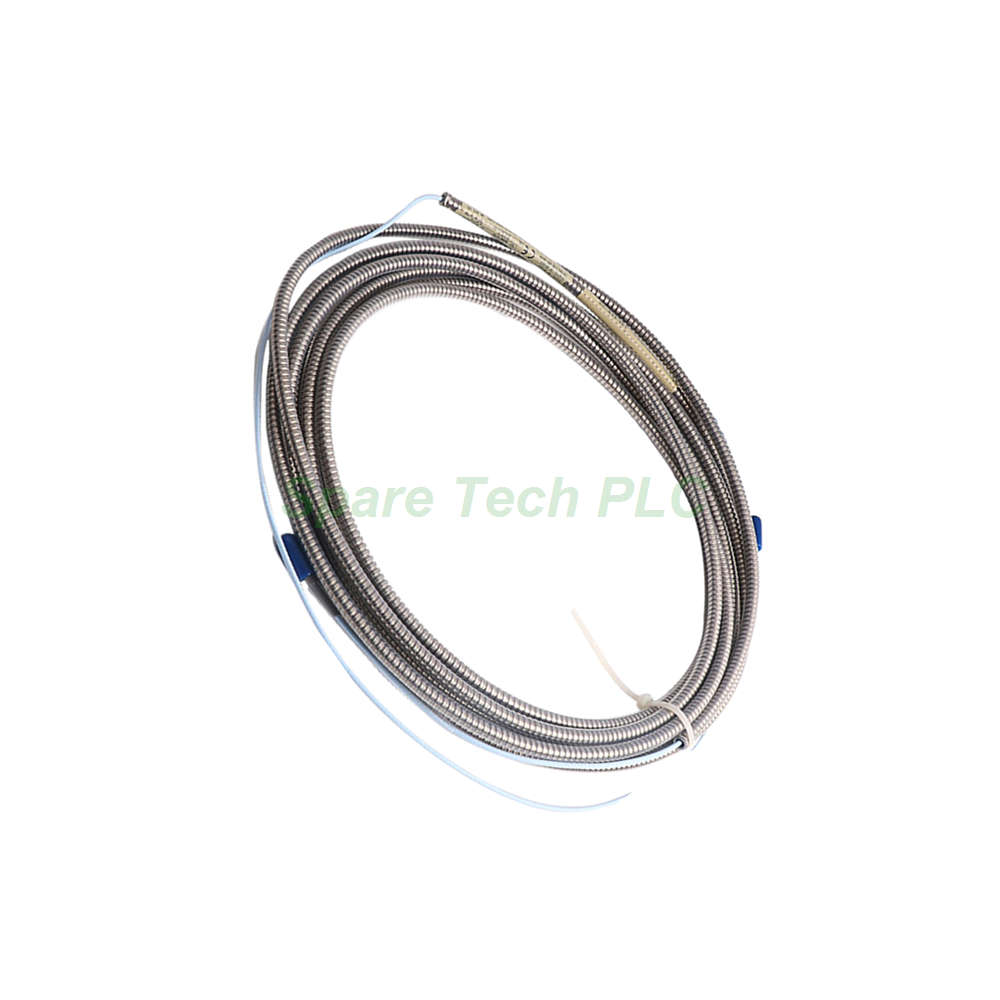
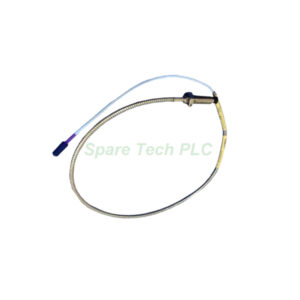
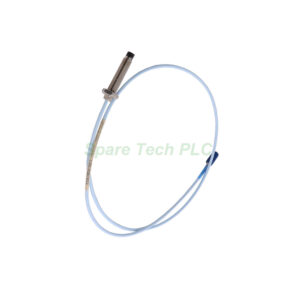
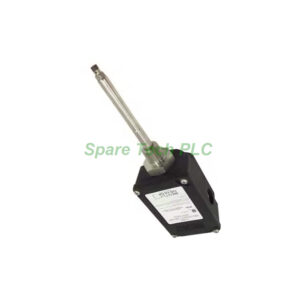
Bently Nevada 330130-070-13-CN Armored Extension Cable
Product Introduction
The Bently Nevada 330130-070-13-CN is a rugged, high-performance extension cable engineered to connect 3300 XL 8mm proximity probes to the Proximitor sensor. This 7.0-meter (22.9 feet) cable features the advanced Armored FluidLoc design. Specifically, the armor provides exceptional mechanical protection against physical damage. Meanwhile, the FluidLoc technology prevents oil and other process liquids from leaking out of the machine through the cable's interior. Additionally, it provides a secure and corrosion-resistant connection with its gold-plated ClickLoc connectors. Therefore, this model is an ideal choice for demanding applications like turbines and compressors. Moreover, it offers improved durability and signal integrity over previous designs.
Technical Specifications
This section details the core technical parameters of the 3300 XL Armored Extension Cable.
Electrical and Physical Parameters:
Cable Length: 7.0 meters (22.9 feet).
Cable Type: Armored FluidLoc cable with connector protector.
Connector Type: Corrosion-resistant, gold-plated ClickLoc connectors ensure a secure and reliable connection.
Capacitance: The extension cable has a typical capacitance of 69.9 pF/m (21.3 pF/ft).
DC Resistance (RCORE): The nominal resistance from center conductor to center conductor is 1.54 ± 0.23 Ω for the 7.0-meter length.
DC Resistance (RJACKET): The nominal resistance from outer conductor to outer conductor is 0.46 ± 0.09 Ω for the 7.0-meter length.
Cable Weight: The armored cable weighs approximately 103 g/m (1.5 oz/ft), totaling 0.618 kg for the full length.
Mechanical Durability Features:
Pull Strength: The cable incorporates a patented CableLoc design. As a result, it provides 330 N (75 lbf) pull strength, ensuring a robust attachment between the probe cable and probe tip.
TipLoc Molding: The probe features a patented TipLoc molding method. Consequently, this provides a robust bond between the probe tip and the probe body.
Output Resistance: The Proximitor sensor has a 50 Ω output resistance.
Supply Sensitivity: The system shows less than a 2 mV change in output voltage per volt change in input voltage.
Power and Environmental Requirements
Understanding the operational requirements is crucial for successful implementation.
Power Supply and Operating Conditions:
Power Supply: The Proximitor sensor requires a DC power supply. Specifically, it needs -17.5 Vdc to -26 Vdc without barriers at a maximum consumption of 12 mA. With barriers, the range is -23 Vdc to -26 Vdc.
Operating Voltage: Keep in mind that operation at a voltage more positive than -23.5 Vdc can reduce the linear range.
Humidity Resistance: The 3300 XL 8 mm probes show less than a 3% change in Average Scale Factor (ASF). For instance, this is when tested in 93% humidity per IEC standard 68-2-3 for up to 56 days.
Temperature Range: The specified performance is for operation between +18˚C and +27˚C (+64˚F to +80˚F) at a maximum altitude of 2000 meters.
Pressure Seal: The 3300 XL 8 mm probes are designed to seal differential pressure between the probe tip and case. They use a Viton® O-ring for this purpose.
Installation and Connectivity
Proper installation ensures optimal performance of the Bently Nevada system.
Probe Compatibility and Wiring:
This cable is designed to accept one non-contacting 3300-series 5 mm, 3300 8 mm, or 3300 XL 8 mm Proximity Probe. For the connection between the 3300 XL Proximitor Sensor and the monitor, use 0.2 to 1.5 mm² (16 to 24 AWG) 3-conductor shielded triad cable. Furthermore, the maximum length for this field wiring is 305 meters (1,000 feet).
Connector Protection and Linear Range:
While the cable includes silicone tape for use instead of connector protectors, we do not recommend silicone tape for applications where the probe-to-extension cable connection is exposed to turbine oil. Instead, the included connector protector is the preferred solution for these environments. Meanwhile, the system provides a linear range of 2 mm (80 mils). This range begins at approximately 0.25 mm (10 mils) from the target. Then, it extends from 0.25 to 2.3 mm (10 to 90 mils), corresponding to approximately -1 to -17 Vdc.
Country-Specific Approvals:
This model features the -CN approval option. Thus, it complies with country-specific regulations required for your region.
Packaging and Logistics
The 330130-070-13-CN is shipped with the necessary components for a straightforward installation.
Package Contents:
Shipping Information:
We ship this product worldwide using reliable carriers. For instance, we use FedEx, UPS, and DHL to ensure fast and secure delivery.
Frequently Asked Questions (FAQ)
Q1: What is the advantage of the Armored FluidLoc cable on the 330130-070-13-CN?
A1: The Armored FluidLoc cable offers two key benefits. First, the armor provides superior mechanical protection against crushing, abrasion, and impact damage. Second, the FluidLoc technology prevents oil and other liquids from leaking out of the machine through the cable's interior.
Q2: Can I use this extension cable with a 3300 5mm probe?
A2: Yes, the Bently Nevada 330130-070-13-CN is compatible with 3300-series 5 mm, 3300 8 mm, and 3300 XL 8 mm proximity probes. Thus, it is a versatile component for various system configurations.
Q3: What does the -CN approval option mean for this product?
A3: The -CN designation indicates that this cable meets country-specific approval requirements. Therefore, it is suitable for use in regions with particular regulatory standards.
Q4: Is the silicone tape included with the cable suitable for all applications?
A4: No. While silicone tape is included as an alternative to connector protectors, it is not recommended for applications where the probe-to-extension cable connection will be exposed to turbine oil. Instead, use the connector protector in such cases.
Q5: What is the significance of the patented CableLoc design?
A5: The CableLoc design provides a high pull strength of 330 N (75 lbf). As a result, it ensures the probe cable is securely attached to the probe tip. This robust design enhances the durability and reliability of the connection. Moreover, it reduces the risk of damage or disconnection during operation.