Product Introduction
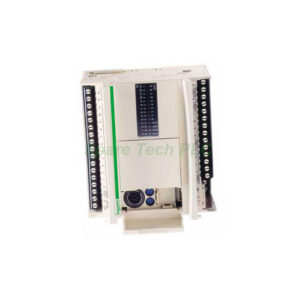
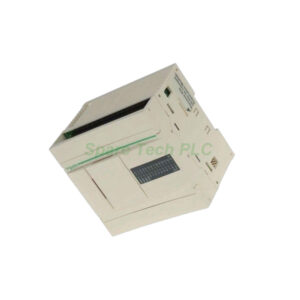
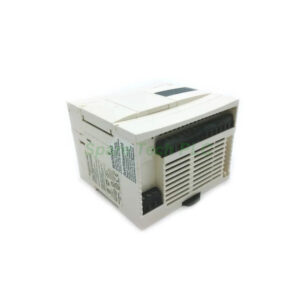
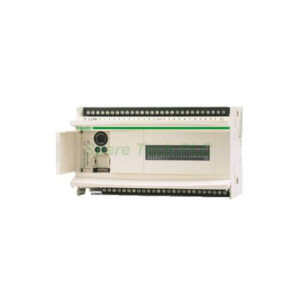
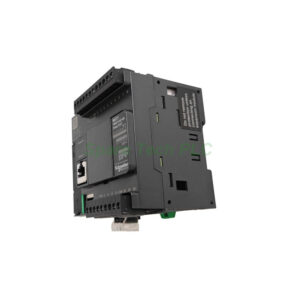
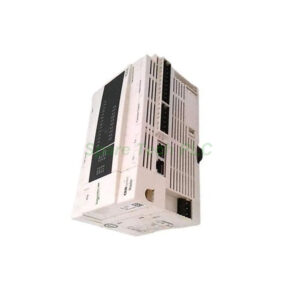
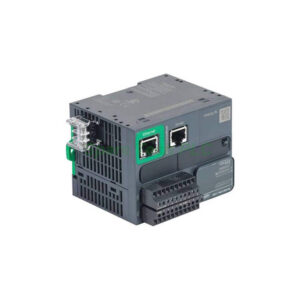
The Schneider Electric TWDLCDA16DRF offers a reliable and compact control solution for smaller automation tasks. Operating on a 24V DC supply, this Twido PLC provides 9 discrete inputs and 7 relay outputs, perfectly suited for applications with limited I/O requirements. Its design supports one expansion slot, giving you flexibility for future upgrades. Additionally, the built-in Modbus communication enables easy integration into existing networks, making this controller both practical and versatile.
Technical Specifications
Power Supply and Inputs
The TWDLCDA16DRF operates on a nominal 24V DC supply, with a voltage range of 20.4 to 28.8V DC. It draws a maximum inrush current of 35A and consumes only 4.6W during operation. Its 9 discrete inputs accept 24V DC and support both sink and source logic configurations. Specifically, inputs I0.0 and I0.1 draw 11 mA, while inputs I0.2 to I0.8 draw 7 mA. Consequently, the input impedance measures 2100 Ohms for the first two channels and 3400 Ohms for the rest, ensuring proper signal detection from various sensors.
Outputs and Memory
For output control, the TWDLCDA16DRF provides 7 relay outputs, each rated for 2A at both 240V AC and 30V DC. The electrical durability reaches 100,000 cycles, while mechanical durability extends to 20,000,000 cycles. Program memory accommodates 2000 instructions, with a swift execution time of 1 ms per 1000 instructions. System overhead remains minimal at 0.5 ms, ensuring responsive performance for most control loops.
Communication and Expansion
This Twido PLC features a non-isolated serial link with a mini DIN connector, supporting Modbus RTU/ASCII master/slave protocols at speeds up to 38.4 kbit/s. An optional serial link interface adaptor allows for RS232C or RS485 connectivity. Furthermore, the controller includes one free slot for a memory cartridge or real-time clock cartridge, providing additional functionality when needed.
Mechanical and Environmental Parameters
Physical Dimensions and Mounting
The TWDLCDA16DRF boasts a compact footprint measuring 90 mm (W) x 95 mm (H) x 70 mm (D) and weighs only 0.25 kg. You can mount it on a 35 mm symmetrical DIN rail or a panel using the appropriate fixing kit. The non-removable screw terminal block ensures secure and reliable wiring connections.
Environmental Resilience
This controller withstands vibration up to 4 gn (25-100 Hz) when panel-mounted and 1 gn (57-150 Hz) on DIN rail. Shock resistance reaches 15 gn for 11 ms. Additionally, the operating temperature ranges from 0 to 55°C, with storage from -25 to 70°C. Relative humidity tolerance spans 30 to 95% without condensation, and the IP20 rating provides protection against solid objects larger than 12.5 mm.
Installation Guide
First, disconnect all power sources before beginning installation. Next, mount the TWDLCDA16DRF securely on a DIN rail or panel, ensuring adequate clearance for heat dissipation. Then, connect the 24V DC power supply to the (+)PW_POS and (-)PW_NEG terminals. Wire your input devices to terminals 0 through 8, connecting the common return to the COM terminal. For outputs, connect loads to terminals 0 through 6, grouping commons appropriately (COM0 for outputs 0-3, COM1 for outputs 4-7). Finally, power up the unit and verify the green PWR LED illuminates. Check the RUN LED to confirm proper operation.
Packaging List
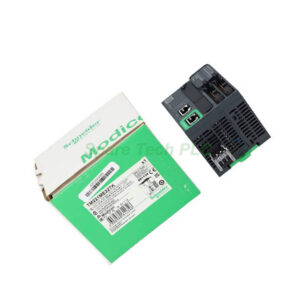
The product package for the Schneider TWDLCDA16DRF includes the following items:
Schneider Electric TWDLCDA16DRF Compact Base Controller
Non-removable screw terminal block (installed)
Quick start guide
Product documentation on CD-ROM
All items will be shipped via Fedex, UPS, or DHL.
Frequently Asked Questions (FAQ)
1. Q: What power supply does the TWDLCDA16DRF require?
A: This controller requires a 24V DC power supply, with an acceptable voltage range of 20.4 to 28.8V DC.
2. Q: Can I expand the I/O on this Twido PLC?
A: This model includes one free slot for a memory or real-time clock cartridge. However, it does not support physical I/O expansion modules like the larger Twido models.
3. Q: How is program memory retained during power loss?
A: The internal RAM is backed by a lithium battery for up to 30 days. This battery charges in 10 hours and has a typical lifespan of 10 years.
4. Q: Does the TWDLCDA16DRF support Modbus communication?
A: Yes, it features an RS485 serial link supporting Modbus RTU/ASCII master and slave protocols for easy integration into automation networks.
5. Q: What is the maximum switching frequency for relay outputs?
A: For optimal durability and electrical life, operate relay outputs at a maximum of 30 cycles per minute.