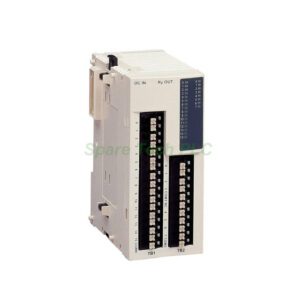
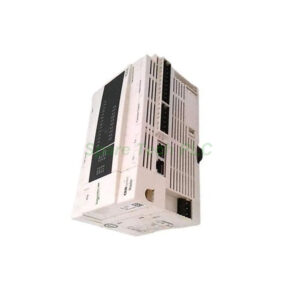
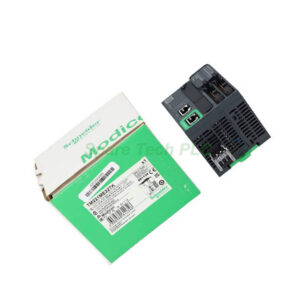
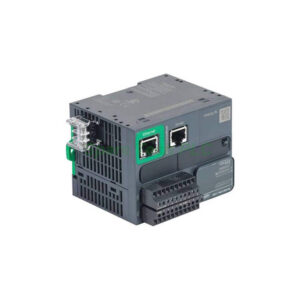
Schneider Electric TWDDRA16RT Twido Discrete Output Module
The Schneider Electric TWDDRA16RT expands your Twido PLC system with 16 independent relay outputs. This discrete output module drives solenoids, contactors, indicators, and other AC or DC loads with ease. Each of the 16 outputs delivers up to 2 A continuous current, and the module organizes them into two commons, each supporting 8 A total. The TWDDRA16RT uses a removable screw terminal block, which makes installation and maintenance significantly more convenient.
Technical Specifications
Knowing the exact specifications ensures proper integration into your control architecture.
Output Characteristics:
Discrete Outputs: 16, relay (Form A / normally open)
Output Commons: 2 commons (COM0 for outputs 0–7, COM1 for outputs 8–15)
Current per Channel: 2 A
Maximum Current per Common: 8 A
Contact Resistance: ≤ 40000 µOhm
Response Time: ≤ 7 ms
Isolation and Protection:
Terminal Block:
Connection Type: Removable screw terminal block
This design allows you to pre-wire the block offline and then plug it into the module. Consequently, it reduces downtime during replacement or maintenance.
Power Consumption
The TWDDRA16RT draws power from both the 5 V DC and 24 V DC supplies. When all outputs are energized, it consumes 45 mA at 5 V DC and 75 mA at 24 V DC. In the de-energized state, it only draws 5 mA at 5 V DC. Therefore, you must account for these values when sizing your system power supply to avoid overloading.
Installation and Mounting
Installing the TWDDRA16RT is straightforward when you follow these steps:
Mounting: Clip the module onto a standard 35 mm DIN rail inside your enclosure. Ensure adequate spacing for heat dissipation.
Wiring Preparation: Remove the screw terminal block from the module. This step gives you easy access to all terminals.
Wire Stripping: Strip your wires to the length recommended for screw terminals, typically 7–8 mm.
Output Wiring: Connect your loads to the output terminals (0 through 15). For AC loads, connect the live wire through the relay contact and the neutral directly to the load. For DC loads, connect the positive through the contact and the negative directly.
Common Connections: Wire the COM0 terminal to the power supply return for outputs 0–7. Wire the COM1 terminal for outputs 8–15. Ensure these commons are properly fused.
Reattach: Plug the terminal block back into the TWDDRA16RT module and secure it firmly.
Check: Double-check all connections before powering up the system.
Environmental and Mechanical Parameters
The TWDDRA16RT is built for reliable operation in industrial environments.
Operating Temperature: 0...55 °C
Storage Temperature: -25...70 °C
IP Degree of Protection: IP20 (suitable for installation inside a control cabinet)
Product Weight: 0.145 kg (approx. 0.20 kg with packaging)
Product Certifications: CSA, UL
Packaging List
Note: Cables, DIN rail, and mounting accessories are not included and must be ordered separately.
Frequently Asked Questions (FAQ)
Q1: Can the TWDDRA16RT switch both AC and DC loads?
Yes, the relay outputs on the TWDDRA16RT are dry contacts. Therefore, they can switch AC or DC loads up to the rated current of 2 A per channel and 8 A per common.
Q2: What is the advantage of a removable terminal block?
The removable screw terminal block on the TWDDRA16RT allows you to disconnect all wiring at once without loosening individual screws. This feature speeds up module replacement and simplifies panel wiring during initial installation.
Q3: How do I connect the commons on the TWDDRA16RT?
The module has two commons. COM0 serves outputs 0 through 7, and COM1 serves outputs 8 through 15. You must connect these to the corresponding return path of your power supply. Do not exceed 8 A total current through either common.
Q4: What is the contact resistance of the relays on the TWDDRA16RT?
The contact resistance is ≤ 40000 µOhm. This low resistance minimizes heat generation and voltage drop across the relay contacts during operation.
Q5: Does the TWDDRA16RT require external fusing?
Yes, it is strongly recommended to fuse each output or at least each common. This practice protects the TWDDRA16RT from overcurrent conditions and prevents damage to the module in case of a load short circuit.