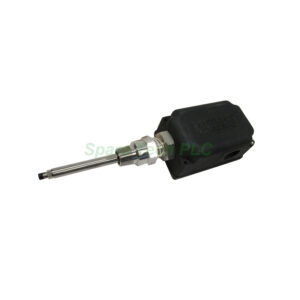
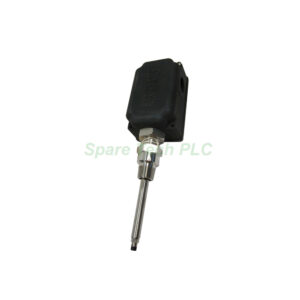
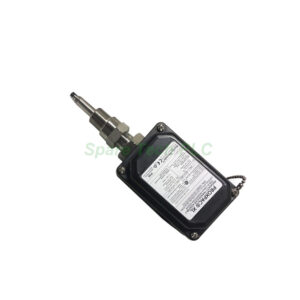
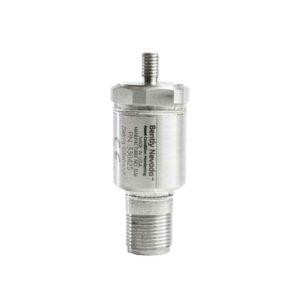
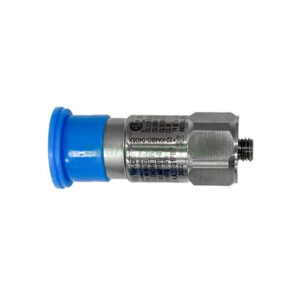
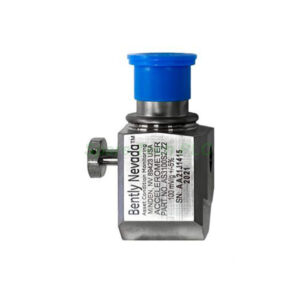
The Vibro-Meter accelerometer is a shear-mode PZT ceramic sensor. It offers a dynamic sensitivity of 500 mV/g with ±5% tolerance at 25°C. This device measures acceleration up to 10 g peak. Its frequency response spans 0.4 Hz to 1,000 Hz within ±10%. For broader needs, the ±3 dB range extends from 0.2 Hz to 2,300 Hz. You can use this sensor for wind turbines, compressors, and pumps. Additionally, it withstands harsh environments from -50°C to 120°C.
Technical Specifications
Sensitivity and Range
The sensor’s core specification is 500 mV/g sensitivity. At room temperature (25°C), the tolerance stays within ±5%. The amplitude nonlinearity is only 1%, which ensures accurate readings. Furthermore, the resonant frequency reaches 15 kHz, far above the operating range. This design avoids mechanical interference near critical speeds.
Frequency Response and Noise
For frequency response, two key ranges matter. First, the ±10% window covers 0.4 Hz to 1,000 Hz. Second, the ±3 dB window spans 0.2 Hz to 2,300 Hz. Meanwhile, broadband electrical noise measures only 8 μg from 2.5 Hz to 25 kHz. Specifically, spectral noise density is 2 μg/√Hz at 10 Hz. At 100 Hz, it drops to 0.4 μg/√Hz. At 1000 Hz, it reaches 0.2 μg/√Hz. Therefore, this Vibro-Meter sensor captures small vibrations clearly.
Electrical Characteristics
You need a voltage source between 18 and 30 Vdc. The current regulating diode accepts 2 to 10 mA. Output impedance is 100 Ω maximum. Bias output voltage is fixed at 10 Vdc. The case is isolated and internally shielded. This grounding scheme prevents ground loops. Additionally, the connector follows MIL-C-5015 style with two pins. Pin A carries power and signal. Pin B is common. The shell connects to ground.
Transverse and Temperature Response
Transverse sensitivity is limited to ±5% of axial reading. For temperature response, expect -10% at -50°C. At +120°C, the response increases by +10%. Hence, you must apply compensation for extreme temperatures. However, the sensor remains functional across the full -50°C to 120°C range.
Mechanical and Environmental Limits
Vibration and Shock Ratings
The vibration limit is 250 g peak. Shock survival reaches 5,000 g peak. Therefore, this Vibro-Meter accelerometer tolerates severe industrial shocks. Base strain sensitivity is very low at 0.0001 g/μstrain. This property minimizes errors from mounting surface flexing.
Electromagnetic and Sealing
Electromagnetic sensitivity is 20 μg/gauss maximum. This rating ensures stable readings near motors or generators. The sensor is hermetically sealed. Consequently, moisture and dust cannot enter the housing. Case material is 316L stainless steel, which resists corrosion.
Physical Attributes
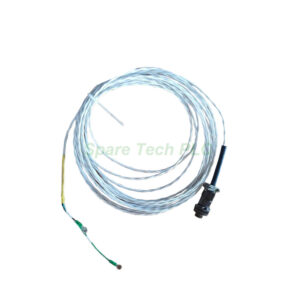
The sensing element uses PZT ceramic in a shear design. Weight is 142 grams. Mounting requires a 1/4-28 UNF tapped hole. The connector exits from the top. For cabling, use shielded twisted pair. Cable length should not exceed 100 feet.
Installation Guide
First, prepare the mounting surface. Clean the 1/4-28 UNF threaded hole thoroughly. Apply a thin layer of grease or anti-seize compound. Next, screw the sensor into place. Tighten to the recommended torque (typically 5 to 10 N·m). Do not overtighten. Meanwhile, route the shielded twisted pair cable away from power cables. Connect the wires to the two-pin MIL-C-5015 connector. Pin A carries power and signal. Pin B is common. The shell connects to earth ground at one point only. Finally, power the sensor with 18-30 Vdc. Check the bias voltage: it should read 10 Vdc at the output.
Packaging List
Vibro-Meter accelerometer (1 unit)
Protective dust cap for connector
Mounting thread lubricant packet
Installation instruction sheet (print)
FAQ
1. Can I use this sensor above 1000 Hz? Yes, but accuracy decreases. The ±3 dB response extends to 2,300 Hz. However, the ±10% specification stops at 1,000 Hz. For precise measurements, stay within 0.4–1000 Hz.
2. What happens if I exceed the 10 g peak range? The sensor may output a clipped signal. Amplitude nonlinearity rises above 1%. Brief overloads up to 250 g peak are safe. But continuous operation above 10 g peak degrades data quality.
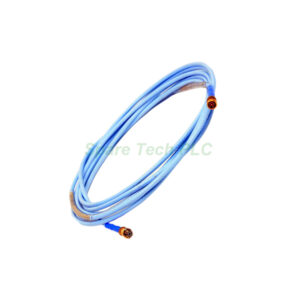
3. Which cable should I buy for this Vibro-Meter model? Use a shielded twisted pair cable. Maximum length is 100 feet. Do not use unshielded cables. For best noise rejection, keep the cable away from variable frequency drives.
4. How do I mount the sensor on a curved surface? You need a flat mounting pad. Drill and tap a 1/4-28 UNF hole. Alternatively, use a stud adapter. Never mount directly on a curved surface. Base strain might introduce errors.
5. Is the sensor suitable for outdoor use? Yes. The hermetic seal and 316L stainless steel case resist moisture. Operating temperature ranges from -50°C to 120°C. However, protect the connector from direct water spray using a boot.
Attention: The above product information is sourced from the internet and cannot be guaranteed to be authentic.
For specific product parameters and prices, please contact
SpareTech PLC professionals in a timely manner.
Brand Name
Bently Nevada
Model No.
AP3500T2-Z1
Product Type
Accelerometer
hasMerchantReturnPolicy
Adjust according to reality
Shippingdetails
Adjust according to reality
This Vibro-Meter accelerometer delivers reliable vibration sensing for industrial monitoring. It features a 500 mV/g sensitivity and a 10 g peak acceleration range. Ideal for predictive maintenance on rotating machinery. SpareTech PLC provides you with a PDF version of the instructions about
Bently Nevada AP3500T2-Z1,
where you can download the
Bently Nevada AP3500T2-Z1 manual PDF for free: Download PDF