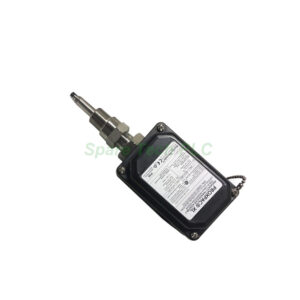
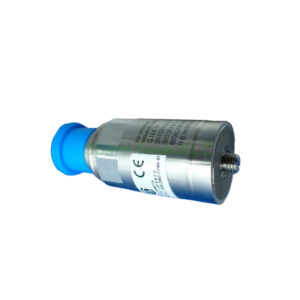
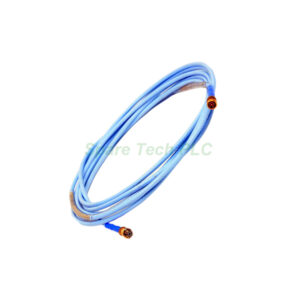
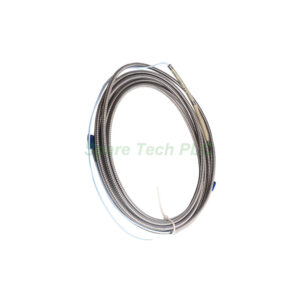
Bently Nevada 330425-02-00 Accelerometer – Complete Technical Guide
Product Introduction
The Bently Nevada 330425-02-00 is a precision acceleration transducer built for industrial vibration monitoring. This model uses an M8 x 1 integral stud, making it ideal for metric mounting applications. You will find it on compressors, pumps, turbines, and fans where reliable data matters. The sensor provides a sensitivity of 10.2 mV/m/s² (100 mV/g) within a ±5% tolerance. Its frequency response spans 10 Hz to 15 kHz, capturing everything from low-speed imbalances to high-frequency bearing defects. Additionally, the 330425-02-00 operates from -55°C to +121°C without performance loss. The case is hermetically sealed and rated IP68, so dust and moisture cannot enter. Because the -00 agency approval option means no country-specific certifications, this model suits global markets without restrictions.
Key Technical Specifications
Sensitivity and Measurement Range
Sensitivity: 10.2 mV/m/s² (100 mV/g) ±5%.
Acceleration range: 490 m/s² (50 g) peak within 10 Hz to 15 kHz.
Amplitude Linearity: ±1% up to 490 m/s² (50 g) peak.
Broadband Noise Floor: 0.039 m/s² (0.004 g) rms from 10 Hz to 15 kHz.
The low noise floor allows you to detect very small vibration changes. However, vibrations above 15 kHz will significantly reduce the usable acceleration range. Therefore, always check your machine's highest frequency before installation.
Frequency Response Details
10 Hz to 15 kHz (600 to 900,000 cpm) within ±3dB.
30 Hz to 10 kHz (1,800 to 600,000 cpm) within ±10%.
This wide response captures both slow roll and high-frequency events. For instance, you can track bearing defects, gear mesh vibrations, or vane pass frequencies effectively.
Electrical and Power Requirements
Input Voltage: -24 ± 0.5 Vdc.
Bias Current: 2 mA nominal.
Output Bias Voltage: -8.5 ± 0.5 Vdc.
Grounding: Case isolated.
Maximum cable length: 305 metres (1000 ft) with no signal degradation.
Ground isolation prevents ground loops that often corrupt low-level signals. Furthermore, the long cable capability allows you to place monitoring electronics far from the machine.
Environmental and Mechanical Limits
Temperature and Humidity Performance
Operating and storage temperature: -55°C to +121°C (-67°F to +250°F).
Relative humidity: 100% condensing, non-submerged.
IP Rating: Equivalent to an IP68 (dust tight and watertight).
The hermetically sealed case ensures reliable operation even in condensing humidity. Nevertheless, remember that the IP68 rating applies to the sensor only, not to the attached cable.
Shock Survivability and Resonance
Shock survivability: 49,050 m/s² (5000 g) peak maximum.
Mounted resonant frequency: Greater than 30 kHz.
Resonant peak amplitude: 20 dB maximum.
Transverse sensitivity: Less than 5% of axial.
These robust specifications protect the Bently Nevada 330425-02-00 from accidental impacts during operation or maintenance. Additionally, low transverse sensitivity minimizes measurement errors from side-to-side motion.
Base Strain Sensitivity – Critical Note
For serial numbers preceded by the letter "G" (all new sensors):
For serial numbers NOT preceded by "G" (shipped before April 2004):
If you own an older unit without the "G" prefix, always install it with the mounting base. This practice reduces base strain sensitivity by a factor of 200. For new units with the "G" prefix, the base is optional but still recommended for best accuracy.
Magnetic Field Susceptibility
This low susceptibility makes the 330425-02-00 suitable for use near generators and large motors.
Physical Dimensions and Mounting
Size, Weight, and Materials
Weight (no cable): 99 g (3.5 oz) typical.
Diameter: 23 mm (0.93 in).
Height: 59 mm (2.3 in) including mounting stud.
Case Material: 316L stainless steel.
Connector: 3-pin MIL-C-5015 receptacle.
The 316L stainless steel provides excellent corrosion resistance for chemical or offshore environments.
Mounting Instructions for M8 Stud
Mounting thread option: 02 – M8 x 1 integral stud.
Mounting surface finish: 32 minch rms.
Mounting torque: 4.1 N·m (3.0 ft·lb).
Mounting angle: Any orientation.
First, clean the mounting surface to achieve the required 32 minch rms finish. Next, apply the recommended torque of 4.1 N·m. Do not overtighten, as this may damage the stud or distort the sensor base. Finally, you can install the sensor horizontally, vertically, or at any angle without affecting performance.
Installation Guide
Pre-Installation Checklist
Inspect the Bently Nevada 330425-02-00 for any visible damage.
Verify the M8 x 1 threaded hole on your machine is clean and undamaged.
Check that the 3-pin MIL-C-5015 connector matches your cable assembly.
Confirm your power supply provides -24 Vdc ±0.5 V.
Cabling and Electrical Connections
Use a low-noise coaxial or twisted-pair cable.
Maximum cable length is 305 metres without signal loss.
Connect the -24 Vdc power supply carefully, observing correct polarity.
The isolated case does not require an external ground connection.
For best results, route the cable away from high-voltage lines and variable frequency drives. This avoids electromagnetic interference. Additionally, secure the cable with strain relief near the connector to prevent mechanical damage.
Packaging List
1 x Bently Nevada 330425-02-00 accelerometer unit
1 x M8 x 1 integral mounting stud (pre-installed)
1 x Protective dust cap for the 3-pin MIL-C-5015 connector
1 x Installation instruction sheet
Note: Cables, connectors, and mounting bases are sold separately. No calibration certificates or warranty documents are included in this package.
Shipping and Delivery
Carriers: FedEx, UPS, DHL
Packaging: Anti-static foam with reinforced cardboard box
Tracking information: Provided within 24 hours after dispatch
Frequently Asked Questions (FAQ)
1. Q: What is the difference between the 330425-01-CN and the 330425-02-00?
A: The main difference is the mounting thread. The -01-CN uses a 1 ¼-28 UNF integral stud (inch thread) with country-specific approval. The 330425-02-00 uses an M8 x 1 metric stud with no agency approvals. All other electrical and environmental specifications remain identical.
2. Q: Can I use this accelerometer on a machine running at 500 RPM?
A: Yes and no. The 10 Hz lower limit equals 600 CPM. For 500 RPM (8.3 Hz), the signal will be attenuated by approximately 3dB. You can still use it for trend monitoring, but for accurate amplitude measurement below 10 Hz, consider a low-frequency velocity sensor instead.
3. Q: What happens if I apply +24 Vdc instead of -24 Vdc?
A: The sensor will not operate correctly and may suffer permanent damage. Always verify your power supply polarity before connection. The Bently Nevada 330425-02-00 requires negative 24 Vdc with respect to common.
4. Q: Do I need the mounting base for a new "G" prefix unit?
A: Not strictly required, but we recommend it. The "G" prefix units already have low base strain sensitivity of 49 mm/s²/mstrain. Adding the mounting base further reduces it to approximately 4.9 mm/s²/mstrain, giving you cleaner low-frequency data.
5. Q: How do I clean the 3-pin MIL-C-5015 connector?
A: Use isopropyl alcohol and a lint-free swab. Do not use contact cleaners containing silicone. Ensure the connector is completely dry before mating. For harsh environments, apply a thin layer of dielectric grease to the pins.