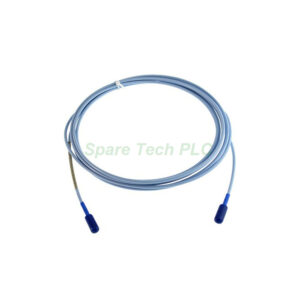
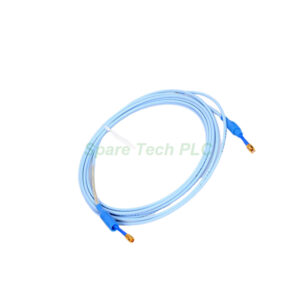
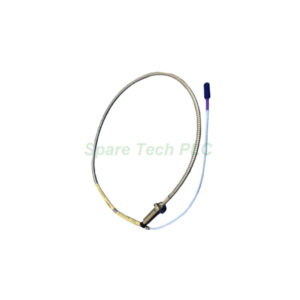
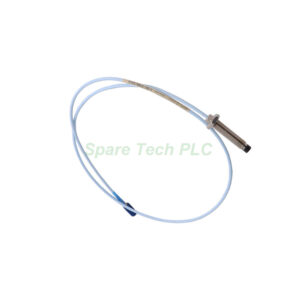
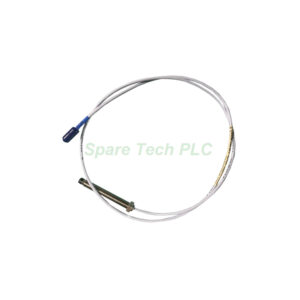
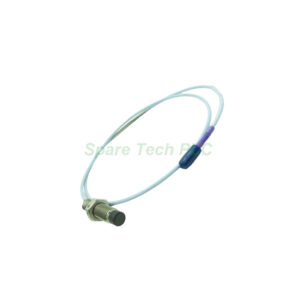
Bently Nevada 330190-085-01-05 3300 XL ETR Armored Extension Cable
Product Introduction
The Bently Nevada 330190-085-01-05 represents a robust solution for demanding industrial monitoring applications. This extension cable features armored construction for superior mechanical protection in harsh environments. It belongs to the 3300 XL series and supports extended temperature range (ETR) operation. Moreover, this model carries critical hazardous area certifications for use in explosive atmospheres. Consequently, it delivers dependable signal transmission where safety and durability are paramount.
Technical Specifications
The Bently Nevada 330190-085-01-05 offers a precise length of 8.5 meters (27.9 feet). Its center conductor to center conductor DC resistance measures 1.87 ± 0.28 Ω. Meanwhile, the outer conductor to outer conductor resistance is 0.56 ± 0.11 Ω. The typical capacitance of this armored extension cable is 69.9 pF/m (21.3 pF/ft). This cable utilizes 75Ω triaxial construction with perfluoroalkoxy (PFA) insulation for extreme temperature resistance. Additionally, its connectors feature gold-plated brass or beryllium copper materials for optimal signal integrity.
Armored Construction and Mechanical Parameters
The 330190-085-01-05 distinguishes itself through its rugged armored design. The armored version weighs significantly more at 103 g/m (1.5 oz/ft), compared to just 34 g/m for standard cables. This added weight reflects the robust protective layer that shields the cable from physical damage. Furthermore, it maintains the same minimum bend radius of 25.4 mm (1.0 inch) as the standard version. The maximum connector torque remains at 0.565 N•m (5 in•lbf). Consequently, this cable withstands crushing forces, abrasion, and impact in heavy industrial settings.
Environmental and Temperature Performance
This extension cable operates reliably across an exceptional temperature spectrum. It supports both operating and storage temperatures from -52°C to +260°C (-62°F to +500°F). For instance, this makes it suitable for gas turbine compartments and steam valve environments. The PFA insulation maintains its dielectric properties even under prolonged heat exposure. Therefore, you can deploy this cable in applications where standard FEP-insulated cables would quickly degrade. Its thermal stability ensures consistent measurement accuracy over extended service life.
Hazardous Area Certifications
The 330190-085-01-05 carries the Agency Approval Option 05, which includes three critical certifications. Specifically, it holds CSA certification for North American hazardous locations. Additionally, it meets ATEX requirements for European explosive atmospheres. It also complies with IECEx standards for international hazardous area installations. These approvals confirm that this cable meets rigorous safety requirements for use in Zone 0, Zone 1, and Zone 2 classified areas. As a result, plant operators can confidently install this cable in oil refineries, chemical plants, and mining operations.
Additional Compliance Standards
Beyond hazardous area approvals, this cable meets numerous other global standards. First, it complies with FCC Part 15 rules for electromagnetic interference. Next, it adheres to the European EMC Directive 2014/30/EU and RoHS Directive 2011/65/EU. For maritime environments, it satisfies the 2019 Rules for Conditions of Classification for both vessels and offshore units. Moreover, this cable supports functional safety ratings of SIL 2 with HFT = 0 and SIL 3 with HFT = 1. These certifications collectively demonstrate its suitability for safety-instrumented systems.
Installation and Field Wiring Recommendations
For field wiring, we recommend using a 3-conductor shielded triad cable with tinned conductors. The acceptable wire gauge ranges from 0.2 to 1.5 mm² (16 to 24 AWG). However, the total field wiring length between the Proximitor Sensor and the monitor must not exceed 305 meters (1,000 feet). Notably, you should consult the frequency response graphs for signal rolloff characteristics at higher frequencies. The linear range for this proximity system starts at approximately 0.25 mm (10 mils) from the target. Furthermore, the linear range extends from 0.25 to 2.3 mm (10 to 90 mils), corresponding to -1 to -17 Vdc. For radial vibration monitoring, we recommend a gap setting of -9 Vdc, which equals about 1.27 mm (50 mils). Finally, this armored cable remains fully interchangeable with non-XL 3300 5 mm and 8 mm components when you observe the minimum bend radius.
Packaging List
Shipping Information
We dispatch all orders via FedEx, UPS, or DHL for reliable worldwide delivery.
Frequently Asked Questions (FAQ)
1. What makes the armored version different from the standard cable?
The armored version includes a rugged protective layer that resists crushing, abrasion, and impact. Consequently, it suits harsh industrial environments where standard cables may suffer damage.
2. Which hazardous area certifications does this cable hold?
This cable carries CSA, ATEX, and IECEx approvals. Therefore, you can install it in explosive atmospheres across North America, Europe, and internationally.
3. Does the armored construction affect the cable's flexibility?
The armored cable maintains the same minimum bend radius of 25.4 mm. However, it is heavier and slightly less flexible than the standard version.
4. Can I use this cable with existing 3300 non-XL systems?
Yes, this cable is electrically and physically interchangeable with non-XL 3300 components. Nevertheless, you must still observe the minimum cable bend radius during installation.
5. What shipping carriers do you use for this product?
We use FedEx, UPS, and DHL as our primary shipping partners to ensure prompt and secure delivery.