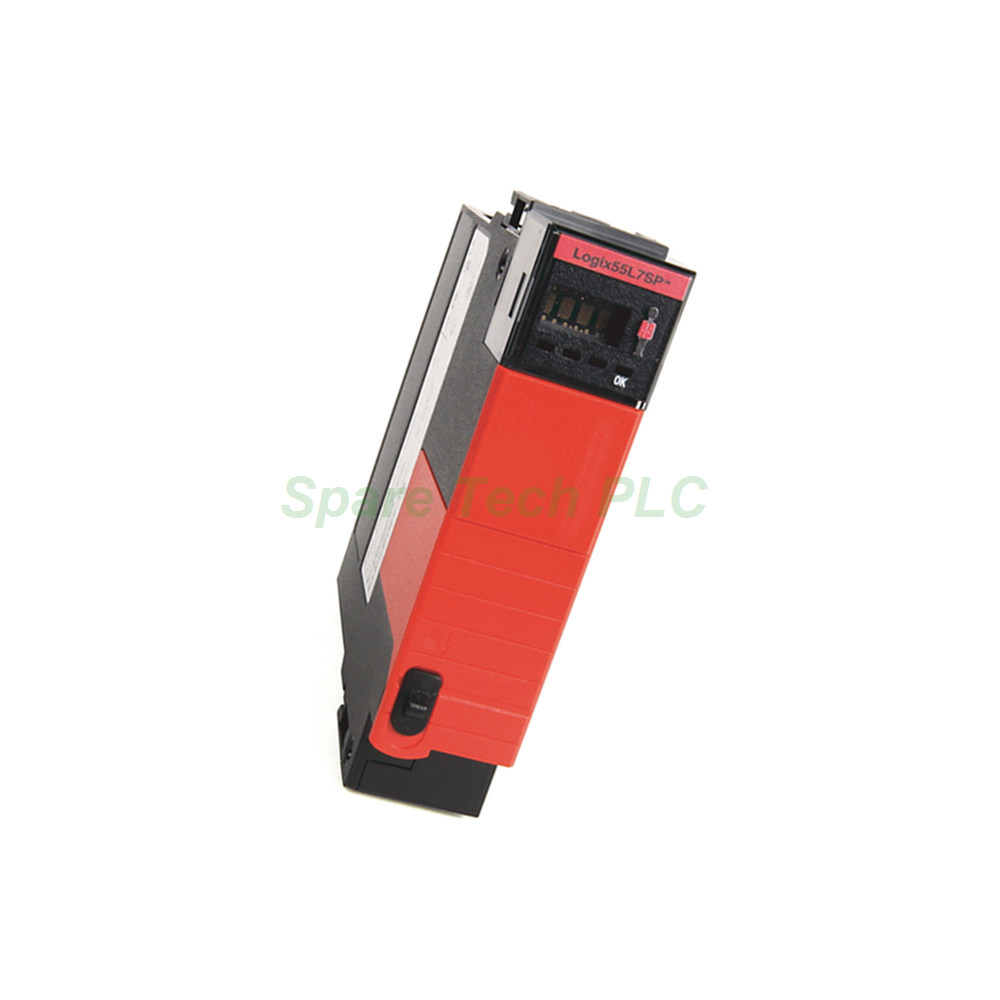
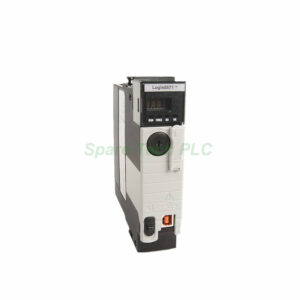
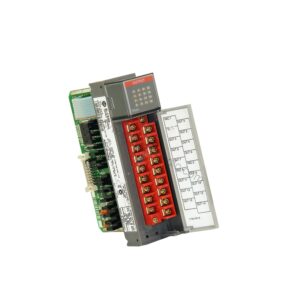
1756-LSP Safety Controller by Allen-Brandley for PAC
Product Introduction
The 1756-LSP from Allen-Bradley is a dedicated safety partner module within the GuardLogix 5560 series. Its primary role is to act as a co-processor, handling safety-related tasks independently from the standard control logic.
This module does not execute standard user programs. Instead, it provides a second, isolated channel for safety functions, which is essential for systems requiring high integrity. Its memory configuration is directly tied to the paired primary controller, ensuring seamless synchronization of safety data.
Technical Specifications and Compatibility
The 1756-LSP is exclusively compatible with three primary controllers: the 1756-L61S, 1756-L62S, and 1756-L63S. Its safety memory capacity changes based on the primary unit used. For instance, pairing it with the 1756-L61S or 1756-L62S provides 1 MB of safety memory. Meanwhile, using it with the 1756-L63S expands this capacity to 3.75 MB.
In terms of power, the module draws 1200 mA at 5.1V DC and 14 mA at 24V DC. Its power dissipation is rated at 3.5 W, while thermal dissipation reaches 11.9 BTU/hr. Furthermore, the isolation voltage is specified at 30V continuous, with a type-tested dielectric strength of 720V DC for 60 seconds between the RS-232 port and the system.
Mechanical and Environmental Ratings
This safety partner module is built to withstand harsh industrial environments. Its operating temperature spans from 0 °C to 60 °C (32 °F to 140 °F), with a non-operating range of -40 °C to 85 °C (-40 °F to 185 °F). Additionally, it can endure an operating shock of 30 g and a non-operating shock of 50 g. The module’s vibration resistance is rated at 2 g over a frequency range of 10 to 500 Hz. Moreover, it functions reliably in a non-condensing humidity range of 5% to 95%.
Installation Guidelines for the 1756-LSP
Proper installation is critical for achieving SIL 3 compliance. The 1756-LSP must be placed in the slot immediately to the right of its paired primary controller. This physical adjacency ensures the dedicated backplane communication required for safety tasks.
The module occupies a single slot. However, because it requires a primary partner, the pair occupies two slots total. It supports various ControlLogix chassis, including the 1756-A4, 1756-A7, 1756-A10, 1756-A13, and 1756-A17. For power, you can use standard supplies like the 1756-PA50, 1756-PA72, 1756-PA75, 1756-PB50, 1756-PB72, or 1756-PB75.
This module does not have its own key switch or primary communication port, besides an RS-232 port for specific functions. Its configuration is managed entirely through the primary controller. A 1756-BA2 battery provides backup for the clock and memory retention.
Packaging and Shipping Information
Each 1756-LSP unit ships with the following items:
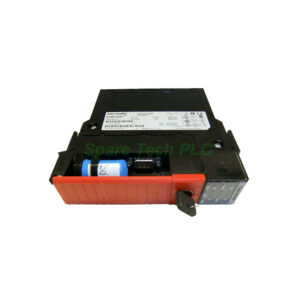
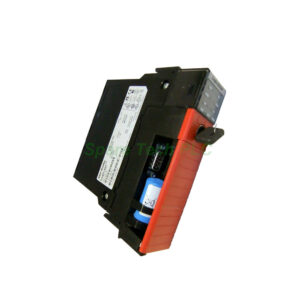
The 1756-LSP safety partner module itself.
A nonvolatile CompactFlash memory card.
A 1756-BA2 lithium battery (0.50 g).
All shipments are handled via trusted global carriers, including Fedex, UPS, and DHL. The module’s dimensions are 27 x 17 x 7 centimeters, and the gross weight is approximately 0.7 lbs (0.32 kg).
Frequently Asked Questions (FAQ)
1. What is the main function of the 1756-LSP?
The 1756-LSP acts as a safety co-processor, providing a redundant, isolated channel for executing safety functions independently from the primary controller.
2. How much safety memory does the 1756-LSP have?
Its safety memory is not fixed; it mirrors the primary controller. It provides 1 MB with the 1756-L61S or -L62S, and 3.75 MB with the 1756-L63S.
3. Does the 1756-LSP require its own power supply?
No, it draws power from the ControlLogix chassis backplane. The chassis requires a compatible standard power supply, such as the 1756-PB75.
4. Which chassis are compatible with the 1756-LSP?
It fits in any standard ControlLogix chassis, including the 1756-A4, -A7, -A10, -A13, and -A17. Remember to install it in the slot to the right of the primary controller.
5. What is the temperature range for operating the 1756-LSP?
The module operates reliably within a temperature range of 0 °C to 60 °C (32 °F to 140 °F). For storage, it can withstand temperatures from -40 °C to 85 °C (-40 °F to 185 °F).