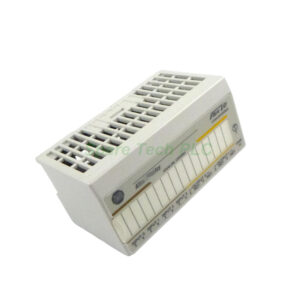
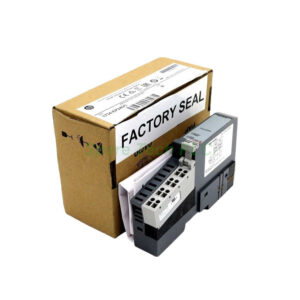
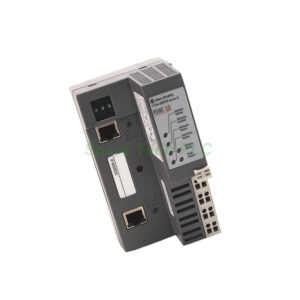
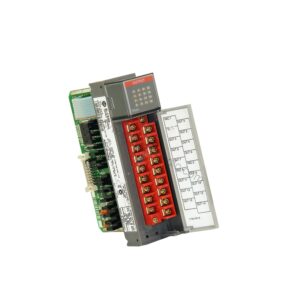
Allen-Bradley 1794-OW8XT Flex I/O Relay Output Module
Robust Relay Switching for Demanding Applications
The 1794‑OW8XT provides eight isolated relay outputs. Each channel is normally open and electrically isolated from others. Therefore, you can mix AC and DC loads on the same module. For instance, control a 120V AC motor starter on channel 0 and a 24V DC solenoid on channel 1.
Additionally, this module has a conformal coating. This coating protects against moisture, dust, and high temperatures. Consequently, the 1794‑OW8XT works reliably in harsh industrial environments. The compact Flex I/O design saves panel space while delivering robust switching performance.
Technical Specifications of the 1794-OW8XT
Outputs: 8 relay, normally open, isolated
Supply voltage range: 19.2 to 31.2V DC
Current draw: 126mA at 24V DC
Relay contact rating: 250V AC
Initial contact resistance: 30 mΩ (max)
Bounce time: 1.2ms
Switching frequency: 1 operation per 3 seconds (0.3Hz at rated load)
Off‑state leakage current: 1.0mA through snubber circuit
Minimum contact load: 100 μA at 100 mV DC
Furthermore, the 1794‑OW8XT has a FlexBus current of 5V DC. Power dissipation is 5.5W. Thermal dissipation reaches 18.8 BTU/hr max. These ratings ensure stable operation under continuous use.
Protective Features and Recommended Practices
The module includes a snubber circuit across each relay contact. This snubber reduces arcing when switching inductive loads. However, the snubber also creates 1.0mA off‑state leakage current. Keep this in mind when switching very sensitive loads.
Moreover, Allen‑Bradley recommends adding external fusing to each output channel. Fuses protect the relay contacts from overcurrent damage. For AC loads, use fast‑blow fuses rated for the load current. For DC loads, consider adding a flyback diode across inductive devices.
Terminal Base Compatibility and Mounting
The 1794‑OW8XT requires a terminal base unit. Compatible bases include the 1794‑TB2, 1794‑TB3, 1794‑TB3S, 1794‑TB3T, and 1794‑TB3TS series. The terminal base holds all field wiring connections.
Mount the module on a DIN rail. For proper grounding, use a zinc‑plated yellow‑chromate steel DIN rail. This rail ensures a low‑impedance ground path. Ground the DIN rail to the system ground bus bar. Additionally, a trained technician should perform installation and startup.
Environmental and Mechanical Ratings
Storage temperature: –40 to 85 °C (–40 to 185 °F)
Operating temperature: 0 to 55 °C (32 to 131 °F)
Dimensions: 46 x 94 x 53 mm (1.8 x 3.7 x 2.1 inches)
Conformal coating: Yes, for humidity and contamination protection
Installation Guidelines for the 1794-OW8XT
First, mount the terminal base on the DIN rail. Next, snap the 1794‑OW8XT into the base. Then, connect your field wiring to the terminal base screw terminals. For AC loads, route power wires away from low‑voltage signals.
After wiring, connect the external 24V DC supply to the terminal base. Finally, test each relay channel with a multimeter before connecting actual loads. Verify that contacts open and close correctly.
⚠️ Always disconnect power before removing or inserting the 1794‑OW8XT. Do not exceed the 250V AC contact rating. Add external fuses to protect against short circuits.
Packaging List
1794‑OW8XT module (one unit)
Conformal coating label (pre‑applied)
Quick start reference card
Note: Terminal base is sold separately. No certificate or warranty documents are included. Shipping via FedEx, UPS, or DHL.
Frequently Asked Questions (FAQ)
1. Can the 1794‑OW8XT switch both AC and DC loads?
Yes, each relay channel is isolated. You can switch 250V AC or 30V DC loads. Mixing AC and DC on different channels is allowed.
2. Why does the 1794‑OW8XT have off‑state leakage current?
The internal snubber circuit creates 1.0mA leakage. This snubber reduces arcing. For very sensitive loads like LED indicators, add a bleed resistor.
3. What happens if I exceed the switching frequency?
The 1794‑OW8XT has a maximum switching frequency of 0.3Hz (one operation per 3 seconds). Exceeding this may cause relay overheating and premature failure.
4. Is external fusing really necessary for the 1794‑OW8XT?
Yes, Allen‑Bradley strongly recommends fusing each output channel. Internal overload protection is not provided. Fuses prevent contact welding during overloads.
5. Can I replace the 1794‑OW8XT without removing wiring?
Absolutely. The terminal base holds all wiring. You can snap out the faulty module and insert a new 1794‑OW8XT without touching the field connections.