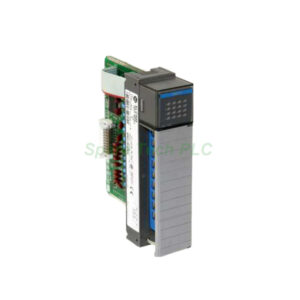
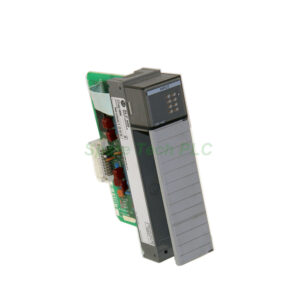
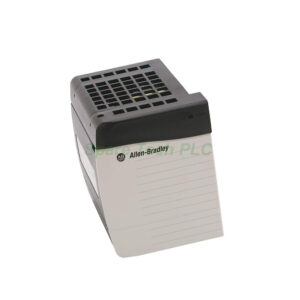
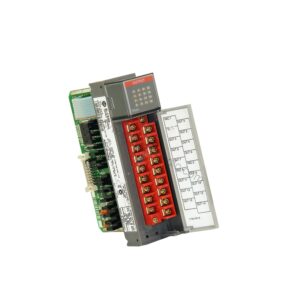
1746-INT4 Allen-Bradley SLC 500 Isolated Thermocouple/mV Input Module
Product Introduction
The 1746-INT4 from Allen‑Bradley brings four isolated inputs to your SLC 500 chassis. You can connect thermocouple types C, D, J, K, T, E, R, S, B, and N. Alternatively, use it for –100…100 mV DC signals. This module uses a sigma‑delta ADC with an 8 Hz bandwidth. Its cold junction compensation maintains ±1.5 °C accuracy from 0…70 °C. Additionally, the 1746-INT4 provides open‑circuit detection with upscale, downscale, or zero options. For consistent performance, field calibration is required once per year.
Key Technical Specifications
The 1746-INT4 operates with a backplane current of 110 mA at 5V DC and 85 mA at 24V DC. Its total power dissipation is only 0.6 W. Resolution is 16 bits, and update time equals 500 milliseconds. Step response reaches 100 ms input to 2.5 ms output. Moreover, the module supports –50…50 mV and –100…100 mV DC ranges. Input impedance stays above 10 MΩ. Normal mode rejection exceeds 60 dB at 60 Hz, while common mode rejection surpasses 120 dB with 1 kΩ unbalance.
For thermocouple linearization, the 1746-INT4 follows IPTS‑68, NBS MN‑125, and NBS MN‑161. You can select temperature display in °C or °F with 0.1° resolution. Millivolt scaling offers 0.1 mV or 0.01 mV steps. Open‑circuit detection time is typically 5 seconds. Bandwidth is fixed at 8 Hz.
Isolation and Protection Features
Channel‑to‑channel and channel‑to‑backplane isolation withstands 1000 V transient or 150 V AC. This protects your SLC 500 backplane from field wiring faults. Furthermore, each of the four channels is individually isolated. Five LED indicators show channel status (four LEDs) and module health (one LED). When an open circuit occurs, you can configure the output as upscale, downscale, or zero.
Mechanical and Environmental Ratings
Operating temperature ranges from 0…60 °C (32…140 °F). Non‑condensing humidity is allowed from 5 % to 95 %. The module carries CE, CSA, and UL certifications. Its compact size fits any SLC 500 chassis slot. Meanwhile, the 1746-INT4 weighs only 0.35 kg, making it easy to handle during installation.
Installation Guidelines
First, always power down the SLC 500 chassis before inserting or removing the 1746-INT4. Next, align the module with the card guides and push firmly until the top and bottom latches click. Then, connect your thermocouple or mV wiring using shielded twisted‑pair cables. For thermocouples, maintain proper polarity. Additionally, keep signal wires away from AC power lines to reduce noise. Finally, configure the module’s channels via your SLC 500 programming software. Select the correct sensor type and open‑circuit behavior. Remember: field calibration is required annually.
Typical Applications
You will find the 1746-INT4 in industrial ovens, furnaces, plastic molding machines, and laboratory test stands. It also suits temperature monitoring in chemical reactors and HVAC systems. Because it accepts multiple thermocouple types, one module can handle diverse temperature zones. For instance, use Type K for general‑purpose heating and Type R for high‑temperature processes up to 1768 °C.
Packaging List
1746-INT4 module – 1 unit
Installation instructions (printed) – 1 copy
Terminal block (removable) – 1 piece
Label sheet for channel identification – 1 sheet
Note: No certificates or warranty documents are included in the package.
Shipping
We ship via FedEx, UPS, or DHL. Standard transit time is 3–7 business days depending on your location.
Frequently Asked Questions (FAQ)
1. Can I mix thermocouple types on different channels of the same 1746-INT4?
Yes, each channel is independently configurable. You can assign Type J to channel 0, Type K to channel 1, and so on.
2. What happens if a thermocouple wire breaks during operation?
The 1746-INT4 detects the open circuit in about 5 seconds. You select the response: upscale (full scale), downscale (minimum value), or zero.
3. Does the 1746-INT4 require external power?
No. It draws all necessary power from the SLC 500 backplane (110 mA at 5 V and 85 mA at 24 V).
4. How often must I calibrate this module?
Allen‑Bradley requires field calibration at least once every 12 months to maintain specified accuracy.
5. Can I use the 1746-INT4 with millivolt signals from pressure transducers?
Absolutely. It accepts –50…50 mV and –100…100 mV DC. This makes it suitable for many analog sensors besides thermocouples.