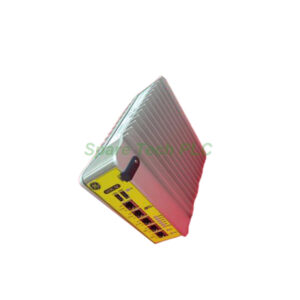
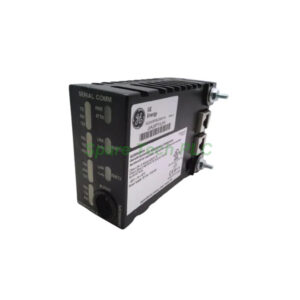
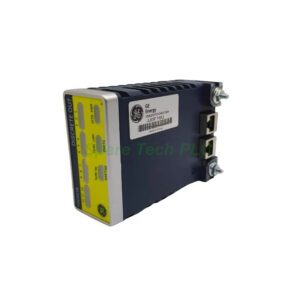
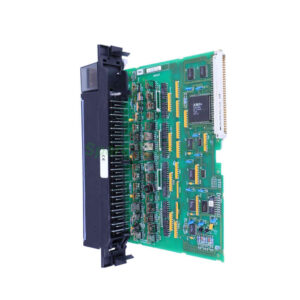
IS420YDIAS1B GE Mark VIeS Discrete Contact Input Module
Product Introduction
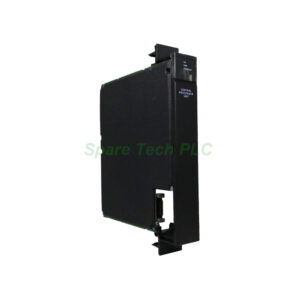
The IS420YDIAS1B belongs to GE’s Mark VIeS functional safety series. This discrete contact I/O module creates an electrical interface between one or two I/O Ethernet networks and a discrete input terminal board. Inside, a common processor board works alongside an acquisition board specific to the discrete input function.
Specifically, the IS420YDIAS1B accepts up to 24 contact inputs. It also reads terminal board-specific feedback signals. Three different voltage levels are supported. System input arrives through dual RJ-45 Ethernet connectors and a three-pin power connector. Discrete signal input uses a DC-37 pin connector that mates directly with the associated terminal board.
Key Technical Specifications
The IS420YDIAS1B provides 24 relay channels. Input isolation reaches 1500 V. Input filter AC voltage rejection handles 125 V dc. The module uses surface mount technology.
Physical dimensions measure 8.26 cm high x 4.19 cm wide x 12.1 cm deep. Operating temperature spans -40°C to 70°C. The module is manufactured in the United States. Reference manual GEH-6855 provides complete documentation.
Input Circuit Design
The discrete input acquisition board provides second-stage signal conditioning. It also handles level shifting to interface terminal board inputs with control logic. Initial signal conditioning happens on the terminal board.
Each input circuit uses a comparator with a variable threshold. An opto-coupler isolates every input from the control logic. An isolated power supply supports this isolation. Note that inputs are not isolated from each other, only from the logic side.
All 24 inputs include filtering and hysteresis. A yellow status LED accompanies each input. This LED turns ON when the input picks up. The LED stays OFF when the input drops out.
Threshold and Voltage Detection
The input threshold derives from the contact wetting voltage input terminal. In most cases, this voltage scales to provide a 50% input threshold. The circuit clamps this threshold to 13%. This clamping prevents an indeterminate state if the contact-wetting voltage drops to zero.
Furthermore, an under-voltage detector monitors the contact wetting voltage. If this voltage drops below 40% of nominal, the detector annunciates the condition to the control system. A special test mode also exists. This mode forces inputs directly from the control pack.
Self-Diagnostic Testing
Every four seconds, the IS420YDIAS1B performs a self-test. The threshold pulses high and then low. The system checks the response of all opto-couplers. Any non-responding inputs trigger an alarm. This diagnostic ensures reliable operation in safety-critical applications.
Terminal Board Compatibility
The contact input module consists of two orderable parts. First, the I/O pack itself is the IS420YDIAS1B. Second, a contact input terminal board completes the assembly. Multiple DIN-rail mounted terminal boards are available. These provide different contact voltages, redundancy options, and terminal block styles.
Two common terminal board types include the Simplex Contact Input (STCI) terminal board and the Contact Input (TBCI) terminal board. The TBCI board offers TMR capability. However, you can also use it in simplex configuration with a single IS420YDIAS1B I/O pack.
Redundancy Configurations
The IS420YDIAS1B works in both simplex and TMR configurations. Select the configuration that best addresses your availability and SIL level requirements. For TMR I/O configuration, the controller performs 2-out-of-3 voting on the discrete inputs.
For dual I/O configuration, controllers listen to the first reporting IS420YDIAS1B I/O pack. No voting occurs in dual configuration. This flexibility allows you to scale safety integrity levels according to application needs.
Installation Guidelines
First, mount the appropriate terminal board on a DIN rail. Next, plug the IS420YDIAS1B directly into the terminal board connector. Then, secure the I/O pack using the provided mounting hardware. After mechanical installation, connect one or two Ethernet cables to the RJ-45 ports.
Connect the three-pin power input to a suitable 28 V dc supply. Finally, apply power and verify the indicator LEDs respond correctly. Use ToolboxST software to configure the module and monitor input status.
Visual Diagnostics and LEDs
Eight or more LED indicators provide visual feedback. Each of the 24 input channels has a dedicated yellow LED. Additional status LEDs indicate power, communication health, and diagnostic conditions. The OT LED indicates over-temperature warnings when applicable.
Transition Words for Clarity
Specifically, the IS420YDIAS1B suits safety-critical discrete input applications. Moreover, its 1500V isolation protects control logic from field wiring faults. Furthermore, the self-test every four seconds ensures opto-coupler health. Therefore, undetected failures become highly unlikely. Additionally, the wide temperature range supports outdoor turbine installations.
Why Choose the IS420YDIAS1B?
This discrete input module delivers reliable contact monitoring for Mark VIeS systems. Its variable threshold comparator adapts to different contact wetting voltages. The built-in under-voltage detector alerts operators before signals become unreliable.
Because the IS420YDIAS1B supports simplex and TMR, you can use it in various safety integrity configurations. The yellow LEDs per channel simplify troubleshooting. The four-second self-test meets demanding safety standards for SIL-rated systems.
Packaging List
IS420YDIAS1B Discrete Contact I/O Module (1 unit)
Anti-static protective bag (1 piece)
Foam padding for shipment protection (1 set)
Cardboard shipping carton (1 piece)
Note: No certificates or warranty documents are included in this package.
Shipping Information
All orders ship via FedEx, UPS, or DHL. Tracking numbers are provided within 24 business hours.
Frequently Asked Questions (FAQ)
1. What terminal boards work with the IS420YDIAS1B?
It works with STCI (simplex) and TBCI (TMR) terminal boards, among others.
2. Are the 24 inputs isolated from each other?
No. Each input isolates from the control logic, but inputs share a common reference.
3. How often does the self-test run?
A self-test runs every four seconds, pulsing the threshold high and low.
4. What happens when contact wetting voltage drops below 40%?
The under-voltage detector annunciates this condition to the control system.
5. Can I use the IS420YDIAS1B in a TMR configuration?
Yes. Use the TBCI terminal board. The controller performs 2-out-of-3 voting on inputs.