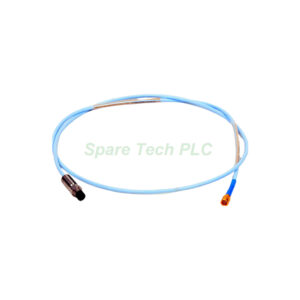
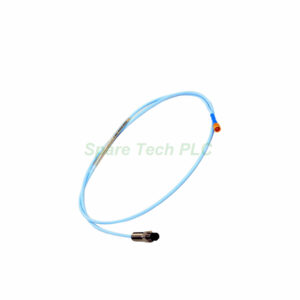
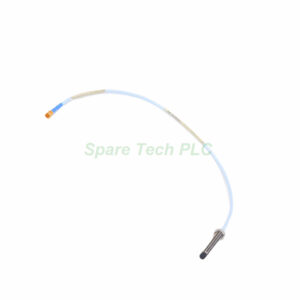
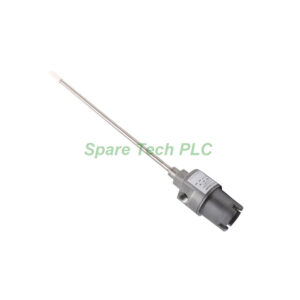
Bently Nevada 330105-02-12-30-12-CN 3300 XL Reverse Mount Probe
Product Introduction
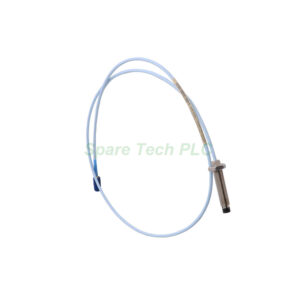
The Bently Nevada 330105-02-12-30-12-CN is a precision 3300 XL 8 mm reverse mount probe. It measures vibration and radial position in turbines, compressors, and pumps. This model includes country-specific agency approvals for hazardous locations.
The probe features a polyphenylene sulfide (PPS) tip for durability. Its case uses AISI 303 or 304 stainless steel (SST). The 3/8-24 UNF thread is common in North American machinery. Total length reaches 3.0 meters, including the probe and attached cable.
Additionally, the Miniature ClickLoc coaxial connector (option -12) includes FluidLoc cable technology. However, most 330105 and 330106 installations do not need FluidLoc due to the existing probe sleeve. Evaluate your application carefully before ordering this option.
Technical Specifications
Electrical Characteristics
The nominal DC resistance (RPROBE) from center to outer conductor is 8.17 ± 0.50 Ω for the 3.0 meter length. This value ensures consistent signal quality. The probe uses a 75Ω triaxial cable with fluoroethylene propylene (FEP) insulation.
For extended temperature ranges, a perfluoroalkoxy (PFA) insulated cable is available. Optional flexible armor uses AISI 302 or 304 SST with an FEP outer jacket.
Mechanical Details
Probe tip material: Polyphenylene sulfide (PPS)
Probe case material: AISI 303 or 304 stainless steel (SST)
Probe case thread: 3/8-24 UNF
Maximum thread engagement: 0.563 inch (14.3 mm)
Connector material: Gold-plated brass or gold-plated beryllium copper
Weight: 323 g per meter (11.4 oz per meter)
Dimensions (packaged): 20.4 cm x 22.2 cm x 3.7 cm
Environmental Ratings
The standard probe operates from -52°C to +177°C (-62°F to +350°F). The extended temperature range probe handles -52°C to +218°C (-62°F to +425°F) at the tip and -51°C to +260°C (-60°F to +500°F) at the cable and connector.
Important note: Exposing the probe to temperatures below -34°C (-30°F) may cause premature pressure seal failure.
Humidity and Pressure Performance
Humidity testing shows less than a 3% change in Average Scale Factor (ASF) after 56 days at 93% relative humidity (IEC 68-2-3). The probe seals differential pressure between the tip and case using a Viton® O-ring. Probes are not pressure tested before shipment.
Hazardous Area Approvals
The -CN agency approval option provides country-specific certifications for explosive atmospheres.
Intrinsically Safe (ia) Installation
When installed with intrinsically safe zener barriers (drawing 141092) or galvanic isolators, the probe meets:
Class I, Zone 0: AEx/Ex ia IIC T5...T1 Ga
Class I, Groups A, B, C, D
Class II, Groups E, F, G
Class III
Non-incendive (nA, ec) Installation
When installed with non-incendive circuit connection (drawing 140979), the probe meets:
Class I, Zone 2: AEx/Ex nA IIC T5…T1 Gc
Class I, Division 2, Groups A, B, C, D
Class I, Zone 2: AEx/Ex ec llC T5…T1 Gc
Temperature Schedule for EPL Ga and Gc (Probe Only)
Temperature Schedule for EPL Dc
Mechanical and Installation Guide
Thread and Mounting
The 3/8-24 UNF thread is standard for many American-made turbine housings. Maximum thread engagement is 0.563 inch (14.3 mm). The reverse mount design allows installation in tight spaces where standard probes cannot fit.
Cable and Connector Handling
The Miniature ClickLoc coaxial connector provides a secure push-pull locking mechanism. This gold-plated connector ensures low contact resistance. The FluidLoc cable option adds extra fluid ingress protection. Nevertheless, most 330105 installations do not need this feature because the probe sleeve already provides adequate sealing.
Tensile Strength Limits
Do not exceed 330 N (75 lbf) of pull force between the probe case and probe lead. Additionally, do not exceed 270 N (60 lbf) at the connection between the probe lead and extension cable. Exceeding these limits can damage internal connections.
Installation Best Practices
First, inspect the mounting hole threads to ensure they are clean and undamaged. Next, hand-tighten the probe into the housing until it seats lightly. Then, use a wrench to tighten no more than 0.563 inch of thread engagement.
Furthermore, avoid bending the probe cable sharply near the connector or probe case. The minimum bend radius is approximately 50 mm for the standard FEP cable. For armored cable, maintain a larger radius to prevent kinking.
Finally, verify the DC resistance after installation. A reading outside 8.17 ± 0.50 Ω may indicate a damaged cable or connector. For hazardous area installations, follow the applicable installation drawings (141092 for intrinsic safety or 140979 for non-incendive circuits).
Packaging List
1 x Bently Nevada 330105-02-12-30-12-CN probe assembly (3.0 meter total length)
1 x Miniature ClickLoc coaxial connector (FluidLoc option -12)
1 x Installation sheet (basic guidelines)
Note: No calibration certificate or warranty document is included. Contact your supplier for warranty terms.
Shipping Method
All orders ship via FedEx, UPS, or DHL. Tracking number will be provided after dispatch.
Frequently Asked Questions (FAQ)
1. What does the -CN agency approval option include?
The -CN option provides country-specific hazardous area certifications. For this Bently Nevada 330105 probe, it includes intrinsic safety (ia) for Zone 0 and non-incendive (nA/ec) for Zone 2 and Class I Division 2.
2. Can I use this probe without the FluidLoc cable option?
Yes. The -12 FluidLoc cable is optional. For most standard applications, the probe sleeve provides sufficient sealing. Only order FluidLoc if your environment involves continuous fluid immersion or high-pressure washing.
3. How do I check if my Bently Nevada 330105 probe is damaged?
Measure the DC resistance between center and outer conductors. For this 3.0 meter probe, the value should be 8.17 ± 0.50 Ω. A short circuit or open circuit indicates damage.
4. What is the difference between the 330105 and 330106 models?
Both are 8 mm reverse mount probes. The 330105 typically uses a 3/8-24 thread, while the 330106 uses an M10 x 1 metric thread. Choose based on your housing thread type.
5. Is this probe compatible with Bently Nevada extension cables?
Yes, the Miniature ClickLoc connector mates directly with standard Bently Nevada extension cables. Ensure the extension cable also uses the same connector type and matches the hazardous area rating.