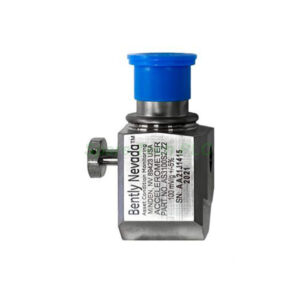
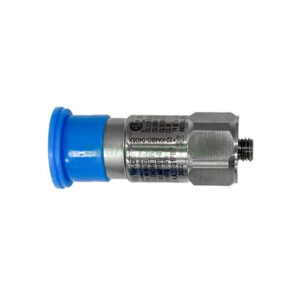
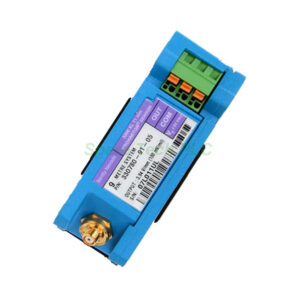
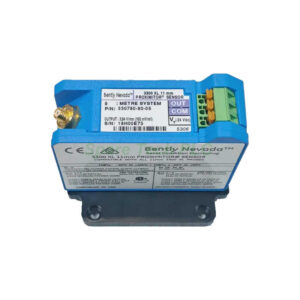
Bently Nevada 181M6049 Dual Output Vibration & Temperature Sensor
Integrated Vibration and Temperature Measurements
The Bently Nevada 181M6049 eliminates the need for two separate sensors. Its accelerometer channel offers 100 mV/g dynamic sensitivity with ±5% accuracy at 25°C. The acceleration range reaches 60 g peak. Amplitude nonlinearity stays at only 1%, ensuring faithful signal reproduction.
For thermal monitoring, this dual output sensor provides a dedicated temperature channel. Output sensitivity is 10 mV/°C. The measurement range runs from 2°C to 120°C. Temperature response shifts by -10% at -50°C and +10% at +120°C for the vibration side.
Electrical Specifications for Both Channels
The Bently Nevada 181M6049 requires an 18-28 Vdc voltage source. It uses a current regulating diode from 2 to 10 mA. Broadband electrical noise measures 700 µg from 2.5 Hz to 25 kHz.
Spectral electrical noise values are consistently low. At 10 Hz, it is 10 μg/√Hz. At 100 Hz and 1000 Hz, it drops to 5 μg/√Hz. Output impedance is 100 Ω max. Bias output voltage for the accelerometer channel is 12 Vdc.
The case is isolated and internally shielded. This design prevents ground loop interference effectively. For instance, you can mount it on painted or coated surfaces without signal degradation.
Temperature Sensor Details
The integrated temperature sensor makes this 181M6049 unique among accelerometers. Its output sensitivity is exactly 10 mV/°C. At 25°C room temperature, you read 250 mV. At 80°C, you get 800 mV.
Measurement range starts at 2°C and ends at 120°C. Below 2°C, the output is not specified for accuracy. Above 120°C, the vibration channel may drift beyond its temperature response limit.
The temperature signal shares Pin B common with the accelerometer. Use Pin C for temperature signal output. This pin arrangement keeps cabling simple and organized.
Mechanical and Environmental Limits
Temperature range spans -50°C to +120°C for the entire unit. Vibration limit reaches 500 g peak for survival. Shock limit is an extreme 5,000 g peak. Electromagnetic sensitivity equals 70 μg/gauss max.
Sealing is hermetic to block moisture, dust, and contaminants. Base strain sensitivity is very low at 0.0002 g/μstrain maximum. This ultra-low value prevents false vibration readings from mounting surface flex. Many competing sensors offer ten times higher strain sensitivity.
The sensing element uses PZT ceramic in shear mode. Weight is only 90 grams, which is remarkably light. Case material is 316L stainless steel for excellent corrosion resistance.
Mounting uses a ¼-28 UNF tapped hole in the sensor base. You screw it onto a stud or directly into a prepared machine surface. Always use a clean, flat mounting surface for best results.
Connector and Cabling Guide
The connector is a 3-pin MIL-C-5015 style industrial standard. Pin functions are clearly defined for easy wiring:
Shell – ground and case connection
Pin A – accelerometer power (18-28 Vdc) and dynamic signal output
Pin B – common return for both accelerometer and temperature sensor
Pin C – temperature sensor signal output (10 mV/°C)
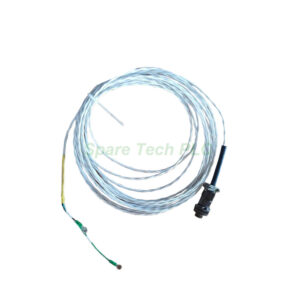
Recommended cabling comes in two options. Use 16925-XX for non-armored applications in clean environments. Use 16710-XX with armor for harsh industrial settings with abrasion or crushing risks. Always use shielded twisted pair wiring for best noise rejection.
Why Choose This Dual Output Sensor
The 181M6049 saves significant installation space and cost. One sensor provides two critical parameters for machine health monitoring. You avoid drilling two separate mounting holes and running two cables.
The 100 mV/g vibration sensitivity matches standard industrial accelerometers. Meanwhile, the temperature output helps detect thermal changes before bearing failure occurs. Additionally, the hermetic seal allows installation in dirty or humid environments without reliability concerns.
Weight is only 90 grams, which reduces mechanical stress on small mounting points. Base strain sensitivity of 0.0002 g/μstrain is among the lowest in its class. Therefore, you get reliable data even when mounting on thin or flexible surfaces like pump casings or gearbox covers.
Packaging List
Bently Nevada 181M6049 dual output sensor (90 g, 316L stainless steel)
Protective dust cap for 3-pin MIL-C-5015 connector
Mounting torque specification sheet
Quick start wiring and installation guide
Shipping: Fedex, UPS, DHL
Frequently Asked Questions
1. Can I use only the vibration channel and ignore the temperature output?
Yes, absolutely. Leave Pin C unconnected if you do not need temperature. The 181M6049 functions perfectly as a standalone accelerometer. However, you must still supply power to Pin A and common to Pin B for the vibration channel to operate.
2. What is the maximum cable length for this dual output sensor?
Keep total cable length under 100 feet for both channels. Longer cables increase noise pickup and may degrade high-frequency vibration signals above 5 kHz. The temperature channel is less sensitive to cable length, but keeping both under 100 feet is best practice.
3. Does the temperature sensor require separate power or excitation?
No, it does not. The Bently Nevada 181M6049 draws all its operating power from Pin A (18-28 Vdc). The temperature output on Pin C is a passive voltage signal referenced to Pin B common. No additional excitation is needed.
4. How do I convert the temperature output to degrees Celsius?
Measure the voltage on Pin C relative to Pin B using a DC voltmeter. Subtract any system offset. Then divide by 10 mV/°C. For example, 500 mV equals 50°C. 250 mV equals 25°C. The specified measurement range is 2°C to 120°C.
5. What happens if I exceed the 60 g peak acceleration range?
The 181M6049 may clip or distort the output signal above 60 g peak. Short-duration shocks up to 5,000 g peak will not damage the sensor mechanically. However, continuous vibration above 60 g peak will produce non-linear and inaccurate readings. Reduce machine speed or use a lower-sensitivity sensor for high-amplitude applications.