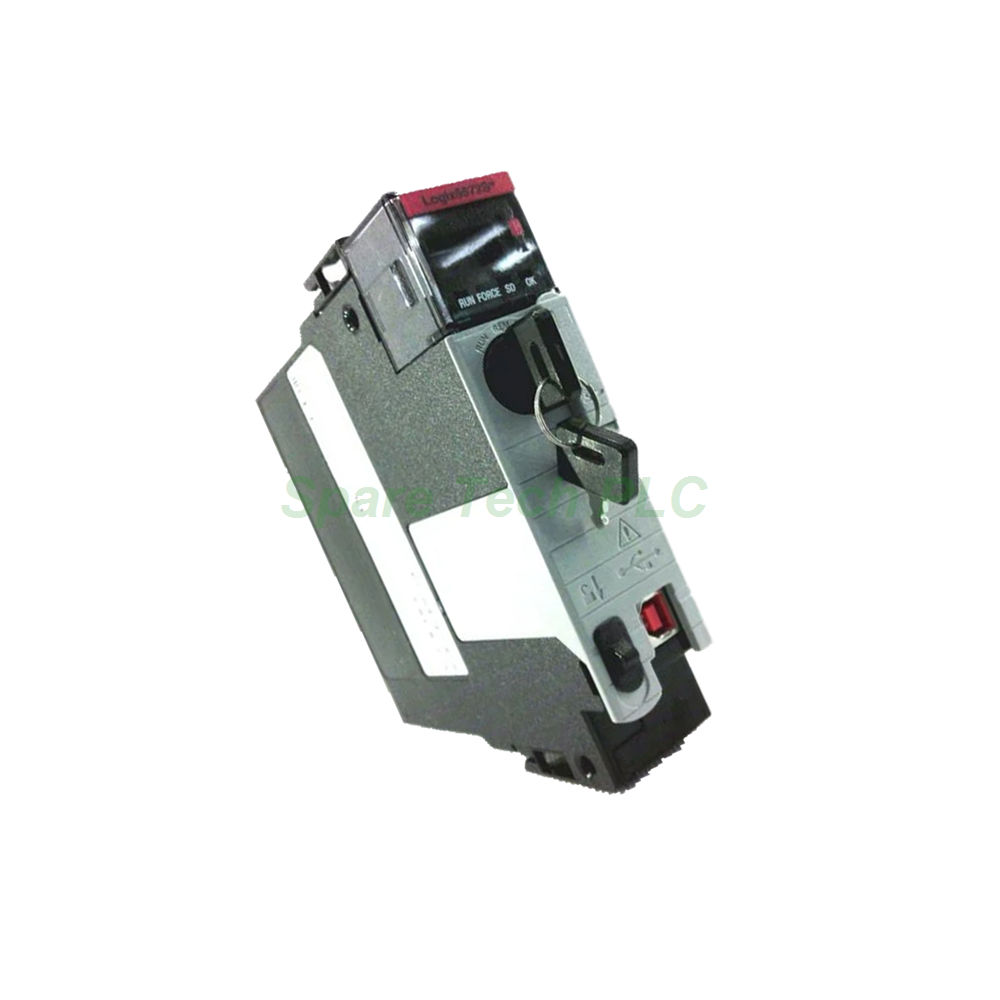
Allen-Bradley 1756-L72S GuardLogix 5570 Programmable Automation Controller
Product Introduction
The Allen-Bradley 1756-L72S is a high-performance GuardLogix 5570 Programmable Automation Controller (PAC). It belongs to the trusted Logix5000 family of controllers. This controller integrates both standard automation and functional safety capabilities into a single platform. Specifically, the 1756-L72S serves as the primary controller in a dual-processor safety architecture. It requires a dedicated safety partner, the 1756-L7SP, to achieve the highest safety ratings. Together, they form a system rated for Safety Integrity Level 3 (SIL 3) , Performance Level e (PL e) , and Category 4 (Cat. 4) . Therefore, this design is ideal for machinery safety, process safety, and critical infrastructure protection. Furthermore, the 1756-L72S uses environmentally friendly energy storage modules instead of traditional lithium batteries. Consequently, this feature reduces maintenance requirements and environmental impact. Additionally, the controller includes a pre-installed 1 GB Secure Digital card for non-volatile storage.
Technical Specifications
The 1756-L72S controller comes equipped with 4 MB of standard user memory. It also features 2 MB of dedicated safety memory for safety-related logic and data. Additionally, it has 0.98 MB of I/O memory for handling input and output operations. The controller supports a maximum total I/O count of 128,000 points. Moreover, it can manage up to 4,000 analog I/O points and 128,000 digital I/O points. The module draws 5 mA at 1.2 Volts DC and 800 mA at 5.1 Volts DC from the backplane. Its power dissipation is 2.5 Watts, translating to 8.5 BTU/hr of thermal dissipation. Meanwhile, the continuous isolation voltage is rated at 30 Volts with basic insulation type. The enclosure is open-style, designed for installation within a protected control cabinet. Besides that, the 1756-L72S weighs approximately 0.55 pounds (0.25 kilograms) , making it lightweight and easy to install.
Memory and Storage Capabilities
The 1756-L72S offers substantial memory for both standard and safety applications. Its 4 MB user memory provides ample space for complex logic, data tables, and extensive programs. In addition, the 2 MB safety memory is dedicated exclusively to safety-related functions. This separation ensures that safety logic is protected and isolated from standard control tasks. For non-volatile storage, the controller ships with a 1784-SD1 Secure Digital card providing 1 GB of storage. Furthermore, this card can be upgraded to the 1784-SD2 for 2 GB of storage capacity. The non-volatile memory is useful for program backup, data logging, and firmware updates. The 1756-L72S uses energy storage modules (ESM) instead of batteries for memory retention. Specifically, the integrated 1756-ESMCAP capacitor module ships with the controller. Optional modules include the 1756-ESMNSE (removable, no residual WallClockTime power backup) and the 1756-ESMNRM (non-removable, enhances security by preventing USB and SD card access).
Safety Architecture and Partner Controller
The 1756-L72S is designed as a primary controller in a dual-processor safety system. It must be paired with a 1756-L7SP safety partner controller to achieve SIL 3/PLe/Cat.4 ratings. The programming software automatically configures the safety partner. Both controllers work together in a 1oo2 (one-out-of-two) safety architecture. This redundancy ensures that the system responds correctly to safety events. Moreover, standard and safety projects are integrated into a single project file. This approach simplifies development and maintenance compared to dedicated safety controllers. The 1756-L72S handles standard control tasks, while the safety partner manages safety functions. Meanwhile, the safety partner must occupy the slot immediately to the right of the 1756-L72S. This physical proximity ensures proper backplane communication and synchronization.
Communication Capabilities
The 1756-L72S includes a built-in USB port for programming and diagnostics. This port provides direct connectivity to configuration software. For network communication, the controller supports various industrial protocols. Specifically, it uses EtherNet/IP, ControlNet, and DeviceNet for standard and safety communication. Safety communication over these networks uses the CIP Safety protocol. Furthermore, the controller can support up to 500 controller connections for extensive system networking. It can control or monitor I/O over the backplane or through remote I/O links. Additionally, the 1756-L72S integrates with third-party process and device networks through compatible modules. This versatility ensures the controller fits into diverse automation architectures. Moreover, the front display provides runtime information for diagnostics and troubleshooting. Users can quickly assess controller status through this display.
Compatible Chassis and Power Supplies
The 1756-L72S is a chassis-based module designed for the 1756 ControlLogix chassis family. Compatible chassis include standard and conformally-coated (K-rated) models. Specifically, these are the 1756-A4, 1756-A4K, 1756-A7, 1756-A7K, 1756-A10, 1756-A10K, 1756-A13, 1756-A13K, 1756-A17, and 1756-A17K. The controller can be installed in any slot of the chassis. Moreover, multiple controllers can also be installed in the same chassis for distributed control. For power supply, the module works with standard ControlLogix power supplies. Compatible power supplies include the 1756-PA50, 1756-PA72, 1756-PA72K, 1756-PA75, 1756-PA75K, 1756-PB50, 1756-PB72, 1756-PB72K, 1756-PB75, and 1756-PB75K. Users should ensure the power supply can handle the combined current draw of all modules in the chassis. Therefore, proper power budgeting is essential for reliable system operation.
Mechanical and Environmental Parameters
The 1756-L72S operates within a temperature range of 0 to 60 degrees Celsius (32 to 140 degrees Fahrenheit) . For storage, it can withstand temperatures from -40 to 85 degrees Celsius. The controller functions reliably in environments with 5 to 95% relative humidity (non-condensing) . Additionally, it can endure operational vibration of 2g at 10 to 500 Hz. Moreover, it has an operational shock tolerance of 30g and a non-operational shock tolerance of 50g. These robust specifications make the 1756-L72S suitable for demanding industrial conditions. The open-style enclosure requires installation in a pollution degree 2 environment. Besides that, proper ventilation should be ensured to maintain optimal operating temperatures.
Programming and Tasks
The 1756-L72S supports multiple programming languages for both standard and safety applications. Supported languages include Relay Ladder Logic (RLL) , Structured Text, Function Block Diagram (FBD) , and Sequential Function Chart (SFC) . The controller features a total of 32 tasks, comprising 31 standard tasks and 1 dedicated safety task. Furthermore, each task can contain up to 100 programs, allowing for structured and organized code. The controller supports event tasks with all event triggers available. This feature enables immediate response to specific external or internal events. Additionally, the 1756-L72S has great processing capabilities and speed for motion and high-performance logic. Users can develop a single project file that contains both standard and safety logic. Consequently, this integrated approach simplifies development and reduces errors.
Installation Guidelines
The 1756-L72S processor module can be installed in any slot of a 1756 ControlLogix chassis. However, when used with a safety partner, the 1756-L7SP must be placed immediately to the right. Begin installation by ensuring the chassis is properly mounted and grounded. Next, align the module with the card guides in the selected slot. Then, carefully slide the 1756-L72S into the chassis until it is firmly seated. Finally, secure the module by closing the locking latch. The module is hot-swappable, but ensure proper system configuration and safety practices. Users should always verify that the power supply meets the backplane current requirements. The 1756-L72S uses the integrated energy storage module for memory retention. Therefore, no battery installation is required. For enhanced security, users can install the 1756-ESMNRM module to prevent USB and SD card access.
Packaging List
The standard packaging for the Allen-Bradley 1756-L72S GuardLogix 5570 PAC includes the following items:
One 1756-L72S GuardLogix 5570 controller module.
One 1784-SD1 Secure Digital card (1 GB) pre-installed for non-volatile storage.
One 1756-ESMCAP energy storage module (integrated).
One product information sheet with installation instructions.
Anti-static packaging to protect the module during transit.
Shipping documentation and packing slip.
Shipping and Delivery
All orders for the 1756-L72S controller are shipped using premium express couriers. We ship exclusively via FedEx, UPS, and DHL to ensure fast and reliable delivery. Shipping options include express, standard, and economy services. Tracking information will be provided once the order is dispatched.
Frequently Asked Questions (FAQ)
1. What safety partner controller is compatible with the 1756-L72S?
The 1756-L72S must be paired with a 1756-L7SP safety partner controller. This combination forms a 1oo2 safety architecture rated for SIL 3, PL e, and Cat. 4 applications.
2. Does the 1756-L72S use a battery for memory retention?
No, the 1756-L72S does not use a traditional lithium battery. It uses energy storage modules (ESM) for memory retention. The 1756-ESMCAP is integrated with the controller. Optional modules include the 1756-ESMNSE and 1756-ESMNRM.
3. What is the memory capacity of the 1756-L72S?
The 1756-L72S has 4 MB of standard user memory, 2 MB of dedicated safety memory, and 0.98 MB of I/O memory. It also includes a 1 GB non-volatile Secure Digital card (1784-SD1) that ships with the controller.
4. What is the maximum I/O supported by the 1756-L72S?
The 1756-L72S supports a maximum total I/O of 128,000 points. This includes 128,000 digital I/O and 4,000 analog I/O points.
5. What communication networks does the 1756-L72S support?
The 1756-L72S supports EtherNet/IP, ControlNet, and DeviceNet for both standard and safety communication. It also includes a built-in USB port for programming and diagnostics.