Product Introduction
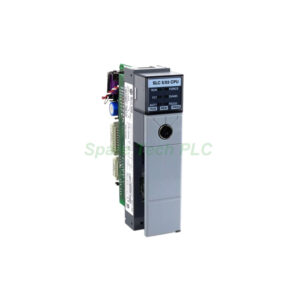
The 1747-L541 processor module serves as the control core for the SLC 500 modular system. This SLC 5/04 controller provides enhanced communication capabilities through its built-in Data Highway Plus channel. It handles up to 4096 inputs and 4096 outputs, making it suitable for demanding industrial automation projects.
Moreover, this Allen-Bradley 1747-L541 includes 16K words of user memory. The memory supports both program and data storage with battery-backed protection. Its program scan time reaches 0.9 milliseconds per thousand words, while the I/O scan time is only 0.225 milliseconds. These performance metrics ensure responsive control for time-critical processes.
Technical Specifications
The 1747-L541 operates with well-defined electrical and performance parameters.
Memory and Processing Capabilities
This SLC 5/04 processor comes with 16K words of battery-backed RAM. The 1747-BA battery preserves the program during power outages. Additionally, the controller supports backup memory via the 1747-M13 flash-based memory device, which provides 64KB of storage for program and data table backup.
The processor executes programs with a scan time of 0.9 milliseconds per thousand words. It also features a 1-millisecond Selectable Timed Interrupt and a 0.5-millisecond Discrete Input Interrupt. These interrupt capabilities allow for precise timing control in critical applications.
I/O Capacity and Scanning
The 1747-L541 supports a maximum of 4096 discrete input points and 4096 discrete output points. It also handles up to 480 local analog I/O channels. The I/O scan time is 0.225 milliseconds, ensuring rapid updates between the processor and field devices.
For physical expansion, this controller manages up to 3 I/O chassis. Each chassis can hold a maximum of 30 module slots. This configuration offers substantial flexibility for system growth and future expansion.
Communication Interfaces
This Allen-Bradley 1747-L541 integrates two communication ports. The first is a Data Highway Plus channel with a default baud rate of 57.6 Kbaud and node address 1. DH+ supports extended distance communication and multi-drop topology, making it ideal for distributed systems.
The second is an RS-232 port, configurable for DF1, DH-485, ASCII, and Modbus RTU communications. The RS-232 port defaults to DF1 Full-duplex mode with a baud rate of 19.2 Kbaud. Handshaking is disabled by default, and the error check uses CRC. Parity is set to none. This port can also connect to a 1761-NET-AIC converter for multi-drop network integration.
Advanced Features and Instruction Set
The 1747-L541 supports a comprehensive set of programming instructions.
Supported Instruction Types
This SLC 5/04 controller executes both basic and advanced instructions. Basic instructions include Bit, Timer, Counter, and Comparison functions. Advanced instructions cover Math operations, Move, Copy, and Bit Shift commands.
Moreover, the processor handles Sequencer, Jump and Subroutine, and Messaging instructions. It also supports STI, FIFO/LIFO, and PID control loops. For complex calculations, the 1747-L541 provides Advanced Math and Trigonometric functions.
Additional Capabilities
Online programming is supported, allowing you to modify logic without stopping the process. The built-in real-time clock and calendar enable time-based control sequences. A 3-position key switch on the front panel provides hardware protection by selecting Run, Remote, or Program modes.
Indirect addressing is also available, expanding the processor's ability to handle complex data structures. Furthermore, the controller supports remote I/O and DeviceNet pass-through, enabling flexible network architectures.
Status Indicators and Diagnostics
The 1747-L541 features LED status indicators on the front panel. These include RUN, FLT, BATT, FORCE, DH+, and RS-232 LEDs. These indicators provide immediate visual feedback for troubleshooting and system diagnostics.
Environmental and Mechanical Specifications
The 1747-L541 is designed for reliable operation in clean industrial settings.
Temperature and Humidity
The operating temperature range is 0 to 60 degrees Celsius. The module should be installed in dry environments to prevent moisture-related issues. Clean, dust-free conditions are recommended for optimal performance.
Shock and Vibration
This processor withstands operational shocks of 30G. Its robust construction ensures stable performance even in areas with minor mechanical disturbances.
Power Consumption
The Allen-Bradley 1747-L541 draws 1 amp at 5 Volts DC from the backplane. It also consumes 200 milliamps at 24 Volts DC. These values are within the typical capacity of SLC 500 power supplies.
Frequently Asked Questions
1. What is the main difference between the 1747-L541 and the SLC 5/03 processors?
The 1747-L541 is an SLC 5/04 processor with a built-in Data Highway Plus communication channel. SLC 5/03 processors use DH485 instead of DH+. Additionally, the 1747-L541 offers a faster program scan time of 0.9 ms/K compared to 1 ms/K on the 5/03 models.
2. Can the 1747-L541 communicate with Modbus RTU devices?
Yes. The RS-232 port on the 1747-L541 is configurable for Modbus RTU communication. This allows connectivity to a wide range of third-party devices that support the Modbus protocol.
3. What is the purpose of the 1747-M13 backup memory?
The 1747-M13 is a flash-based memory device that stores a backup copy of your program and data table. If the battery drains, you can use this module to restore the program without needing to re-download from a programming terminal.
4. How many I/O chassis can the 1747-L541 support?
This controller supports up to 3 I/O chassis with a maximum of 30 module slots per chassis. This provides ample expansion capacity for large control systems.
5. Which shipping carriers do you use for this controller?
We ship all orders via FedEx, UPS, or DHL. Tracking numbers are provided within 24 hours of dispatch.