Product Introduction
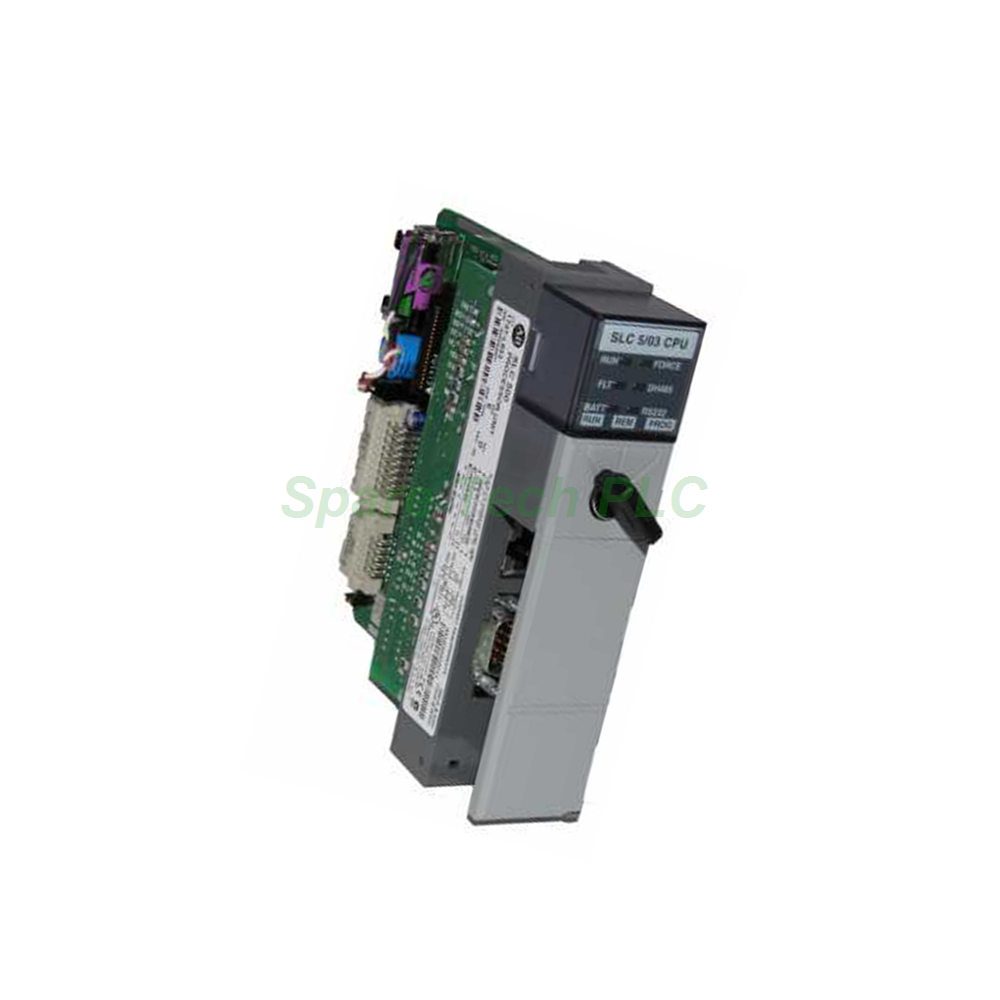
The 1747-L533 processor module serves as the control engine for the SLC 500 modular system. This SLC 5/03 controller provides significantly more memory than its lower-tier counterparts. It handles up to 4096 inputs and 4096 outputs, making it suitable for demanding medium-scale automation projects.
Additionally, this Allen-Bradley 1747-L533 includes 32K words of user memory. The memory splits into 28K words for combined data and program storage, plus 4K words dedicated exclusively to data. Its program scan time reaches 1 millisecond per thousand words, while the I/O scan time is only 0.225 milliseconds.
Technical Specifications
The 1747-L533 operates with well-defined electrical and performance parameters.
Memory and Processing Capabilities
This SLC 5/03 processor comes with 32K words of battery-backed RAM. The battery preserves the program during power outages. Moreover, this controller includes flash backup memory, which provides an additional layer of program protection. If the battery drains, the system automatically reloads the program from flash memory upon power-up.
The processor executes bit instructions in just 0.44 milliseconds. Its overall system throughput is notably ten times faster than many competing controllers. This speed advantage allows for more complex logic routines without sacrificing scan performance.
I/O Capacity and Scanning
The 1747-L533 supports a maximum of 4096 discrete input points and 4096 discrete output points. It also handles up to 480 local analog I/O channels. The I/O scan time is 0.225 milliseconds, ensuring rapid updates between the processor and field devices.
For physical expansion, this controller manages up to 3 I/O chassis. Each chassis can hold a maximum of 30 module slots. This configuration offers substantial flexibility for system growth and future expansion.
Communication Interfaces
This Allen-Bradley 1747-L533 integrates two communication ports. The first is a DH485 port with default settings of 19.2 Kbaud and node address 1. The second is an RS-232 port, configurable as DF1 or DH485 for peer-to-peer applications.
The RS-232 port defaults to DF1 Full-duplex mode with a baud rate of 19.2 Kbaud. Handshaking is disabled by default, and the error check uses CRC. Parity is set to none. You can also use RSLinx auto-configuration to detect this port easily. For network expansion, the RS-232 port can connect to a 1761-NET-AIC converter.
Advanced Features and Instruction Set
The 1747-L533 supports a rich set of programming instructions.
Supported Instruction Types
This SLC 5/03 controller executes both basic and advanced instructions. Basic instructions include Bit, Timer, Counter, and Comparison functions. Advanced instructions cover Math operations, Move, Copy, and Bit Shift commands.
Moreover, the processor handles Sequencer, Jump and Subroutine, and Messaging instructions. It also supports STI, FIFO/LIFO, and PID control loops. For complex calculations, the 1747-L533 provides Advanced Math and Trigonometric functions.
Additional Capabilities
Online programming is supported, allowing you to modify logic without stopping the process. The built-in real-time clock and calendar enable time-based control sequences. A key-switch provides hardware protection against unauthorized program changes.
Floating-point math is also available, expanding the processor's ability to handle analog signals with precision. Furthermore, flash memory upgrades let you update the firmware without replacing the hardware.
Network Integration
With this processor, you can install a remote I/O scanner module or a DeviceNet scanner module. These options allow I/O configuration via a universal remote link or a DeviceNet network. This flexibility makes the 1747-L533 suitable for distributed control architectures.
Environmental and Mechanical Specifications
The 1747-L533 is designed for reliable operation in clean industrial settings.
Temperature and Humidity
The operating temperature range is 0 to 60 degrees Celsius. The module should be installed in dry environments to prevent moisture-related issues. Clean, dust-free conditions are recommended for optimal performance.
Shock and Vibration
This processor withstands operational shocks of 30G. Its robust construction ensures stable performance even in areas with minor mechanical disturbances.
Power Consumption
The Allen-Bradley 1747-L533 draws 500 milliamps at 5 Volts DC from the backplane. It also consumes 175 milliamps at 24 Volts DC. These values are within the typical capacity of SLC 500 power supplies.
Installation Guidelines
Installing the 1747-L533 requires attention to slot placement and system configuration.
First, insert the processor into slot 0 of the SLC 500 chassis. This slot is reserved exclusively for the CPU module. Second, ensure the chassis power is off before installation. Third, connect the programming terminal to the RS-232 port for initial setup.
For communication wiring, use shielded cables to minimize noise interference. The DH485 port supports multi-drop networks with up to 32 nodes. The RS-232 port works best for point-to-point connections with programming software or HMI devices.
After installation, verify the battery status periodically. Replace the battery when needed to prevent program loss. The flash backup memory provides an extra safety net, automatically reloading the program if the battery fails.
Packaging List
When you receive the 1747-L533, the package contains the following items:
One Allen-Bradley 1747-L533 SLC 5/03 Processor Module
One removable terminal cover
One quick-reference installation guide
Please note that the package does not include the battery, communication cables, or scanner modules. These items are available separately.
Frequently Asked Questions
1. What is the main difference between the 1747-L532 and the 1747-L533?
The 1747-L533 offers 32K words of user memory, while the 1747-L532 provides only 16K words. Additionally, the 1747-L533 includes flash backup memory, which the 1747-L532 lacks.
2. Can the 1747-L533 communicate with DeviceNet networks?
Direct DeviceNet communication is not built into this SLC 5/03 processor. However, you can install a DeviceNet scanner module in the I/O chassis to enable DeviceNet connectivity.
3. How does the flash backup memory work on the 1747-L533?
The flash memory stores a copy of your user program. If the battery drains and the RAM loses its data, the processor automatically reloads the program from flash memory during the next power-up cycle.
4. What is the maximum number of I/O points supported by the 1747-L533?
This controller supports up to 4096 discrete inputs and 4096 discrete outputs. It also handles up to 480 local analog I/O channels.
5. Which shipping carriers do you use for this controller?
We ship all orders via FedEx, UPS, or DHL. Tracking numbers are provided within 24 hours of dispatch.