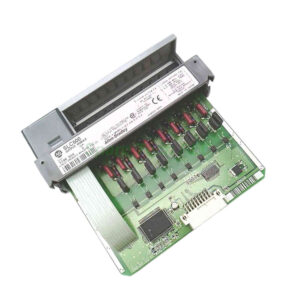
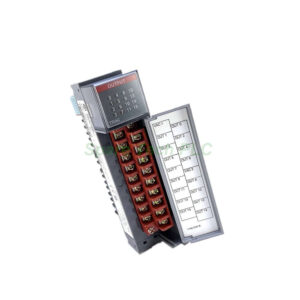
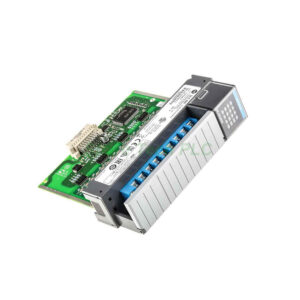
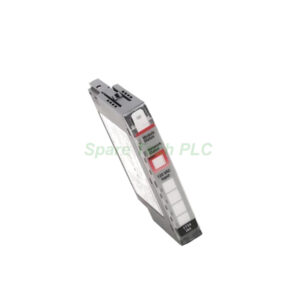
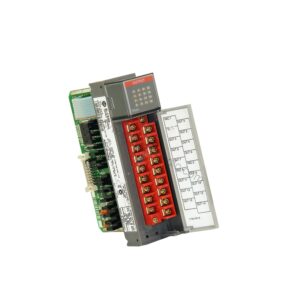
1746-OAP12 Allen-Bradley High-Current AC Output Module
Product Introduction
The Allen-Bradley 1746-OAP12 delivers superior current-handling capability within the SLC500 system. This module provides twelve independent AC output channels, arranged with six points per common terminal. Each common includes an electronic fuse for protection against short-circuit conditions. Notably, the 1746-OAP12 supports a continuous current of 2.0 A per point at 30 °C, making it the highest-current AC output option in the 1746 series. It handles nominal voltages of 120 or 240 VAC with a broad operating range from 85 to 264 VAC. The module's fused common design and optional fuse monitoring provide enhanced diagnostic capabilities for critical applications.
Technical Specifications
Output Capacity and Current Ratings
The 1746-OAP12 features twelve AC outputs grouped into two commons of six channels each. Each output delivers 2.0 A continuously at 30 °C (86 °F), derating to 1.25 A at 55 °C (131 °F) and 1.0 A at 60 °C (140 °F). The total module current reaches 9.0 A at 30 °C, reducing to 6.0 A at 60 °C. Each point withstands a surge current of 17.0 A for 25 milliseconds, with an additional 35 A per common for 10 ms. The on-state voltage drop measures just 1.2 V at 2.0 A, ensuring efficient power delivery. Heat dissipation reaches 10.85 W maximum for the entire module.
Timing and Switching Performance
This module exhibits fast and predictable switching behavior. The ON signal delay is just 1 ms, while the OFF signal delay measures 11 ms. The OFF-state leakage current stays at a low 2 mA, preventing false triggering of sensitive loads. The minimum load current requirement is 10 mA per channel. These response characteristics suit most general-purpose and high-current control applications.
Power Consumption
The 1746-OAP12 draws 370 mA from the 5 VDC backplane and 0 mA from the 24 VDC supply. This backplane current matches the 16-channel OA16 model, demonstrating efficient power management despite the higher per-point current rating.
Fuse Protection and Diagnostics
Fused Common Design
Each of the two commons on the 1746-OAP12 includes an internal electronic fuse. These fuses protect the module from short-circuit conditions on the output field wiring. However, they do not provide overload protection. For overload conditions, you must install external user-supplied fuses rated appropriately for your load. The recommended overload protection fuse is SAN-O HT, with a maximum rating of 2.0 A.
Blown Fuse Monitoring
The 1746-OAP12 includes a configurable jumper for blown fuse monitoring. When you set the jumper to short pins 2 and 3, the module enables fuse monitoring. In this configuration, a blown fuse triggers a processor major fault bit (S:1/13) and stores the fault code in S:6. By default, the jumper connects pins 2 and 1, which disables this monitoring function. A blown fuse LED illuminates when a fuse opens, provided both backplane and load power are present.
Replacement Fuse Information
Use a SAN-O HQ 6.3A fuse for replacement to maintain UL/CSA rating. The replacement fuse kit is catalog number 1746-F9, which contains five fuses per kit. The fuse holder design allows easy replacement using needle-nose pliers or fingers. Always remove system power before replacing fuses.
Mechanical and Environmental Parameters
Physical Design
This module occupies a single slot in the 1746 chassis. Its compact form factor allows efficient use of rack space. The color-coded Removable Terminal Block (RTB) simplifies wiring and maintenance. You can replace the module quickly without disconnecting field wires, significantly reducing downtime during troubleshooting.
Shock and Vibration Ratings
The 1746-OAP12 withstands operational shock of 30G and vibration of 5G at 10-500 Hz. These rugged specifications make it suitable for demanding environments with heavy machinery or conveyor systems.
Temperature and Humidity
This module operates reliably from 0 °C to 60 °C (32 °F to 140 °F). It also tolerates relative humidity between 5% and 95%, non-condensing. These environmental ratings ensure consistent performance across diverse factory floor conditions.
Installation and Integration Guide
Mounting Procedure
First, verify your chassis power supply can accommodate the additional 370 mA backplane load. Then, select an available slot in the SLC500 rack. Insert the 1746-OAP12 carefully, aligning it with the backplane connector. Press firmly until the module seats completely. Finally, secure it with the retaining screws to prevent loosening from vibration.
Wiring Recommendations
Connect your AC loads to the appropriate terminals on the removable connectors. Each common group of six outputs shares a neutral terminal. You can power each group from different AC sources if required. However, ensure each source stays within the 85-264 VAC range. Use properly sized conductors for the expected load currents. For inductive loads, consider installing snubber circuits across the load terminals to reduce electrical noise and extend contact life.
Programming and Addressing
The 1746-OAP12 occupies 12 bits of the output image table in your SLC500 processor. Each channel maps to a specific bit address. You control outputs using standard ladder logic instructions like OTE (Output Energize) or OTU (Output Unlatch). The module's front panel features LED indicators for each channel and a separate blown fuse LED. These provide immediate visual feedback on output status, simplifying field troubleshooting.
Fault Handling
For SLC5/02 and later processors, programming a fault routine is not compatible for clearing the major fault bit. The module's major fault bit is S:1/13 with the major fault code stored in S:6. When a fuse blows, the processor logs this fault, allowing you to identify the affected channel group quickly.
Packaging List
Allen-Bradley 1746-OAP12 Discrete AC Output Module (1 unit)
Removable terminal block connectors (2 units, 7 positions each)
Installation instruction sheet
Note: Fuse replacement kit 1746-F9 is sold separately. Cables and programming software are not included.
Shipping Information
All orders ship via FedEx, UPS, or DHL with tracking numbers provided. Please ensure your shipping address and contact details are correct for prompt delivery.
Frequently Asked Questions
1. What makes the 1746-OAP12 different from the 1746-OA16?
The 1746-OAP12 provides 12 outputs with 2.0 A per point, making it ideal for high-current loads. The 1746-OA16 offers 16 outputs but only supports 0.5 A per point. Choose the 1746-OAP12 when you need to drive larger AC loads like heavy contactors or solenoids.
2. How do I enable blown fuse monitoring on this module?
Locate the jumper on the 1746-OAP12 circuit board. Set the jumper to short pins 2 and 3 to enable monitoring. The default position (pins 2 and 1) disables this feature. Refer to the installation guide for precise jumper location.
3. Can I replace the fuse while the module is powered?
No, you must remove all system power before replacing any fuse. The 1746-OAP12 does not support hot-swapping fuses. Always power down the chassis, then use needle-nose pliers to extract and insert the new SAN-O HQ 6.3A fuse.
4. What happens if a fuse blows with monitoring disabled?
With monitoring disabled (jumper on pins 2 and 1), the module does not report a blown fuse to the processor. However, the blown fuse LED will still illuminate if both backplane and load power are present. You must manually check the LED status.
5. Is the 1746-OAP12 compatible with older SLC500 processors?
Yes, the 1746-OAP12 works with all SLC500 processors. However, fuse monitoring functionality via major fault bit only works with SLC5/02 and later models. For older processors, rely on the front panel LED indicators for fuse status.