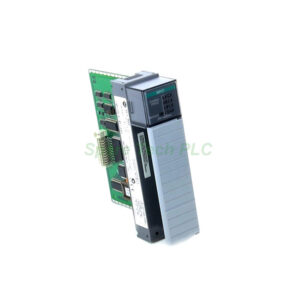
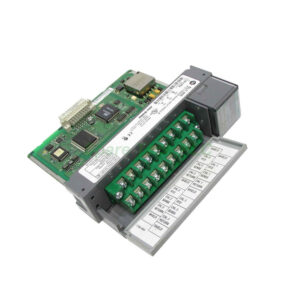
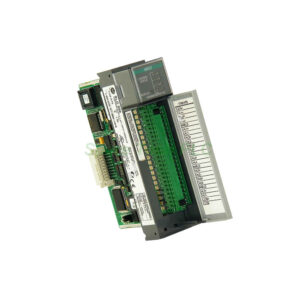
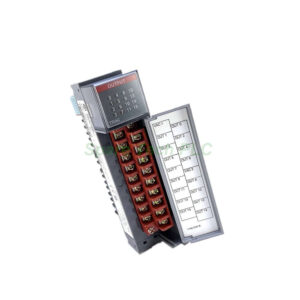
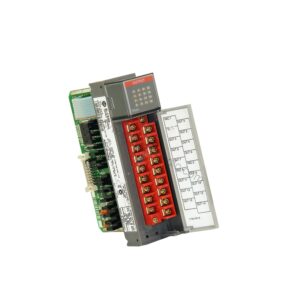
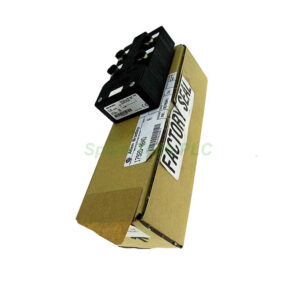
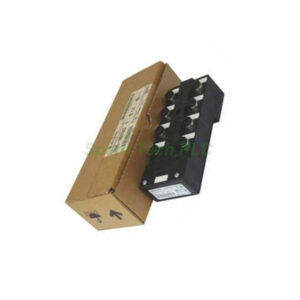
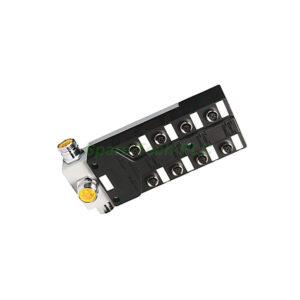
Allen-Bradley 1746-NT4 SLC 500 Thermocouple/mV Input Module
Product Introduction
The Allen-Bradley 1746-NT4 is a versatile Thermocouple/mV Analog Input Module designed for the SLC 500 control platform. This module provides four isolated input channels for direct connection to a wide range of thermocouple sensors, including types J, K, T, E, S, R, B, and N. Beyond temperature measurement, the 1746-NT4 also accepts ±50 mV and ±100 mV analog signals, making it suitable for various process monitoring applications. Its sigma-delta A/D conversion and programmable input filtering deliver stable, accurate readings even in electrically noisy environments. Additionally, the module features two cold-junction compensation (CJC) sensors that maintain measurement accuracy without requiring offset voltage adjustments. For convenient diagnostics, the 1746-NT4 includes configurable open-circuit detection with Zero, Upscale, and Downscale settings.
Technical Specifications and Performance
The 1746-NT4 offers robust technical capabilities for precise temperature measurement. It provides a 16-bit resolution for input conversion and 14-bit resolution for output data, ensuring detailed and accurate readings. The module's update time ranges from 26 milliseconds to 1.2 seconds, allowing you to balance speed and filtering based on your application requirements. Furthermore, it uses sigma-delta modulation for analog-to-digital conversion, which effectively rejects high-frequency noise. The step response is rated at 60 ms in and 2.5 ms out, meaning the module reacts swiftly to input signal changes. For input filtering, the 1746-NT4 incorporates programmable digital filters with selectable frequencies of 250 Hz, 60 Hz, 50 Hz, and 10 Hz. Consequently, you can minimize the effect of electrical noise and AC line interference that might cause erratic readings. However, note that the module ignores the input filter when you select a Cold Junction Compensation (CJC) input.
Supported Thermocouple Types and mV Inputs
This module supports an extensive range of thermocouple types, providing great flexibility for diverse temperature sensing needs. Specifically, it works with J, K, T, E, S, R, B, and N thermocouples. Each type covers different temperature ranges and accuracy characteristics, so you can select the most suitable sensor for your process. Beyond thermocouple inputs, the 1746-NT4 accepts direct millivolt signals of ±50 mV and ±100 mV. Therefore, you can use this module not only for temperature but also for measuring other process variables that produce low-level voltage outputs, such as pressure transducers or strain gauges. Each channel includes open-circuit detection that immediately identifies a broken sensor. You can configure the module's response to an open circuit as Zero (forces the reading to 0), Downscale (forces the reading to the lowest value), or Upscale (forces the reading to the maximum value). These settings help you quickly diagnose channel status and implement fail-safe operations based on your process requirements.
Wiring, CJC, and Cable Recommendations
Proper wiring ensures optimal performance from the Allen-Bradley 1746-NT4. For thermocouple inputs, you must use shielded twisted thermocouple extension wire to maintain signal integrity and measurement accuracy. For millivolt inputs, Belden 8761 cable or an equivalent shielded wire works well. The module's removable terminal block accepts two wires per terminal with a maximum wire size of 2.5 mm (14 AWG) and supports a maximum cable impedance of 25 ohms. The 1746-NT4 incorporates two cold-junction compensation (CJC) sensors instead of offset voltages. These CJC sensors automatically compensate for temperature variations at the terminal block, ensuring accurate thermocouple readings. For best results, position the module away from heat sources and maintain stable ambient temperatures around the terminal block. Also, ground the cable shield at one end only to prevent ground loops. The terminal block compatible with this module provides secure connections for reliable long-term operation.
Mechanical, Environmental, and Power Parameters
The 1746-NT4 is engineered for reliable operation in demanding industrial settings. It operates within an ambient temperature range of 0°C to 60°C and can withstand storage between -40°C and 85°C. For electrical isolation, the module provides backplane isolation on all four channels, protecting your control system from potential ground loops and voltage spikes. The module draws 60 mA from the 5V DC backplane supply and 40 mA from the 24V DC supply. Its total backplane power consumption reaches a maximum of 0.8 W (0.3 W at 5V DC and 0.5 W at 24V DC). This low power draw reduces thermal buildup inside the chassis and enhances overall system reliability. The 1746-NT4 performs auto-calibration at power-up and whenever you enable a channel, ensuring consistent measurement accuracy without manual intervention. The module's front panel features five green LED status indicators: one for module health and one for each of the four channels, enabling quick visual diagnostics.
Installation and Compatibility Guide
Installing the Allen-Bradley 1746-NT4 is simple and straightforward. You can place it in any slot of an SLC 500 chassis, except for Slot 0, which is reserved for the processor or an adapter module. This module is compatible with both fixed and modular SLC 500 hardware styles. In a fixed system, it typically installs in a 1746-A2 expansion chassis. Meanwhile, in a modular system, it fits into any local or remote I/O chassis. The module occupies a single slot and draws its power directly from the backplane, so no external power supply is required. Note that in a remote I/O configuration, the 1746-NT4 requires block transfers for proper data exchange with the processor. During installation, match the sensor wiring to the correct channel terminals and configure the input type, filter frequency, and open-circuit response settings in your SLC 500 program for optimal performance.
Packaging List
Shipping
We ship this product worldwide using FedEx, UPS, or DHL to ensure fast and secure delivery.
Frequently Asked Questions (FAQ)
1. Can I install the 1746-NT4 in Slot 0 of my SLC 500 chassis?
No. The 1746-NT4 can occupy any slot except Slot 0. Slot 0 is exclusively reserved for the SLC 500 processor or a communication adapter module.
2. What thermocouple types does the 1746-NT4 support?
This module supports J, K, T, E, S, R, B, and N thermocouple types. It also accepts ±50 mV and ±100 mV analog input signals.
3. What does the CJC feature do on the 1746-NT4?
The Cold Junction Compensation (CJC) feature uses two onboard sensors to automatically compensate for temperature variations at the terminal block. This compensation ensures accurate thermocouple readings without requiring manual offset adjustments.
4. How does the 1746-NT4 respond to an open thermocouple circuit?
You can configure the module's response as Zero (forces reading to 0), Downscale (forces reading to the lowest value), or Upscale (forces reading to the maximum value). Choose the setting that best supports your process fail-safe strategy.
5. Does the 1746-NT4 require an external power supply?
No. The 1746-NT4 draws its operating power directly from the SLC 500 backplane. It consumes 60 mA at 5V DC and 40 mA at 24V DC, with a total power consumption of 0.8 W maximum.