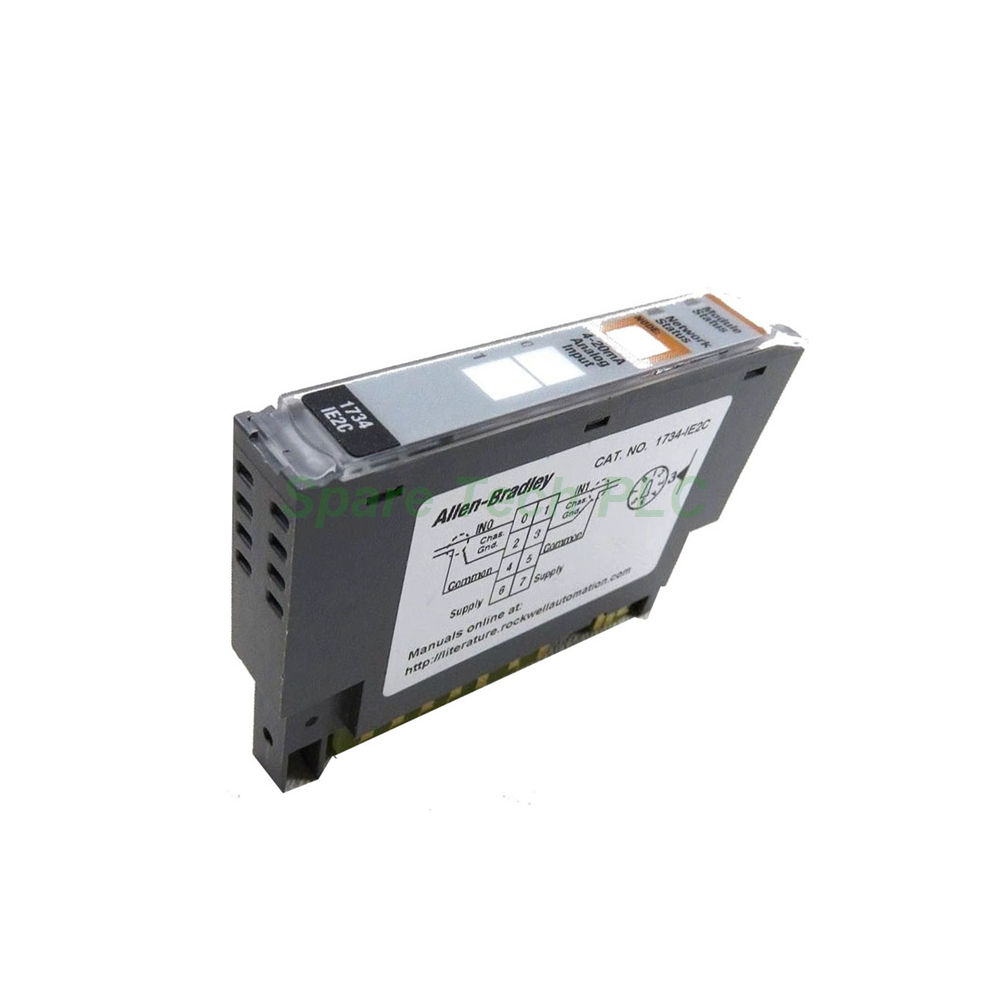
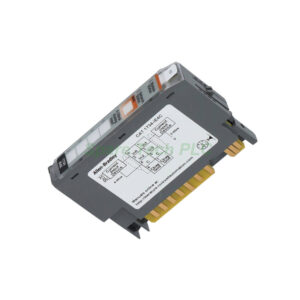
1734-IE2C 2-Channel Analog Input Module
Product Introduction
The 1734-IE2C belongs to the Allen‑Bradley POINT I/O product family and serves as a versatile analog input module. It provides two single‑ended, non‑isolated current input channels. These channels are independently configurable for either 0‑20 mA or 4‑20 mA signals. Its 16‑bit resolution ensures precise data conversion across the 0...21 mA range, offering a sensitivity of 0.32 μA per count.
Technical Specifications
The 1734-IE2C employs a Delta‑Sigma conversion type for accurate digital representation. Its absolute accuracy reaches 0.1% of full scale at 25 °C. Additionally, the module offers selectable input step response times. For instance, it provides an 80 ms response at a 50 Hz notch filter setting. The default setting at 60 Hz yields a 70 ms response. Furthermore, faster settings of 16 ms and 8 ms are available for 250 Hz and 500 Hz respectively.
The module's input update rate varies with the notch filter selection as well. Specifically, it updates every 120 ms at 50 Hz, every 100 ms at 60 Hz (default), every 24 ms at 250 Hz, and every 12 ms at 500 Hz. Moreover, this module comes factory calibrated and supports overvoltage fault protection up to 28.8 Volts DC. Its data format uses signed integer, which simplifies data handling in the controller.
Power and Mechanical Parameters
This analog input module requires an external DC supply voltage between 10 and 28.8 Volts DC, with 24 Volts DC nominal. It draws a current of 10 mA and consumes just 75 mA from the 5V DC backplane. Consequently, its maximum power dissipation reaches only 0.6 W at 28.8V DC. This efficiency results in a thermal dissipation of just 2.0 BTU/hour.
The 1734-IE2C has compact dimensions of 56 x 12 x 75.5 mm (2.2 x 0.47 x 2.97 in.) and weighs approximately 0.036 kg. Its open‑style enclosure makes it suitable for installation within a larger control cabinet. Furthermore, the module supports horizontal or vertical mounting on a standard 35 mm DIN rail.
Installation and Compatibility
For proper operation, you must mount the 1734-IE2C onto a compatible wiring base assembly. Suitable bases include the 1734‑TB, 1734‑TBS, 1734‑TOP, or 1734‑TOPS. During installation, ensure the module's keyswitch is in position 3. This correct positioning prevents incorrect module insertion and guarantees a secure connection.
The 1734-IE2C works with any POINT I/O communication adapter. Therefore, you can integrate it seamlessly with various networks, including ControlNet, DeviceNet, and EtherNet/IP. This module functions particularly well with ControlLogix and CompactLogix controllers. It also supports other Allen‑Bradley controller platforms, making it a highly adaptable choice for your automation system.
Packaging List
Your shipment will include:
One (1) Allen‑Bradley 1734-IE2C Analog Input Module
One (1) removable terminal block (if ordered with a wiring base)
Product installation instructions manual
Note: Calibration certificates and warranty information do not come with the package.
Shipping Information
All orders ship using premium express courier services. We primarily use FedEx, UPS, or DHL to ensure fast and reliable delivery worldwide.
Frequently Asked Questions (FAQ)
1. Can the 1734-IE2C accept a 0‑20 mA signal?
Yes, the 1734-IE2C can accept both 0‑20 mA and 4‑20 mA input signals. You simply select the appropriate mode via the configuration software.
2. Which terminal base does this module require?
This module requires a 1734 series terminal base. The compatible bases include the 1734‑TB, 1734‑TBS, 1734‑TOP, or 1734‑TOPS.
3. What resolution does the 1734-IE2C offer?
The 1734-IE2C provides a high 16‑bit resolution. This translates to a sensitivity of 0.32 μA per count over the 0...21 mA measurement range.
4. Does this module provide channel isolation?
No, the 1734-IE2C offers two single‑ended, non‑isolated channels. Its isolation voltage is 50 Volts, and it withstands 2550 Volts DC for 60 seconds.
5. How fast does the 1734-IE2C update its input data?
The update rate depends on the notch filter setting. At the default 60 Hz setting, it updates every 100 ms. Alternatively, you can set it to update as quickly as 12 ms at 500 Hz.