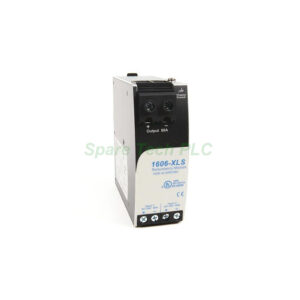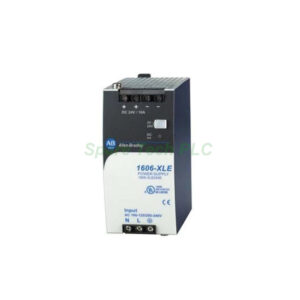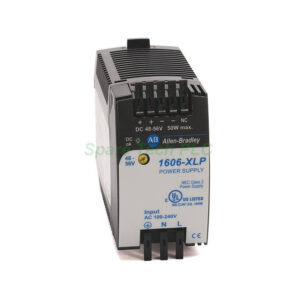
1606-XLP50E 24V 2.1A Compact Power Supply Allen-Bradley
The Allen-Bradley 1606-XLP50E is a 50W Compact power supply providing 24V DC at 2.1A. It accepts wide-range 100-240V AC or DC input and uses spring clamp terminals in a small 45mm wide housing.


The 1606-XL480E-3 belongs to the legacy Bulletin 1606-XL switched-mode power supply line. This unit suits larger panels that run three-phase power and need a strong 24V DC rail. Specifically, it converts three-phase 400-480V AC input into a regulated 24V DC output. The 480W rating covers PLC racks, I/O clusters, and field device loads in one compact DIN-rail package.
Note that Rockwell lists this model as discontinued, with end of sale on 2017-10-30. The direct replacement is the 1606-XLS480E-3. Buyers should confirm spares availability before designing the unit into new builds.
The 1606-XL480E-3 delivers 480W of rated output with 20A at 24V across 0-60°C ambient. Efficiency reaches a typical 92% at 24V/20A, which limits heat inside the cabinet. Output voltage spans 24-28V DC with a preset of 24V ±0.5%, so users can trim the rail for cable drop or sensitive loads.
Input specifications cover three-phase 400-480V AC, with a continuous range of 408-576V AC and a DC range of 550-820V. Furthermore, a 600W boost mode provides 25A at 24V below 45°C, which covers short-term peaks from contactors and motor starters. Ripple and noise stay below 20mVpp including spikes to 20MHz, keeping the rail clean for analog and communication devices. Hold-up time exceeds 11ms at 24V/20A, supporting brief ride-through during line dips. The unit carries UL 60950-1, cUL, and CE marks under the standard Bulletin 1606 approvals.
The 1606-XL480E-3 measures 124mm high, 220mm wide, and 102mm deep, with a weight of 1.8 kg. Its IP20 open-frame housing fits inside control cabinets with DIN-rail mounting per 1606-AP023. Operating temperature runs from 0°C to +70°C with derating above 60°C, while storage spans -25°C to +85°C. The manufacturer does not publish a relative humidity figure for this model.
For monitoring, this model includes no communication interface and no DC OK relay contact. Therefore, integration relies on hardwired panel wiring rather than status signaling. Besides the power conversion, the wide input range supports both AC and DC bus feeds in the same enclosure.
First, mount the 1606-XL480E-3 onto a standard DIN rail per the 1606-AP023 instructions. Keep ventilation clearance above and below the housing because the open-frame design relies on convection cooling. Verify the three-phase input wiring matches the L1, L2, L3, and PE terminals before energizing.
Next, check the input voltage falls within 408-576V AC or 550-820V DC. Then wire the output to the + and – terminals and confirm the 24V preset before connecting loads. Finally, derate the output above 60°C ambient to avoid thermal shutdown, and keep total continuous draw within 20A.
1 × Allen-Bradley 1606-XL480E-3 Power Supply Unit
1 × Installation Instruction Sheet
Protective cardboard packaging
Shipping: Fedex, UPS, DHL
Q1: Is the 1606-XL480E-3 still available?
A: Rockwell lists this model as discontinued with end of sale on 2017-10-30. The direct replacement is the 1606-XLS480E-3.
Q2: What input voltage does this unit require?
A: The 1606-XL480E-3 accepts three-phase 400-480V AC nominal input. Its continuous range covers 408-576V AC and 550-820V DC.
Q3: Does this model support a power boost?
A: Yes. Below 45°C ambient, it delivers 25A at 24V (600W) for short-term peaks. Continuous output stays at 20A (480W) up to 60°C.
Q4: Does the 1606-XL480E-3 have a DC OK relay?
A: No. This model offers no DC OK relay contact and no communication interface, so status monitoring needs external devices.
Q5: What is the efficiency of this power supply?
A: The 1606-XL480E-3 reaches a typical 92% efficiency at 24V/20A. This figure comes from the PULS OEM counterpart SL20.300.
| Brand Name | |
| Model No. | 1606-XL480E-3 |
| Product Type | Switched-Mode Power Supply |
| hasMerchantReturnPolicy | Adjust according to reality |
| Shippingdetails | Adjust according to reality |