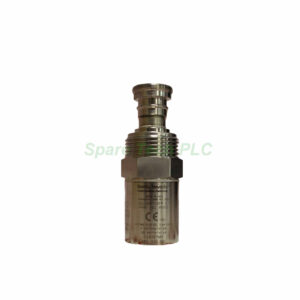
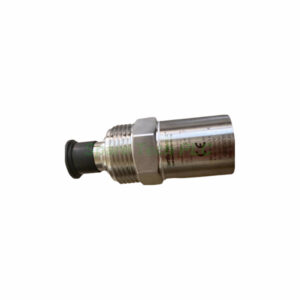
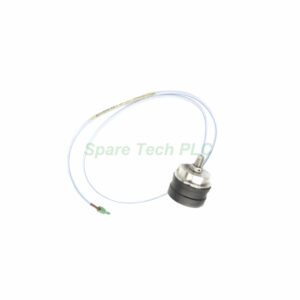
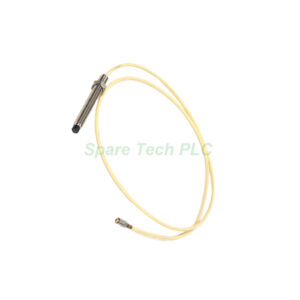
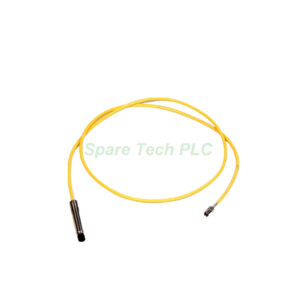
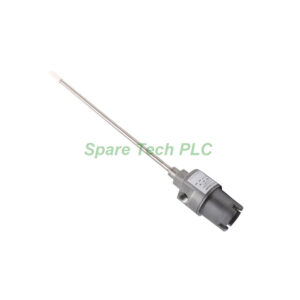
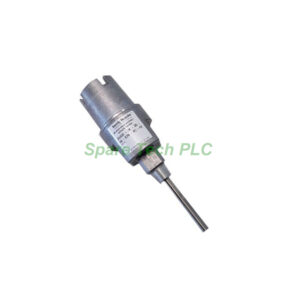
Bently Nevada 21504-24-44-05-02 Proximity Vibration Probe
The Bently Nevada 21504-24-44-05-02 provides non-contact vibration and position sensing for critical rotating machinery. This 8mm proximity probe operates as part of the 7200 series transducer systems. It converts physical shaft movement into a proportional voltage signal. Therefore, it plays a vital role in protecting turbines, compressors, and pumps from excessive vibration damage.
Technical Specifications
The Bently Nevada 21504-24-44-05-02 delivers a calibrated linear range of 80 mils (2.0 mm). Measurement begins at approximately 10 mils (0.25 mm) from the probe face. Its scale factor measures 200 mV/mil (7.87 V/mm) with ±4% accuracy when calibrated as a complete system. Furthermore, the system maintains ±9.5% accuracy even when you interchange components.
Linearity performance remains within 0.8 mils (0.02 mm) of a 200 mV/mil straight line for system-calibrated units. Including interchangeability errors, this specification extends to 2.3 mils (0.06 mm). The frequency response spans 0 to 10 kHz (0 to 600,000 cpm), with only -5% deviation at the upper limit.
The probe requires a power input between -17.5 Vdc and -26 Vdc, consuming a maximum of 12 mA. Additionally, temperature sensitivity shows typically -3% change in scale factor at +150°F (+65°C) with a 50-mil gap (1.27 mm).
Configuration Details
This specific configuration, the 21504-24-44-05-02, includes several ordering options. First, the unthreaded length option 24 provides 240 mm of flexible mounting adjustment. Second, overall case length option 44 measures 4.4 inches. Third, total length option 05 gives you 0.5 metre (20 inches) with a tolerance of +0.13 metre to -0.05 metre. Finally, connector option 02 features a miniature male coaxial connector for secure signal transmission.
The tip construction uses a standard 8mm diameter with 3/8-24 threads. This probe does not include lead armor, making it suitable for installations where flexibility and reduced weight are priorities.
Environmental Limits and Durability
For the Proximitor, operating temperatures range from -60°F to +212°F (-51°C to +100°C). Meanwhile, the probe and extension cable tolerate -30°F to +350°F (-34°C to +177°C). The system also withstands relative humidity up to 95% non-condensing.
Moreover, the 8mm probe construction resists corrosion from direct contact with air, water, lube oil, ammonium hydroxide, 10% sulfuric acid, MEK (methyl-ethyl ketone), and DMF (dimethylformamide). Therefore, this Bently Nevada 21504-24-44-05-02 probe performs reliably in harsh industrial environments.
This probe's total weight reaches only 1.3 lbs (0.59 kg), which simplifies mounting on lightweight structures. However, you must observe the temperature limits for both the Proximitor and the probe cable. For instance, keep the Proximitor within its -60°F to +212°F range while allowing the probe itself to endure up to +350°F. Besides that, ensure the environment stays below 95% relative humidity and remains non-condensing to avoid measurement drift. The Bently Nevada 21504-24-44-05-02 also demonstrates excellent chemical resistance. Consequently, you can install it in areas where oil mist or mild chemical vapors exist without worrying about sensor degradation.
FAQ
1. What is the calibrated range of the 21504-24-44-05-02 probe?
This probe offers an 80-mil (2.0 mm) linear range, starting at approximately 10 mils (0.25 mm) from the tip face.
2. Can I use this probe with other Bently Nevada extension cables?
Yes, but for best accuracy, we recommend using it with matching 7200 series extension cables to maintain the stated ±4% scale factor accuracy.
3. What does the "05" total length option mean?
The "05" option specifies a 0.5-metre (20-inch) total cable length, with a tolerance of +0.13 metre to -0.05 metre.
4. Is this probe suitable for submersible applications?
No, this probe is not rated for continuous submersion. However, it resists splashing from water, oil, and mild chemicals as listed in the corrosion resistance section.
5. How do I verify the probe is working correctly after installation?
You can check the DC gap voltage from the Proximitor and compare it to the target position. A deviation beyond the specified linearity (0.8 mils system-calibrated) may indicate incorrect mounting or cable issues.