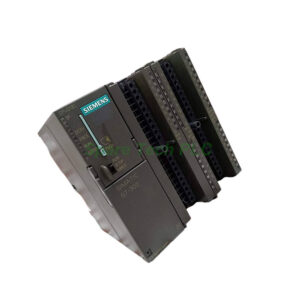
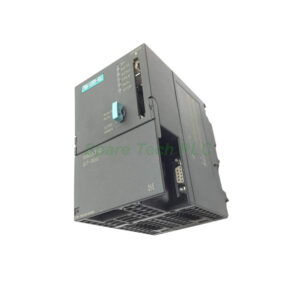
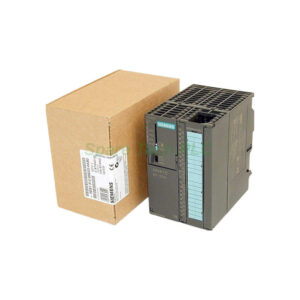
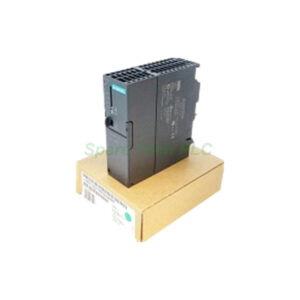
6ES7313-5BE01-0AB0 Siemens SIMATIC S7-300 Compact CPU
Product Introduction
The 6ES7313-5BE01-0AB0 represents a more advanced version of the S7-300 compact CPU series. Unlike its predecessor, this model includes a front connector (2 x 40-pin) and requires a Micro Memory Card. It runs on firmware version V2.0.0. Additionally, you need STEP 7 V5.2 SP1 or higher for engineering.
This CPU operates at a rated supply voltage of 24V DC. The permissible range stays between 20.4V and 28.8V. Typical current consumption is 700 mA, while no-load operation draws only 150 mA. Power loss typically reaches 14 W.
Memory and Processing Performance
The integrated work memory holds 32 kbytes for program and data. This capacity is not expandable. However, the load memory accepts MMCs up to 8 Mbytes. Data retention on the MMC lasts at least 10 years after the last programming. Backup is completely maintenance-free.
Processing times show clear improvements. Bit operations take 0.1 µs typically (0.2 µs max). Word operations run at 0.2 µs typical. Fixed-point arithmetic requires 2 µs, while floating-point math takes only 3 µs.
The 6ES7313-5BE01-0AB0 supports up to 1,024 total blocks (DBs, FCs, FBs, OBs, SDBs). You can use up to 511 DBs, each 16 kbyte max. FBs and FCs go up to 512 each, also 16 kbyte max. OBs include free cycle (OB1), time alarm (OB10), delay alarm (OB20), cyclic interrupt (OB35), process alarm (OB40), startup (OB100), and error OBs.
Counters, Timers, and Data Areas
You get 256 S7 counters with adjustable retentivity. The counting range runs from 0 to 999. IEC counters are present via SFB. For timers, 256 S7 timers are available with adjustable retentivity. The time range spans from 10 ms to 9,990 s. IEC timers are unlimited, limited only by RAM capacity.
The flag area covers 256 bytes with full retentivity (MB0 to MB255). Preset retentivity starts at MB0 to MB15. Local data per priority class reaches 510 bytes. Data blocks are retentive by default, though this setting is not adjustable.
I/O Address Area and Hardware Configuration
I/O address space includes 1 kbyte for inputs and 1 kbyte for outputs. The process image uses 128 bytes each. Default addresses for integrated channels: digital inputs at 124.0 to 126.7, digital outputs at 124.0 to 125.7, analog inputs at 752 to 761, and analog outputs at 752 to 755.
You can connect up to 3 expansion units. The system supports up to 4 racks with a maximum of 8 modules per rack (rack 3 allows only 7). Up to 4 DP masters are possible via CP. Recommended FM count is 8, CP PtP is 8, and CP LAN is 6.
Digital and Analog I/O Details
The 6ES7313-5BE01-0AB0 includes 24 digital inputs with a rated voltage of 24V DC. Signal “0” spans -3V to +5V, while signal “1” requires +15V to +30V. Typical input current for signal “1” is 8 mA. Input delay is parameterizable at 0.1, 0.3, 3, or 15 ms. For technological functions, the delay from “0” to “1” is max 16 µs.
For digital outputs, 16 channels are available. Short-circuit protection is clocked electronically. Minimum output voltage for signal “1” is L+ (-0.8 V). Maximum output current per channel is 500 mA at 0–60°C. The minimum load current required is 5 mA. Switching frequency with resistive load reaches 100 Hz max.
Analog inputs total 4 for voltage or current, plus one dedicated input for Pt100 or resistance measurement. Voltage range includes 0 to +10V. Current ranges cover 0–20 mA, -20–+20 mA, and 4–20 mA. Resistance range is 0–600 ohms. Resolution is 12 bits including sign. Integration time is adjustable at 2.5, 16.6, or 20 ms.
Analog outputs number 2. Voltage ranges: 0–10V and -10–+10V. Current ranges: 0–20 mA, -20–+20 mA, and 4–20 mA. Conversion time per channel is 1 ms.
Communication Interfaces
The CPU includes one MPI interface with RS 485 physical layer. It is not isolated. Maximum cable length without repeater is 50 m. Transmission rate reaches 187.5 kbit/s. Up to 8 connections are supported.
Services include PG/OP communication, global data communication, S7 basic communication, and S7 communication as a server. Note that S7 communication as a client requires a CP and loadable FB. Global data packets max out at 22 bytes. S7 basic communication allows 76 bytes per job. S7 communication as a server permits 180 bytes per job.
Integrated Functions and Clock
Three fast counters run at 30 kHz max. Frequency measurement is supported across three channels. A PID controller is built-in. Three pulse outputs operate at a limit frequency of 2.5 kHz.
The hardware clock is retentive and synchronizable. Backup time lasts 6 weeks at 40°C. Maximum deviation per day is 10 seconds. One operating hours counter is available with 1-hour granularity.
Mechanical Data and Installation
Dimensions: 120 mm width, 125 mm height, 130 mm depth. Weight is approximately 660 g.
To install the 6ES7313-5BE01-0AB0, first mount it on a DIN rail. Ensure the MMC is inserted before powering up. Then connect the 24V DC supply. Verify the voltage stays between 20.4V and 28.8V. Next, wire I/O using the supplied 2 x 40-pin front connector. Use shielded cables for analog signals and technological functions. Finally, configure the CPU with STEP 7 V5.2 SP1 or higher.
Frequently Asked Questions (FAQ)
1. What is the main difference between 6ES7313-5BE00-0AB0 and 6ES7313-5BE01-0AB0?
The 6ES7313-5BE01-0AB0 offers a higher firmware version (V2.0.0), supports MMCs up to 8 MB, and includes a front connector. It also has slightly faster floating-point math (3 µs vs 15 µs).
2. Does this CPU work without an MMC?
No. The 6ES7313-5BE01-0AB0 requires a Micro Memory Card for program and data storage. Without it, the CPU will not run.
3. What is the maximum size of MMC I can use?
You can use MMCs up to 8 Mbytes. Data retention on the MMC lasts at least 10 years.
4. Can I use this CPU as an S7 communication client?
Yes, but only via a CP (communications processor) and a loadable FB. As a server, it works directly over MPI.
5. Which programming software is required?
You need STEP 7 V5.2 SP1 or higher. Supported languages include LAD, FBD, STL, SCL, GRAPH, and HiGraph®.