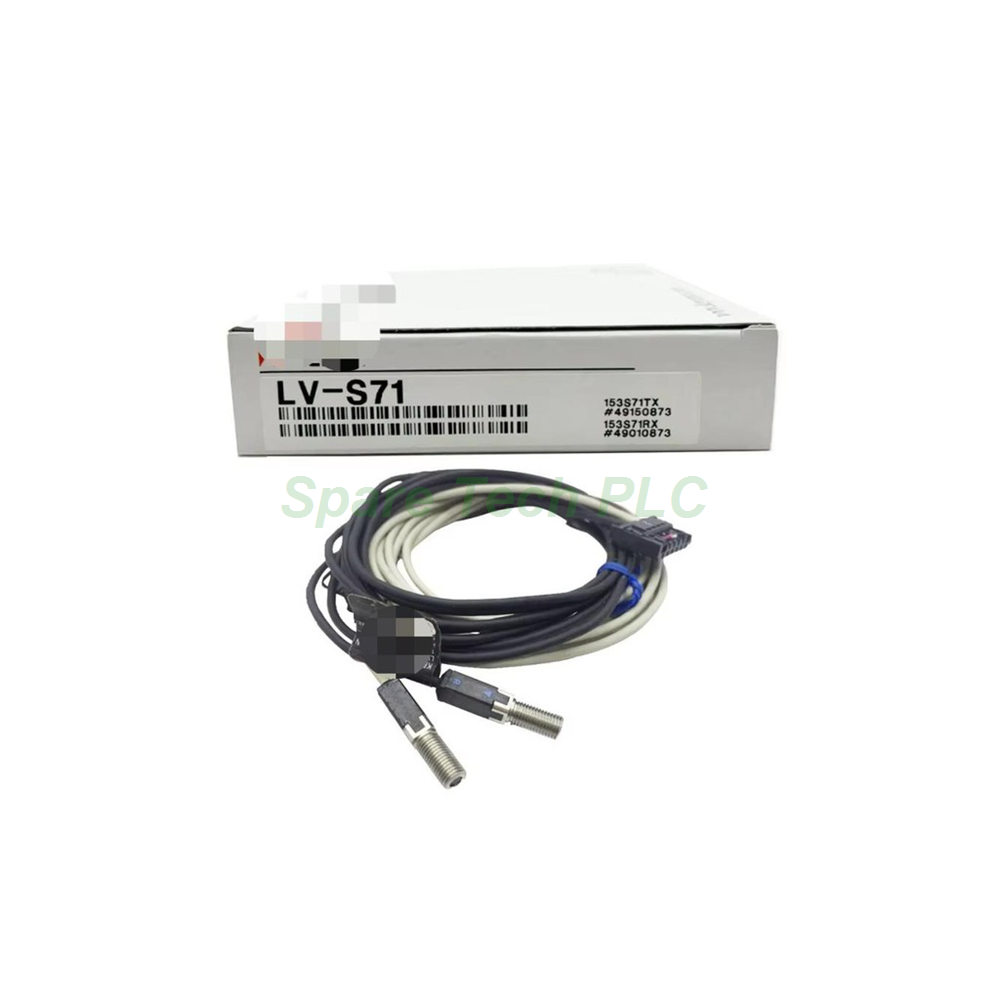
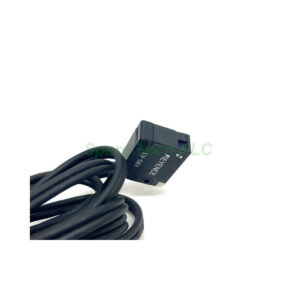
Keyence LV-S72 Thrubeam Laser Sensor Head with Slit
Product Introduction
The LV-S72 belongs to the Keyence LV-S ultra-small sensor head family. This thrubeam spot type model comes with a slit that narrows the beam for small target detection. Its visible red semiconductor laser runs at 655 nm and carries Class 1 certification under FDA CDRH Part 1040.10 and IEC 60825-1. Engineers commonly deploy it on fine wire detection, small part counting, and narrow edge sensing stations. The sensor head itself has no built-in ports. Instead, it connects to an LV-N series amplifier through a dedicated cable. Power, signal output, and threshold tuning all pass through the amplifier unit.
Technical Specifications
The optical design of the LV-S72 centers on a thrubeam spot-type configuration with a slit aperture. Specifically, the slit narrows the emitted beam so the sensor resolves tiny targets that a standard thrubeam head might miss. A detecting distance of 500 mm applies across all modes, which supports consistent setup on small work cells. Meanwhile, the Class 1 laser classification removes the need for safety barriers and operator eyewear in normal use.
The sensing head carries no communication ports or protocols. This design choice keeps the unit small and rugged. All configuration happens on the LV-N amplifier. Therefore, users tune sensitivity and output mode at the amplifier, not at the head.
Mechanical and Environmental Parameters
The glass reinforced plastic housing balances rigidity and low weight. At roughly 70 g, the head adds little load to mounting brackets. Operating temperature ranges from -10 to +50 °C with no freezing allowed. Installers should shield the unit from direct heat sources and condensation. Relative humidity and protection rating data are not published for this model. Consequently, buyers should confirm IP requirements against the amplifier enclosure and cabinet design. The LV-S72 suits indoor industrial environments such as assembly cells and fine part handling lines.
Installation Guide
First, mount the emitter and receiver on rigid brackets facing each other. Keep the beam path clear of vibrating panels and moving guards. Next, connect the dedicated cables to the LV-N amplifier and tighten the connectors. Power comes from the amplifier, so no separate supply wiring is needed at the head. After that, power on the amplifier and align the slit beam with the receiver aperture. Then fine-tune the threshold until the indicator stabilizes.
For small targets, teach the amplifier with the object present and absent. This two-point teach routine improves detection repeatability on fine wires and tiny parts. Besides, route the cable away from motor drives and inverter output lines to reduce noise. Finally, record the final settings and lock the amplifier to prevent accidental changes.
Packaging List
1 × Keyence LV-S72 sensor head
1 × Dedicated connection cable
1 × Mounting bracket and screws
1 × Protective packaging
Shipping
Orders ship via Fedex, UPS, DHL. Stock items usually leave the warehouse within 1–2 business days after payment confirmation.
FAQ
Q1: How does the slit on the LV-S72 help detection?
A: The slit narrows the beam, so the LV-S72 resolves fine wires and tiny parts better than a standard thrubeam head.
Q2: What is the detecting distance of this sensor head?
A: The LV-S72 provides 500 mm across all modes, so range stays constant regardless of mode selection.
Q3: Does the sensor head work without an LV-N amplifier?
A: No. The head draws power and sends signals through the LV-N amplifier via its dedicated cable.
Q4: Is the laser safe for open production areas?
A: Yes. It is a Class 1 laser product under IEC 60825-1 and FDA CDRH Part 1040.10.
Q5: What is the operating temperature range?
A: The LV-S72 operates from -10 to +50 °C. Avoid condensation on the lens.