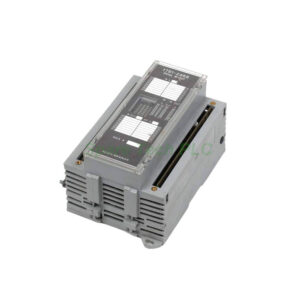
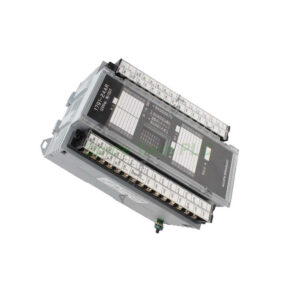
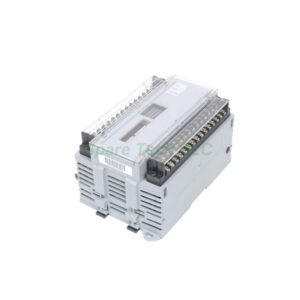
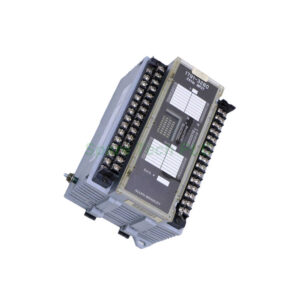
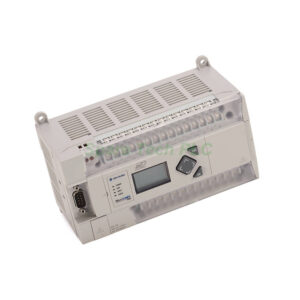
1791-24BR: DC Inputs with Versatile Relay Outputs
The Allen-Bradley 1791-24BR solves a common control problem. Many machines need DC inputs for sensors but require relay outputs for mixed voltage loads. This module gives you 24 DC inputs and 8 relay outputs in one compact housing. The inputs operate at 10-30VDC, which matches standard industrial sensors. Meanwhile, the relay outputs switch either AC (20-132VAC) or DC (20-30VDC) loads. Therefore, you avoid using separate interface relays for different voltage types.
Detailed Input Specifications of the 1791-24BR
The 1791-24BR organizes its 24 inputs into three groups of 8 channels each. The on-state voltage range runs from 10VDC to 30VDC. At 10VDC, the minimum on-state current is 2.5mA. At 30VDC, the maximum on-state current reaches 11mA. The off-state voltage stays below 5VDC max, with an off-state current minimum of 1.5mA. Additionally, you can select fast or slow input filter settings. Fast mode gives you 1ms ON and 5ms OFF delays. Slow mode provides 1ms ON and 18ms OFF delays for noise rejection.
Relay Output Specifications and Load Capabilities
The outputs on the 1791-24BR are electromechanical relays, normally open type. For AC loads, the output voltage ranges from 20VAC to 132VAC at 1A resistive max. For DC loads, the range runs from 20VDC to 30VDC at 1A resistive max. At lower currents, the DC voltage can go higher. Specifically, at 0.2A resistive max, the output reaches 125VDC. For inductive AC loads with cos phi = 0.4, the current rating drops to 0.5A. For inductive DC loads with L/R = 7ms, the rating stays at 1A within 20-30VDC.
Power Requirements and Isolation Ratings
The 1791-24BR needs an external power supply between 19.2VDC and 30VDC at 300mA. Maximum power dissipation is 14.5 Watts. Maximum thermal dissipation reaches 49.4 BTU/hour. The module provides 500VAC isolation between the power supply and the remote I/O interface. Additionally, the same 500VAC isolation applies between I/O groups and between I/O groups and logic. This high isolation protects your controller from field wiring faults.
Mechanical Dimensions and Mounting Guidelines
The 1791-24BR measures 6.95 x 4.35 x 3.85 inches (176.5 x 110.5 x 98mm). It weighs 2.38 lbs (1.08 kg). Allen-Bradley recommends vertical mounting on a DIN rail. However, you can also mount the unit horizontally if space is limited. Vertical mounting improves natural convection cooling. Therefore, always prefer vertical orientation when possible. The compact size allows installation near field devices, reducing wiring costs significantly.
Environmental Operating Conditions
This module operates reliably from 0°C to 60°C (32°F to 140°F). Storage temperature ranges from -40°C to 85°C (-40°F to 185°F). Non-condensing relative humidity can vary between 5% and 95%. Consequently, the 1791-24BR suits most industrial environments, including washdown areas and unheated enclosures. Avoid direct sunlight and heat sources above 60°C. Also prevent condensation, which can cause short circuits.
Configuration Switches and Status Indicators
The 1791-24BR has two switch assemblies for easy configuration. You can set the I/O rack number, communication baud rate, and starting I/O group. Additionally, you configure the last state behavior and last chassis settings. Status indicators on the front panel show communication health and I/O states. These LEDs help you troubleshoot field wiring and network problems quickly. Specifically, green lights indicate active channels, while a red light signals a communication fault.
Installation and RIO Network Wiring
First, mount the 1791-24BR vertically on a DIN rail. Second, connect external DC power between 19.2V and 30V at 300mA. Third, wire your DC sensors to the input terminals. Fourth, connect your AC or DC loads to the relay output terminals. Keep input wiring separate from output wiring to reduce noise coupling. For the Remote I/O network, use Belden 9463 blue hose cable. Set the baud rate switch to match your scanner: 57.6K, 115.2K, or 230.4K. Finally, install a terminating resistor (82 or 150 ohm) on the last node of a daisy-chain network.
Controller Compatibility
The 1791-24BR works with many Allen-Bradley controllers. Compatible families include PLC-2, PLC-3, PLC-5/250, and the full PLC-5 family. For SLC systems, use the SLC 5/02 modular controller with a 1747-SN Remote I/O scanner. ControlLogix users need a 1756-RIO scanner module. The 1791-24BR then acts as an adapter on the RIO link. This broad compatibility makes the module ideal for both legacy system upgrades and new installations.
Why Choose the 1791-24BR?
This module combines DC input speed with relay output versatility. The 24 DC inputs respond quickly to sensors and encoders. The 8 relay outputs switch mixed AC and DC loads without extra components. Additionally, the high 500VAC isolation protects your controller from field faults. The compact, self-contained design eliminates external power supplies and communication adapters. Therefore, the 1791-24BR reduces panel space, wiring time, and overall system cost.
Packaging List
1791-24BR block I/O module (1 unit)
Built-in RIO adapter and DC power supply
Removable terminal block connectors (left and right sides)
Quick start installation guide
Note: No certificates or warranty documents are included.
Shipping Method
All orders ship via FedEx, UPS, or DHL. Tracking numbers are provided within 24 business hours.
Frequently Asked Questions (FAQ)
1. Can the 1791-24BR switch 120VAC solenoids directly?
Yes. The relay outputs handle 20-132VAC at 1A resistive max. Most small solenoids fall within this range. For larger solenoids, use the relay to drive an external contactor.
2. What is the difference between the 1791-24BR and the 1791-24AR?
The 1791-24BR has DC inputs (10-30VDC) and relay outputs. The 1791-24AR has AC inputs (79-132VAC) and relay outputs. Choose based on your sensor voltage.
3. How do I set the starting I/O group on the 1791-24BR?
Use the two switch assemblies on the module. One switch sets the rack number. The other switch sets the starting I/O group (0, 2, 4, or 6). Refer to the manual for exact switch positions.
4. Does the 1791-24BR support output state retention after power loss?
Yes. The last state configuration lets you define output behavior on power-up. You can set outputs to remain off or resume their last state before power loss.
5. Can I mount the 1791-24BR horizontally without cooling issues?
Yes, but derate the output current. Horizontal mounting reduces natural convection. For full output current, always mount vertically as recommended by Allen-Bradley.