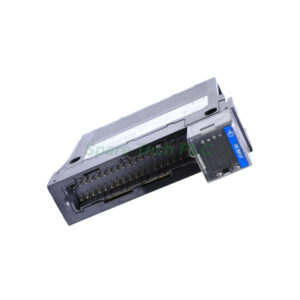
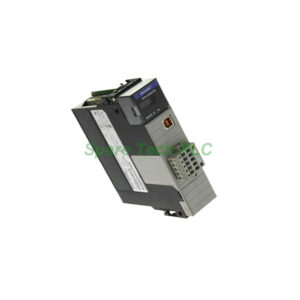
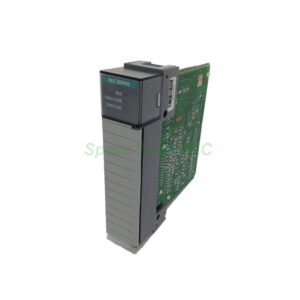
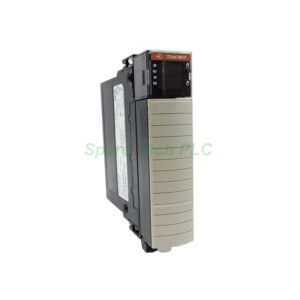
1756-IB16 ControlLogix Digital DC Input Module
Product Introduction
The 1756-IB16 module from Allen-Bradley provides a robust digital input solution for your ControlLogix control system. This module offers 16 sinking DC input channels arranged in two isolated groups of 8 points each. It operates across a wide voltage range of 10-31.2V DC with a nominal 24V DC input. You can rely on the 1756-IB16 for accurate field signal acquisition, whether you are building a small standalone controller or a large distributed control system. Its electronic keying and flexible filter options make it a versatile choice for diverse industrial environments.
Technical Specifications
The Allen-Bradley 1756-IB16 operates with a nominal input voltage of 24V DC and accepts a range from 10V up to 31.2V DC. This module draws 120 mA from the 5.1V backplane and an additional 2 mA from the 24V backplane. Its maximum power dissipation reaches 5.1W at 60°C, translating to a thermal dissipation of 21.1 BTU/hour. For input delay, the off-to-on transition takes a nominal 290 µs with a maximum hardware delay of 1 ms, plus your chosen filter time. Meanwhile, the on-to-off transition has a nominal 700 µs delay with a maximum of 2 ms plus the filter setting. Additionally, the module provides 250V continuous isolation between input groups and the backplane, ensuring robust noise immunity. The on-state current ranges from 2.0 mA at 10V DC to 10 mA at 31.2V DC, while off-state leakage current stays below 1.5 mA per point.
Input Configuration and Filtering
This module features 16 input points split into two groups of eight. Each group shares a common return, making the 1756-IB16 a sinking input configuration. You can configure the input filter times independently for each group. Choose from 0, 1, or 2 milliseconds for off-to-on transitions, and from 0, 1, 2, 9, or 18 milliseconds for on-to-off transitions. These flexible filtering options allow you to tailor the module's response to your specific application needs. For fast-moving production lines, shorter filter times provide quicker response. For noisy environments, longer filter times help reject electrical interference and prevent false triggers. Moreover, the Change of State (COS) feature enables the 1756-IB16 to interrupt the processor's normal scan cycle when an input changes to a predefined state, delivering near-instantaneous logic execution.
Installation and Compatibility
Installing the 1756-IB16 requires a standard slot in any 1756 ControlLogix chassis, whether local or remote. The module supports electronic keying, which prevents you from inserting an incompatible module into the slot. For field wiring, you need a compatible Removable Terminal Block (RTB). The 1756-IB16 works with the 1756-TBNH (20-position NEMA) or the 1756-TBSH (20-position spring clamp) housings. Ensure you have the correct RTB on hand before installation. The module also supports removal and insertion under power (RIUP), so you can replace it without powering down the entire system. Its operating temperature range spans 0°C to 60°C, and it withstands 30g shock and 5g vibration, making it suitable for demanding factory floor conditions.
Application Scenarios
The Allen-Bradley 1756-IB16 fits seamlessly into any ControlLogix configuration. You can deploy it in simple single-rack systems for less critical machinery control. Furthermore, it performs excellently in larger distributed control systems (DCS) and remote I/O networks where reliability is paramount. The module integrates with the PlantPAx DCS platform, providing consistent input handling across your entire facility. There is virtually no limit to the number of 1756-IB16 modules you can install; the only constraints are your processor's memory capacity and the available physical slots in your chassis. Common applications include conveyor monitoring, limit switch detection, pushbutton and selector switch inputs, and sensor feedback in manufacturing and process industries.
Packaging and Shipping
Each 1756-IB16 module ships in anti-static protective packaging to guard against electrostatic discharge. We inspect every unit thoroughly before shipment to ensure flawless operation. The package contains the module only. Please note that the RTB housing is not included and requires a separate purchase. We utilize FedEx, UPS, and DHL for worldwide delivery, processing all orders within 24 hours. You will receive a tracking number upon dispatch to monitor your shipment's progress.
Frequently Asked Questions
Q: What is the difference between the 1756-IB16 and the 1756-IB16D?
A: The standard 1756-IB16 provides basic digital input functionality with 16 points. The 1756-IB16D adds advanced diagnostic features such as open-wire detection, field-power loss monitoring, and fault timestamping. Choose the diagnostic version for applications requiring detailed fault reporting and faster troubleshooting.
Q: Which terminal blocks are compatible with the 1756-IB16?
A: The Allen-Bradley 1756-IB16 works with the 1756-TBNH (NEMA screw-type, 20 positions) and the 1756-TBSH (spring-clamp, 20 positions) removable terminal block housings. Both options provide reliable field wiring connections.
Q: Can the 1756-IB16 accept AC input signals?
A: The 1756-IB16 is strictly a DC sinking input module. It cannot directly accept AC voltages. However, you can use it with AC signals if you install appropriate interposing relays or interface components between the AC source and the module inputs.
Q: What is the Change of State (COS) feature and how does it help?
A: The COS feature allows the 1756-IB16 to trigger an immediate processor interrupt when an input changes from one state to another. This bypasses the normal scan cycle, providing faster response times for critical applications such as emergency stops or high-speed counting.
Q: How do I configure the input filter times on the 1756-IB16?
A: You configure the filter times using Rockwell Automation's Logix Designer software (formerly RSLogix 5000). The module offers separate filter settings for off-to-on and on-to-off transitions. You can adjust these values to balance response speed against noise immunity based on your specific application requirements.