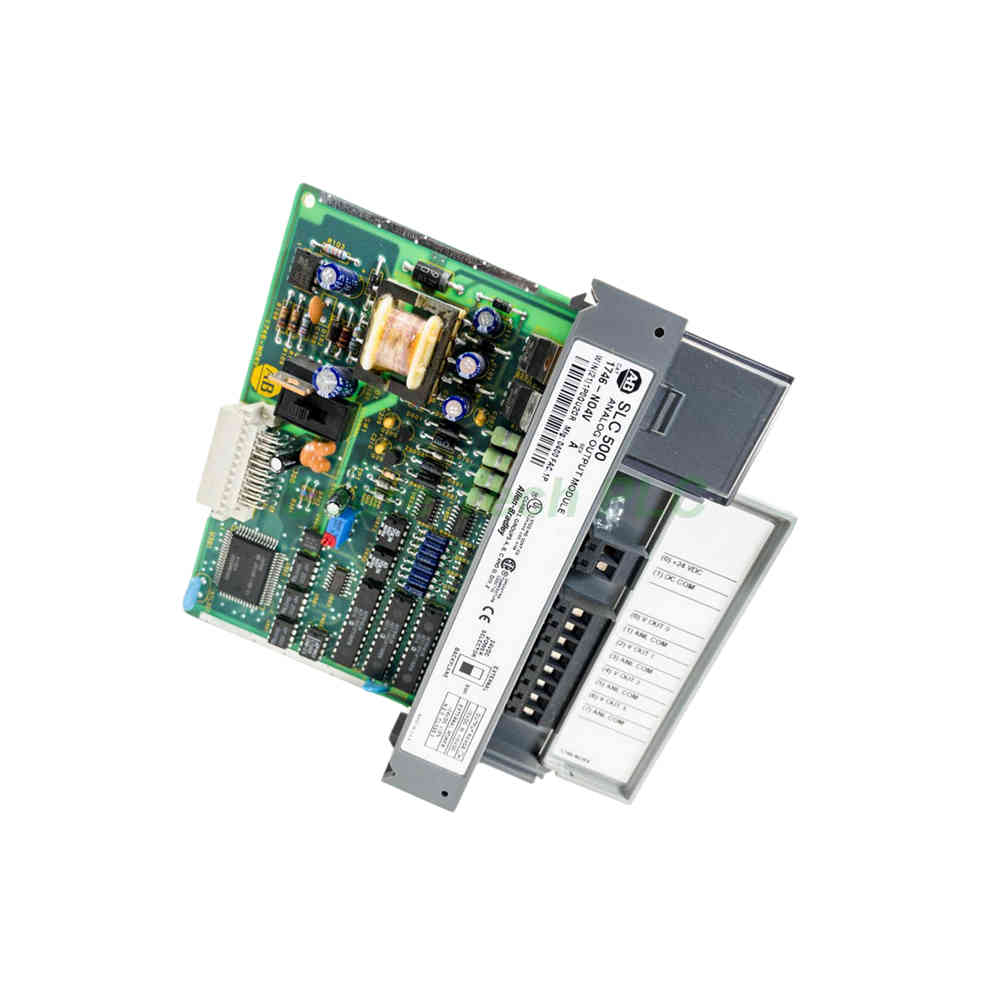
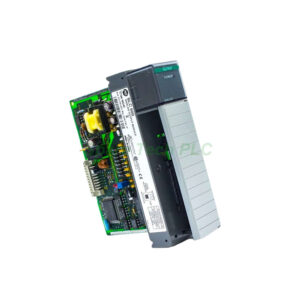
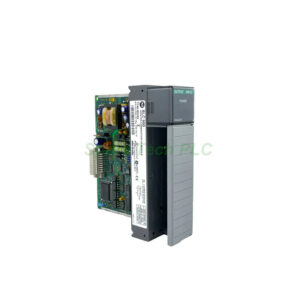
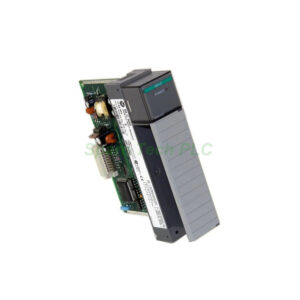
Allen-Bradley 1746-NO4V SLC 500 Analog Voltage Output Module
Product Introduction
The Allen-Bradley 1746-NO4V plays an essential role within the SLC 500 control architecture. This Analog Output Module translates digital instructions from the processor into precise voltage signals that span both positive and negative values. Specifically, it produces outputs ranging from -10 to +10 VDC across its four independent channels. As a result, this module is particularly well-suited for applications that demand directional control, such as reversing motor drives or positioning valves that operate in two directions. Furthermore, its compatibility with both fixed and modular SLC 500 systems provides significant flexibility for engineering teams. The factory-calibrated design also ensures consistent and reliable performance immediately upon installation.
Technical Specifications
The 1746-NO4V incorporates a range of technical features that guarantee accurate and stable signal generation. It offers four (4) output channels, each capable of delivering a voltage span from -10 to +10 VDC, with a full-scale output of 10 VDC. For digital-to-analog conversion, the module utilizes an R-2R ladder network, which achieves a solid 14-bit resolution. This resolution enables exceptionally fine control over the connected actuators. Meanwhile, the voltage output coding employs a 16-bit two's complement binary format, spanning from -32,768 to +32,764, which integrates smoothly with standard PLC data structures.
Additionally, the module demonstrates remarkable speed. Its update time reaches only 512 microseconds for all channels operating simultaneously. Moreover, the step response time settles to 95% of its final value within just 2.5 milliseconds. The field wiring to backplane isolation is rated at 500 Volts DC, offering adequate protection for the control system. For wiring convenience, the module accepts up to #14 AWG wire, and you may terminate a maximum of two wires per terminal to facilitate maintenance and troubleshooting.
Mechanical & Environmental Parameters
This SLC 500 module is built to withstand the rigors of typical industrial environments. Its ambient operating temperature ranges from 0 to 60 degrees Celsius (32 to 140 degrees Fahrenheit). For storage, it can endure temperatures from -40 to 85 degrees Celsius (-40 to 185 degrees Fahrenheit). Additionally, it tolerates a non-condensing relative humidity between 5% and 95% for both operation and storage. The module features an open-type enclosure and mounts directly into a standard 1746 chassis. A front-panel LED status indicator provides immediate visual feedback on the module's operational health. Likewise, the removable terminal block (RTB) simplifies both initial wiring and any future module replacement.
Installation & Power Considerations
Installing the 1746-NO4V requires careful attention to slot selection for optimal performance and longevity. When choosing a location, consider two primary factors: ambient temperature and electrical noise. Specifically, install the module away from AC sources or high-voltage DC lines to minimize electromagnetic interference. Similarly, position it as far as practical from the system power supply. For better thermal management, mounting the module in a chassis slot nearest to the enclosure bottom often yields superior cooling.
Regarding power, this module offers flexibility through an embedded selector switch (SW1). You may choose to draw power from the backplane or from an external 24 VDC supply. The backplane current draw is 55 mA at 5 Volts and 145 mA at 24 Volts. If your backplane lacks sufficient capacity, simply activate SW1 to enable an external 24 VDC power source. However, always remember that this module does not support removal under power. Removing it while energized can cause electrical arcing and potentially damage the circuitry. Therefore, always de-energize the system before installation or removal.
Application & Signal Sources
The 1746-NO4V's output channels can receive their setpoint values from various control sources. For instance, a PID controller may assign its calculated control output to one of these channels. Alternatively, the value might originate from a mathematical operation within the ladder logic. In many cases, operators enter manual values through an HMI or SCADA system. Beyond direct control, this module also excels at signal retransmission. It can send reference signals to multiple downstream devices for monitoring, recording, or further signal conversion. For coordinated control strategies like load sharing, this Analog Output Module distributes the reference signal to all participating controllers, ensuring synchronized operation across the entire system.
Packaging & Logistics
This listing covers the Allen-Bradley 1746-NO4V module exclusively. Your package will include the module itself along with its removable terminal block, ready for immediate installation. Standard mounting hardware is also supplied as per factory specifications. We ship all orders using trusted global carriers, including Fedex, UPS, or DHL, guaranteeing prompt and traceable delivery to your facility worldwide.
Packaging List
1 x 1746-NO4V Analog Voltage Output Module
1 x Removable Terminal Block (RTB)
1 x Installation Instructions Manual
Frequently Asked Questions (FAQ)
1. What voltage range does the 1746-NO4V provide?
The 1746-NO4V generates voltage signals that span both negative and positive values. Its four output channels each cover a range from -10 to +10 VDC, which is essential for controlling devices that require reversal or bidirectional movement.
2. How do I choose between internal and external power for this module?
You can select the power source via switch SW1 on the module. If your SLC 500 backplane provides sufficient 24V power (145 mA), use the internal option. Otherwise, connect an external 24 VDC supply to meet the module’s requirements.
3. What is the maximum load this module can drive?
The 1746-NO4V can handle a maximum load reactance of 1 µF and a maximum load current of 10 mA. Ensure your connected device falls within these limits to maintain signal integrity and prevent any potential damage.
4. Can I remove or install the 1746-NO4V while the system is running?
No, you must never remove or install this module under power. Doing so can create electrical arcs, potentially harming the module and other system components. Always power down the chassis first.
5. How accurate is the output from this module over temperature changes?
The 1746-NO4V exhibits excellent thermal stability, with a maximum overall accuracy drift of only +/- 54 ppm per degree Celsius of full scale. This ensures reliable performance even when ambient temperatures fluctuate during normal operation.