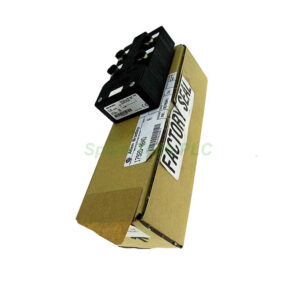
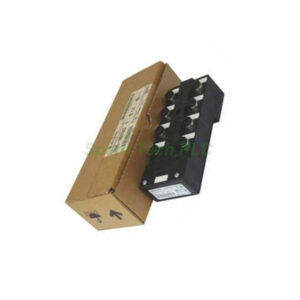
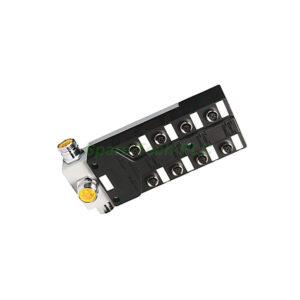
1734-ADN POINT I/O DeviceNet Adapter – Smart Distributed I/O Gateway
Product Introduction
The 1734-ADN from Allen-Bradley functions as a dedicated DeviceNet communication adapter within the POINT I/O family. This module enables distributed I/O architectures by connecting local POINT I/O modules to a DeviceNet network through its integrated interface. Additionally, its compact DIN-rail mounting design saves valuable cabinet space while supporting up to 63 I/O modules per adapter. The 1734-ADN also includes an Auto Device Replacement (ADR) feature, which automatically transfers configuration parameters to a replacement module, minimizing downtime. For engineers seeking a flexible and reliable I/O solution, this adapter delivers both performance and convenience.
Key Technical Specifications
This DeviceNet adapter operates on a nominal 23 Volts DC input voltage and draws 400 milliamps of field-side power. Its inrush current reaches 6 amps during startup, which is typical for this class of device. The 1734-ADN consumes 8.1 watts of total power and dissipates approximately 2.8 watts at 28.8 Volts DC. For backplane communication, it supplies 1000 milliamps of POINTBus current to power connected I/O modules. The adapter supports a maximum of 63 powered modules and up to 504 I/O points in total. Communication rates are selectable at 125K, 250K, or 500K bits per second, with an autobaud feature that detects the network speed automatically. The module mounts on the leftmost position of a POINT I/O system, occupying a single slot.
Installation and Configuration
Installing the 1734-ADN requires a standard DIN rail and a 24V DC power source. First, position the adapter vertically against the DIN rail and apply firm pressure until the locking mechanism engages automatically. Next, attach the DeviceNet plug to the terminal block and tighten the holding screws on both sides for a secure connection. For configuration, use the embedded thumbwheel switch located on the upper right side of the module to set a valid node address between 0 and 63. When powered up, the module uses this address as its default identity. Moreover, the autobaud function detects the primary DeviceNet network baud rate and adjusts the adapter's communication speed accordingly, supporting rates from 125Kbaud up to 1Mbaud (1000Kbaud) when used with compatible masters.
System Integration and Topology
The 1734-ADN resides simultaneously on both the primary DeviceNet network and the local POINT I/O subnet. The PointBus backplane maintains network protocols and also offers configuration capabilities for attached modules. For optimal performance, set the backplane baud rate, subnet I/O module addresses, and primary DeviceNet network parameters before operation. This adapter serves as an ideal replacement for other DeviceNet modules in a POINT I/O system, thanks to its ADR feature. When a faulty module is removed and replaced, the ADR function automatically transfers the previously downloaded configuration values to the new unit, eliminating manual reconfiguration and reducing system downtime.
Mechanical and Environmental Parameters
The 1734-ADN operates reliably within a temperature range of 0 to 55 degrees Celsius and stores safely between -40 and 85 degrees Celsius. It withstands non-condensing humidity from 5 to 95 percent, making it suitable for most industrial environments. For vibration resistance, it handles 5 G at 10 to 500 Hertz, and shock tolerance reaches 30 G. The module mounts directly on a DIN rail and occupies the leftmost position of the POINT I/O system. Its compact form factor and low power dissipation of just 2.8 watts ensure minimal heat buildup even in densely populated cabinets.
Application Scenarios
This DeviceNet adapter excels in applications requiring distributed I/O across a factory floor. For instance, you can install the 1734-ADN near sensors and actuators, significantly reducing long cable runs and simplifying wiring. Its support for up to 63 I/O modules makes it suitable for medium-sized control systems, while the ADR feature proves invaluable in maintenance-critical areas where quick module replacement is essential. Furthermore, the autobaud capability simplifies network integration, as the adapter automatically matches the master's communication speed. Whether used in packaging, material handling, or assembly lines, the 1734-ADN delivers robust and flexible I/O connectivity.
Packaging List
Allen-Bradley 1734-ADN DeviceNet Adapter Module (1 unit)
Removable DeviceNet terminal block (pre-attached)
DIN rail mounting base (integrated)
Quick start installation guide
Anti-static protective packaging
Shipping Information
All orders are shipped via FedEx, UPS, or DHL with full tracking and insurance coverage. Expedited shipping options are available upon request.
Frequently Asked Questions
Q1: What is the maximum number of I/O modules I can connect to the 1734-ADN?
You can connect up to 63 POINT I/O modules per adapter, provided you supply adequate power using additional 1734-EP24DC power supplies.
Q2: Does the 1734-ADN support auto-baud rate detection?
Yes, the autobaud feature automatically detects the primary DeviceNet network baud rate and adjusts the adapter's communication speed from 125K to 500K bps (and up to 1M baud in some configurations).
Q3: How does the Auto Device Replacement (ADR) feature work?
ADR stores configuration parameters in the adapter's non-volatile memory. When you replace a faulty module, the adapter automatically downloads the saved settings to the new unit without manual intervention.
Q4: Where must I install the 1734-ADN in a POINT I/O system?
You must mount this adapter on the leftmost position of the POINT I/O assembly, before installing any other base units or I/O modules.
Q5: What software do I need to configure the 1734-ADN?
You can configure this adapter using RSNetWorx for DeviceNet or RSLogix 5000/Studio 5000, depending on your controller platform and network setup.