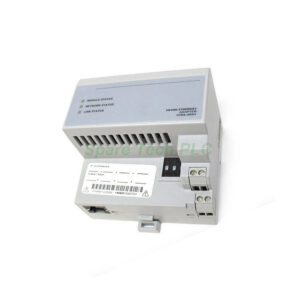
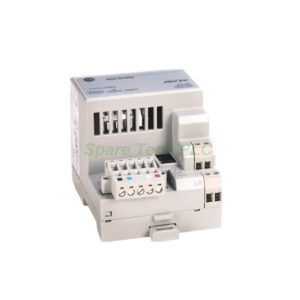
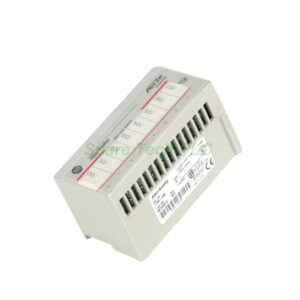
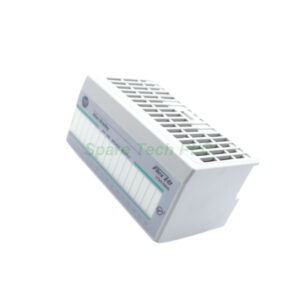
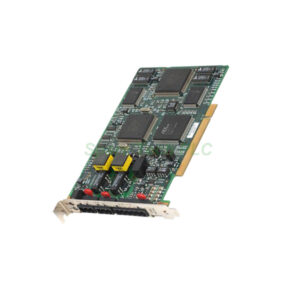
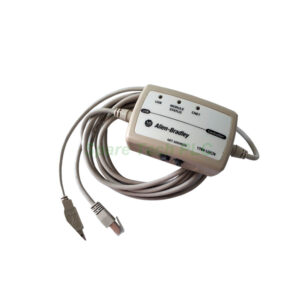
1794-AENTR Allen-Bradley Flex I/O Redundant Ethernet/IP Adapter Module
Product Introduction
The 1794-AENTR module from Allen-Bradley is a dedicated dual-port Ethernet/IP adapter that serves as the gateway for the distributed Flex I/O system. This adapter enables seamless communication between a central Ethernet-enabled controller and up to eight discrete, analog, or specialty I/O modules. It specifically supports redundant media topologies, including Linear and Device Level Ring (DLR), which significantly boosts network reliability for mission-critical processes. Additionally, its compact design and flexible mounting options make it suitable for various industrial applications.
Specifically, this adapter processes input data from field devices and delivers output commands from the controller with minimal latency. It uses the proven Ethernet/IP protocol and the Control and Information Protocol (CIP) to ensure deterministic performance. The dual RJ45 ports on the 1794-AENTR permit connection to both the primary and secondary network paths. This configuration supports a fail-safe architecture without requiring complex external switches. Furthermore, users can configure the IP address, gateway address, and subnet mask before using this module. It operates from an external 24V DC supply.
Key Technical Specifications
This communication adapter includes several critical parameters for proper system design. For instance, it offers a Communication Rate of 10/100 Mbps over each of its two RJ45 ports. The module's Input Voltage Range is between 19.2 to 31.2 Volts DC, with a nominal rating of 24 Volts DC. Additionally, it handles an Inrush Current of 18 Amps for 2 milliseconds. The Flexbus Output Current, which powers the connected I/O modules, can reach a maximum of 640 mA at 5 Volts DC.
The 1794-AENTR also provides visual diagnostics through its built-in LED indicators. Specifically, it features a Mod Status LED, a Network Status LED, and two Link Status LEDs (Link 1 and Link 2). The Link status LEDs flash yellow for 10 Mbps connections and green for 100 Mbps connections. Furthermore, the electrical isolation is robust, with an Isolation Voltage of 50 Volts Continuous, type-tested from power to Flexbus and to Ethernet at 1000 Volts AC for 60 seconds. The power consumption is 500 mA, with 400 mA at 24V DC.
Mechanical and Environmental Ratings
Environmental Limits
The 1794-AENTR is built to withstand demanding industrial conditions. Its Operating Temperature ranges from 0 to 55 °C (32 to 131 °F), with a Storage Temperature range of -40 to 85 °C (-40 to 185 °F). Furthermore, it operates reliably in 5 to 95% non-condensing relative humidity.
Mechanical Stress Tolerance
This adapter is exceptionally durable against physical stress. It meets the IEC 68-2-6 standard for Vibration, rated at 5 g @ 10-500 Hz. For shock, it withstands an Operating Shock of 30 g peak acceleration with an 11 ms pulse width. It also endures a non-operating shock of 50 g. Consequently, the 1794-AENTR remains stable in applications with significant vibration.
Power and Thermal Management
Efficient power management is crucial for the 1794-AENTR. Its Power Dissipation is rated at 6.1 W @ 19.2V DC. Correspondingly, its Thermal Dissipation is 20.8 BTU/hr @ 24V DC. Therefore, this module generates moderate heat that must be accounted for in the panel design. Users should ensure adequate airflow around the module to maintain the surrounding temperature within the specified limit.
Installation Guidelines
Mounting Options
Primarily, the 1794-AENTR is designed for DIN Rail mounting. Its compact dimensions, measuring 87 x 94 x 92 mm, help it fit neatly in crowded cabinets. Remember that the adapter has an open-type enclosure. Hence, it requires an appropriate IP-rated cabinet for protection against dust and direct contact. Inspect the installation point for excessive vibration and shock before mounting.
Ethernet and Flexbus Connections
For network connections, the adapter uses two RJ45 ports with Cat.5 Ethernet cable. Users must connect these to an Ethernet/IP network, supporting Linear or Ring topology. Furthermore, the module connects to the Flex I/O system via the terminal base units. It supports a maximum of eight terminal bases and thus a maximum of eight I/O modules. For power connections, use 0.34 to 2.5 mm² (22 to 12 AWG) stranded copper wire with an insulation rating of 75 °C or higher.
Addressing and Configuration
The 1794-AENTR requires users to configure the IP address, optional gateway address, and subnet mask before using this module. No network scheduling and no routing tables are required for this module. This feature simplifies installation and reduces setup time.
Packaging and Shipping Information
All units of the 1794-AENTR are carefully packaged to prevent static or physical damage. The package includes the adapter module itself. However, the packaging does not include installation manuals, mounting hardware, or terminal base units. We professionally pack the module in anti-static material and secure it for shipping. The shipping weight is approximately 0.23 kg (8.01 oz).
Shipping Carriers: FedEx, UPS, DHL
Warranty and Certificates: Not included in the package
Frequently Asked Questions (FAQ)
1. How many Flex I/O modules does the 1794-AENTR support?
It supports up to eight Flex I/O modules of any combination, including discrete, analog, and specialty modules.
2. What communication speed does the 1794-AENTR offer?
This adapter supports 10/100 Mbps communication rates over its dual RJ45 Ethernet ports.
3. Does the 1794-AENTR support Device Level Ring (DLR) topology?
Yes, it supports both Linear and Ring topologies, including DLR, for high-availability network connections.
4. What cable is recommended for the 1794-AENTR?
Use a standard RJ45 Cat.5 Ethernet cable for network connections.
5. How do I configure the IP address on the 1794-AENTR?
You need to configure the IP address, optional gateway address, and subnet mask before using this module. No network scheduling or routing tables are required.