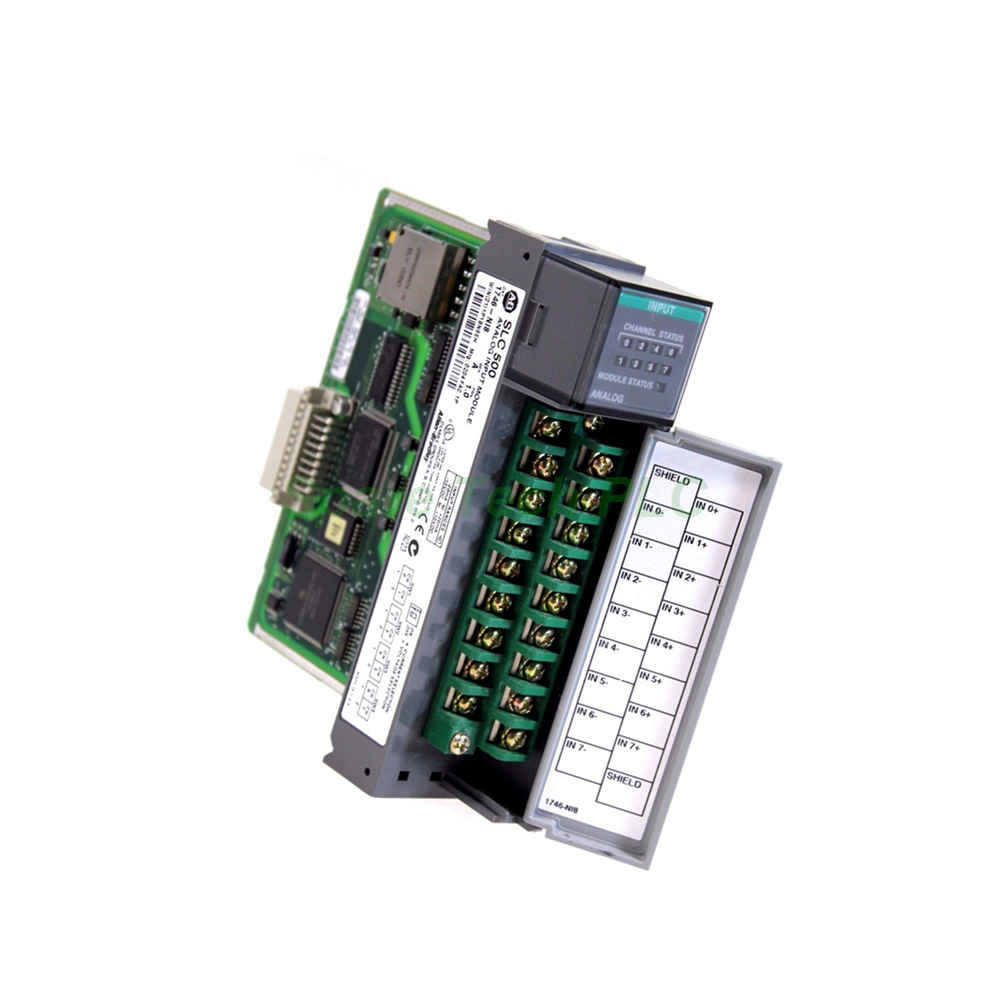
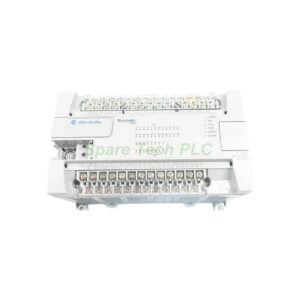
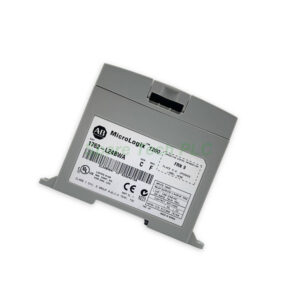
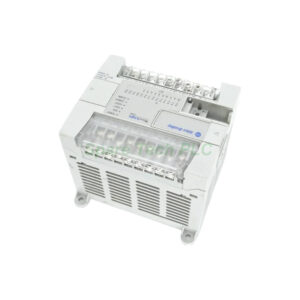
Allen-Bradley 1746-NI8 SLC 500 Analog Input Module
Product Introduction
The Allen‑Bradley 1746‑NI8 is a high-performance analog I/O module designed for the SLC 500 control system. This module provides eight non-isolated differential input channels. You can individually select voltage or current for each channel. It is an ideal solution for applications requiring fast and accurate signal conversion. The 1746‑NI8 module occupies a single slot in the SLC 500 chassis. It is compatible with both fixed and modular hardware styles.
Technical Specifications
This analog module delivers outstanding flexibility and precision. The Allen‑Bradley 1746‑NI8 supports a wide range of input signals. For voltage, it accepts ±10V dc, 1–5V dc, 0–5V dc, and 0–10V dc. For current, it handles 0–20 mA, 4–20 mA, and ±20 mA. The module features a 16-bit resolution for detailed signal representation. It uses a successive approximation conversion method with a switched capacitor front end.
The 1746‑NI8 module offers programmable input filter frequencies. These include 1 Hz, 2 Hz, 5 Hz, 10 Hz, 20 Hz, 50 Hz, and 75 Hz. The bandwidth ranges from 1 to 75 Hertz. Additionally, the update time is a fast 6 milliseconds. The step response varies from 0.75 to 730 milliseconds, depending on the filter selected. Furthermore, the input impedance is 250 Ohms for current inputs.
Power consumption for this module is efficient. It draws 200 mA at 5 Volts DC and 100 mA at 24 Volts DC from the backplane. The total backplane power consumption is 14 Watts maximum. Meanwhile, the thermal dissipation is rated at 3.4 Watts.
Mechanical and Environmental Parameters
The Allen‑Bradley 1746‑NI8 is built for rugged industrial environments. It features an isolation voltage of 750 Volts DC and 530 Volts AC for 60 seconds. The common-mode voltage range is -10 to 10 Volts, with a maximum of 15 Volts between any two terminals. Moreover, the module is rated for Division 2 hazardous locations. It operates reliably within a temperature range of 0 to 60 degrees Celsius.
Installation and Wiring Guide
Installing the 1746‑NI8 is straightforward. You can place it in any I/O module slot except Slot 0 of the SLC 500 chassis. The module comes with an 18-position removable terminal block. This design simplifies replacement without the need for rewiring. For wiring, use Belden 8761 or an equivalent shielded cable. You can connect one or two 14 AWG wires per terminal. Importantly, the maximum loop impedance is 40 Ohms for voltage sources and 250 Ohms for current sources. You select the input signal type using the embedded DIP switches.
The Allen‑Bradley 1746‑NI8 is compatible with several SLC processors. These include the SLC 5/01, 5/02, 5/03, 5/04, and 5/05. Please note that the SLC 5/01 only operates as Class 1. In contrast, the SLC 5/02, 5/03, and 5/04 can be configured for Class 1 or Class 3 operation. You can wire the channels in either single-ended or differential input mode. This flexibility makes the 1746‑NI8 a versatile choice for many control systems.
Data Formats and Diagnostics
This module supports multiple data formats for integration ease. You can configure it for Engineering Units, Scaled-for-PID, or Proportional Counts. The Proportional Counts range is -32,768 to +32,767. Additionally, a user-defined range is available for Class 3 operations. The 1746‑NI8 also supports the 1746‑NI4 data format.
Diagnostics are simple with the module’s LED indicators. It has nine green status LEDs. One indicator is dedicated to each of the eight channels to display input status. A ninth indicator shows the overall module status. This feature allows for quick troubleshooting during operation.
Packaging List
Your shipment for the Allen‑Bradley 1746‑NI8 includes the following items:
Allen‑Bradley 1746‑NI8 Analog I/O Module (1 unit)
Removable Terminal Block (18 positions)
Installation Instructions Manual
Note: Cables and configuration software are sold separately.
Shipping Method: FedEx, UPS, or DHL.
Frequently Asked Questions (FAQ)
1. Can I install the 1746‑NI8 in any slot of the SLC 500 chassis?
Yes, you can install it in any I/O slot. However, you must avoid using Slot 0, which is typically reserved for the power supply or processor.
2. What types of input signals does the Allen‑Bradley 1746‑NI8 support?
It supports both voltage and current signals. Specifically, you can use ±10V, 1-5V, 0-5V, or 0-10V for voltage. For current, it accepts 0-20 mA, 4-20 mA, and ±20 mA.
3. What data formats are available for the 1746‑NI8?
You can configure the module for Engineering Units, Scaled-for-PID, or Proportional Counts. Class 3 users can also define a custom proportional count range.
4. How do I select the input type for each channel?
You select the input signal type using the embedded DIP switches located on the module. This allows for individual channel configuration.
5. What is the resolution and update time of the 1746‑NI8?
The module offers a 16-bit resolution. Its update time is a fast 6 milliseconds for all eight channels.